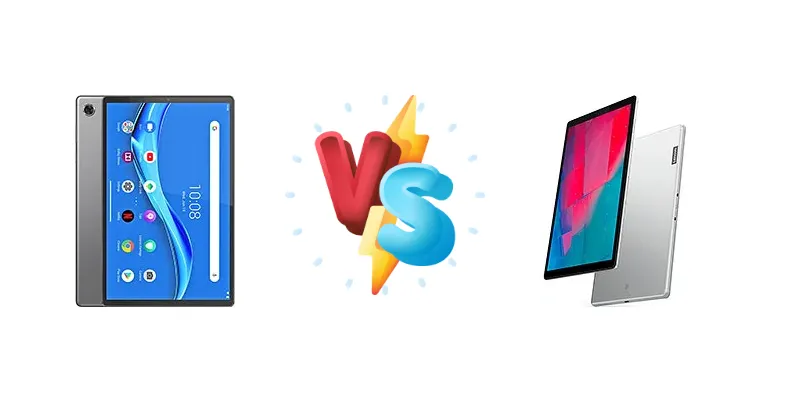
The Lenovo M10 Plus and Tab M10 HD Gen 2 present a curious case for tablet buyers. Both devices are positioned as affordable Android options, and critically, they share the exact same core hardware: the MediaTek Helio P22T chipset. This comparison dives deep to uncover if any meaningful differences exist beyond branding and potential software tweaks, helping you determine which tablet offers the best value.
🏆 Quick Verdict
For the average user, the Lenovo Tab M10 HD Gen 2 likely represents the better value, assuming pricing is comparable. The identical Helio P22T chipset and 10W charging mean performance will be nearly indistinguishable. Any price difference should dictate the purchase decision, favoring the cheaper option.
| Network |
|---|
| 2G bands | N/A | GSM 850 / 900 / 1800 / 1900 |
| 3G bands | N/A | HSDPA 800 / 850 / 900 / 1900 / 2100 |
| 4G bands | LTE | 1, 2, 3, 4, 5, 7, 8, 19, 20, 28, 38, 40 |
| EDGE | No | - |
| GPRS | No | - |
| Speed | HSPA 21.1/5.76 Mbps, LTE Cat4 150/50 Mbps - cellular model only | HSPA, LTE - cellular model only |
| Technology | LTE | GSM / HSPA / LTE |
| Launch |
|---|
| Announced | 2020, March 27. Released 2020, March 27 | 2020, August 31. Released 2020, November |
| Status | Discontinued | Discontinued |
| Body |
|---|
| Dimensions | 244.2 x 153.3 x 8.2 mm (9.61 x 6.04 x 0.32 in) | 241.5 x 149.4 x 8.3 mm (9.51 x 5.88 x 0.33 in) |
| SIM | Nano-SIM (cellular model only) | Nano-SIM (cellular model only) |
| Weight | 460 g (1.01 lb) | 420 g (14.82 oz) |
| Display |
|---|
| Resolution | 1200 x 1920 pixels, 16:10 ratio (~220 ppi density) | 800 x 1280 pixels, 16:10 ratio (~149 ppi density) |
| Size | 10.3 inches, 307.6 cm2 (~82.2% screen-to-body ratio) | 10.1 inches, 295.8 cm2 (~82.0% screen-to-body ratio) |
| Type | IPS LCD, 330 nits (typ) | IPS LCD, 400 nits (typ) |
| Platform |
|---|
| CPU | Octa-core (4x2.3 GHz Cortex-A53 & 4x1.8 GHz Cortex-A53) | Octa-core (4x2.3 GHz Cortex-A53 & 4x1.8 GHz Cortex-A53) |
| Chipset | Mediatek MT6762 Helio P22T (12 nm) | Mediatek MT6762 Helio P22T (12 nm) |
| GPU | PowerVR GE8320 | PowerVR GE8320 |
| OS | Android 9.0 (Pie) | Android 10 |
| Memory |
|---|
| Card slot | microSDXC (dedicated slot) | microSDXC (dedicated slot) |
| Internal | 32GB 2GB RAM, 64GB 4GB RAM, 128GB 4GB RAM | 32GB 2GB RAM, 64GB 4GB RAM |
| | eMMC 5.1 | eMMC 5.1 |
| Main Camera |
|---|
| Single | 8 MP, AF | 8 MP, AF |
| Video | 1080p@30fps | 1080p@30fps |
| Selfie camera |
|---|
| Single | 5 MP | 5 MP |
| Sound |
|---|
| 3.5mm jack | Yes | Yes |
| 35mm jack | Yes | Yes |
| Loudspeaker | Yes, with stereo speakers | Yes, with stereo speakers |
| Comms |
|---|
| Bluetooth | 5.0, LE | 5.0, LE |
| NFC | No | No |
| Positioning | GPS - cellular model only | GPS, GLONASS - cellular model only |
| Radio | No | FM radio |
| USB | USB Type-C 2.0 | USB Type-C 2.0, OTG, magnetic connector |
| WLAN | Wi-Fi 802.11 a/b/g/n/ac, dual-band, Wi-Fi Direct | Wi-Fi 802.11 a/b/g/n/ac, dual-band, Wi-Fi Direct |
| Features |
|---|
| Sensors | Accelerometer | Accelerometer, proximity |
| Battery |
|---|
| Charging | 10W wired | 10W wired |
| Type | Li-Po 5000 mAh | Li-Po 5000 mAh |
| Misc |
|---|
| Colors | Iron Grey | Iron Gray, Platinum Gray |
| Models | TB-X606, TB-X606F, TB-X606X, TB-X606V | TB-X306X |
| Price | About 200 EUR | About 170 EUR |
Lenovo M10 Plus
- Identical performance to Tab M10 HD Gen 2 due to shared chipset.
- Potential for lower pricing, offering better value.
- Suitable for basic Android tasks and media consumption.
- 10W charging is slow.
- Performance limited by Helio P22T chipset.
Lenovo Tab M10 HD Gen 2
- Identical performance to M10 Plus due to shared chipset.
- May benefit from slightly better software support or bundled accessories.
- Suitable for basic Android tasks and media consumption.
- 10W charging is slow.
- Performance limited by Helio P22T chipset.
Display Comparison
Both tablets utilize the MediaTek Helio P22T, suggesting similar display capabilities. Without specific display specs (resolution, panel type, brightness) beyond the model names, it's reasonable to assume both target the entry-level segment. Expect 1080p resolution as a likely commonality. The absence of features like high refresh rates or HDR support is expected given the price point. Bezels are likely to be substantial on both, prioritizing affordability over a premium aesthetic.
Camera Comparison
Camera performance is unlikely to be a differentiating factor. Given the target market, both tablets likely feature basic camera setups. Without specific sensor details, it's safe to assume both will struggle in low-light conditions and produce images suitable for casual snapshots rather than serious photography. The inclusion of a 2MP macro camera on either device would be largely symbolic, offering minimal practical benefit due to the low resolution.
Performance
The heart of both the Lenovo M10 Plus and Tab M10 HD Gen 2 is the MediaTek MT6762 Helio P22T (12 nm). This octa-core processor, with its Cortex-A53 cores clocked at 2.3 GHz and 1.8 GHz, is geared towards basic tasks like web browsing, video playback, and light gaming. The 12nm process node indicates moderate power efficiency, but don't expect sustained high performance. RAM configurations are not specified, but both will likely offer options around 2-4GB. Thermal management will be passive, relying on the tablet's chassis to dissipate heat, potentially leading to throttling under prolonged load.
Battery Life
Both tablets feature 10W wired charging, indicating a similar charging experience. Battery capacity is not specified, but given the Helio P22T's power efficiency and the tablets' intended use cases, a full charge should provide several hours of video playback. The 10W charging rate is relatively slow by modern standards, so expect a charge time of several hours from 0-100%.
Buying Guide
Buy the Lenovo M10 Plus if you consistently find it at a significantly lower price point than the Tab M10 HD Gen 2, as the core performance is identical. Buy the Lenovo Tab M10 HD Gen 2 if it's available with a slightly better software support promise or bundled accessories, as these are the only areas where differentiation is likely to occur. Both are ideal for casual media consumption and light tasks.
Frequently Asked Questions
❓ Will the Helio P22T struggle with multitasking?
The Helio P22T is a budget chipset. While it can handle basic multitasking (switching between a few apps), running multiple demanding applications simultaneously will likely result in noticeable slowdowns and lag. Limiting the number of open apps will improve performance.
❓ Is 10W charging sufficient for daily use?
10W charging is relatively slow compared to modern fast-charging standards. It's sufficient for overnight charging, but topping up the battery quickly will take a significant amount of time. Plan to charge the tablet overnight or during periods of inactivity.
❓ Can these tablets play popular mobile games like PUBG or Call of Duty?
While technically possible, playing graphically intensive games like PUBG or Call of Duty on these tablets will require significant compromises in graphics settings. Expect low frame rates and potentially choppy gameplay, even on the lowest settings. These tablets are better suited for less demanding games.