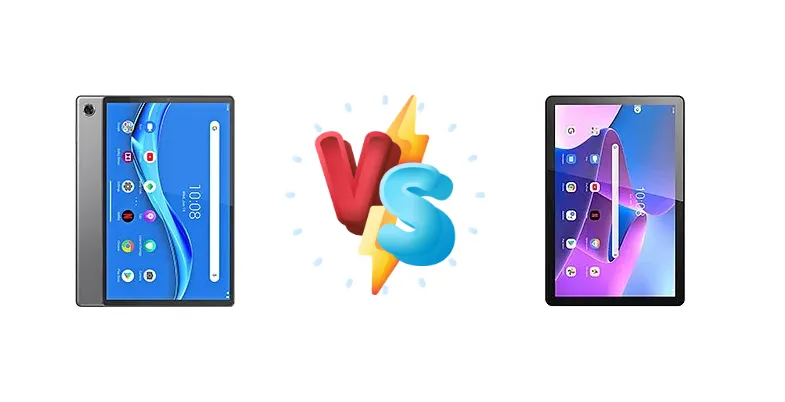
Lenovo’s M10 series consistently offers compelling value in the budget tablet space. The M10 Plus and the newer Tab M10 Gen 3 represent distinct approaches to affordability. While both target similar price points, they diverge significantly in their core processing power, impacting everything from everyday tasks to light gaming. This comparison dissects these differences to help you choose the right tablet for your needs.
🏆 Quick Verdict
For most users, the Lenovo Tab M10 Gen 3 is the better choice. Its Unisoc T610 chipset, featuring Cortex-A75 cores, provides a noticeable performance uplift over the M10 Plus’s Helio P22T, resulting in a smoother and more responsive user experience, despite both sharing the same 10W charging.
| Network |
|---|
| 2G bands | N/A | GSM 850 / 900 / 1800 / 1900 |
| 3G bands | N/A | HSDPA 800 / 850 / 900 / 1900 / 2100 |
| 4G bands | LTE | 1, 2, 3, 4, 5, 7, 8, 19, 20, 28, 38, 40, 41 |
| EDGE | No | - |
| GPRS | No | - |
| Speed | HSPA 21.1/5.76 Mbps, LTE Cat4 150/50 Mbps - cellular model only | HSPA, LTE - cellular model only |
| Technology | LTE | GSM / HSPA / LTE |
| Launch |
|---|
| Announced | 2020, March 27. Released 2020, March 27 | 2022, September |
| Status | Discontinued | Available. Released 2022, September |
| Body |
|---|
| Dimensions | 244.2 x 153.3 x 8.2 mm (9.61 x 6.04 x 0.32 in) | 239.8 x 158.6 x 8.5 mm (9.44 x 6.24 x 0.33 in) |
| SIM | Nano-SIM (cellular model only) | Nano-SIM (cellular model only) |
| Weight | 460 g (1.01 lb) | 460 g (1.01 lb) |
| Display |
|---|
| Resolution | 1200 x 1920 pixels, 16:10 ratio (~220 ppi density) | 1200 x 1920 pixels, 16:10 ratio (~224 ppi density) |
| Size | 10.3 inches, 307.6 cm2 (~82.2% screen-to-body ratio) | 10.1 inches, 295.8 cm2 (~77.8% screen-to-body ratio) |
| Type | IPS LCD, 330 nits (typ) | IPS LCD, 320 nits (typ) |
| Platform |
|---|
| CPU | Octa-core (4x2.3 GHz Cortex-A53 & 4x1.8 GHz Cortex-A53) | Octa-core (2x1.8 GHz Cortex-A75 & 6x1.8 GHz Cortex-A55) |
| Chipset | Mediatek MT6762 Helio P22T (12 nm) | Unisoc T610 (12 nm) |
| GPU | PowerVR GE8320 | Mali-G52 MP2 |
| OS | Android 9.0 (Pie) | Android 11, upgradable to Android 12 |
| Memory |
|---|
| Card slot | microSDXC (dedicated slot) | microSDXC (dedicated slot) |
| Internal | 32GB 2GB RAM, 64GB 4GB RAM, 128GB 4GB RAM | 32GB 3GB RAM, 64GB 4GB RAM |
| | eMMC 5.1 | eMCP or eMMC 5.1 |
| Main Camera |
|---|
| Single | 8 MP, AF | 8 MP, AF |
| Video | 1080p@30fps | 1080p@30fps |
| Selfie camera |
|---|
| Single | 5 MP | 5 MP |
| Video | - | Yes |
| Sound |
|---|
| 3.5mm jack | Yes | Yes |
| 35mm jack | Yes | Yes |
| Loudspeaker | Yes, with stereo speakers | Yes, with stereo speakers (with Dolby Atmos) |
| Comms |
|---|
| Bluetooth | 5.0, LE | 5.0, LE |
| NFC | No | No |
| Positioning | GPS - cellular model only | GPS - cellular model only |
| Radio | No | No |
| USB | USB Type-C 2.0 | USB Type-C 2.0, OTG, magnetic connector |
| WLAN | Wi-Fi 802.11 a/b/g/n/ac, dual-band, Wi-Fi Direct | Wi-Fi 802.11 a/b/g/n/ac, dual-band, Wi-Fi Direct |
| Features |
|---|
| Sensors | Accelerometer | Accelerometer, proximity |
| Battery |
|---|
| Charging | 10W wired | 10W wired |
| Type | Li-Po 5000 mAh | Li-Po 5100 mAh |
| Misc |
|---|
| Colors | Iron Grey | Storm Grey |
| Models | TB-X606, TB-X606F, TB-X606X, TB-X606V | - |
| Price | About 200 EUR | About 200 EUR |
Lenovo M10 Plus
- Potentially lower price due to being an older model.
- Established model with potentially more user reviews.
- Familiar MediaTek chipset.
- Older, less efficient Helio P22T chipset.
- Slower performance compared to the Gen 3.
- Less responsive user experience.
Lenovo Tab M10 Gen 3
- More powerful Unisoc T610 chipset with Cortex-A75 cores.
- Improved multitasking and app responsiveness.
- Better long-term performance potential.
- Unisoc chipset may have less software optimization.
- Potentially slightly higher price.
Display Comparison
Both tablets likely feature similar LCD panels, given their market segment. However, detailed display specs like resolution and brightness are missing. The focus here is on performance, not visual fidelity. Bezels are expected to be comparable, typical of budget tablets. Color accuracy is unlikely to be a strong point on either device, geared towards casual consumption rather than professional content creation.
Camera Comparison
Camera performance is unlikely to be a deciding factor for either tablet. Details on camera sensors are absent, but given the price point, expectations should be tempered. Both will likely suffice for basic video calls and casual snapshots, but neither is intended for serious photography. Focusing on the chipset difference is far more relevant to the overall user experience.
Performance
The core difference lies in the chipsets. The M10 Plus utilizes the MediaTek MT6762 Helio P22T, an older 12nm chip with an octa-core configuration of 4x2.3 GHz Cortex-A53 and 4x1.8 GHz Cortex-A53 cores. The Tab M10 Gen 3 steps up to the Unisoc T610, also 12nm, but with a more modern architecture: 2x1.8 GHz Cortex-A75 and 6x1.8 GHz Cortex-A55 cores. The A75 cores in the T610 represent a significant architectural improvement over the A53 cores in the P22T, offering substantially better single-core performance and improved efficiency. This translates to snappier app launches, smoother scrolling, and a more responsive user interface on the Gen 3. While both have octa-core CPUs, the *type* of core matters significantly.
Battery Life
Both tablets are equipped with 10W wired charging, indicating a similar charging experience – expect around 3-4 hours to fully charge. Battery capacity is not specified, but the more efficient Unisoc T610 in the Tab M10 Gen 3 may translate to slightly longer real-world battery life, even with a similar capacity, due to its improved power management. The performance gains of the T610 won't come at a significant battery life penalty.
Buying Guide
Buy the Lenovo M10 Plus if you prioritize a slightly more established model and your usage is limited to basic tasks like web browsing, video playback, and light social media. Buy the Lenovo Tab M10 Gen 3 if you want a more future-proof device capable of handling multitasking, moderately demanding apps, and offering a more fluid overall experience, even if it means opting for a newer chipset from a less-recognized brand.
Frequently Asked Questions
❓ Will the Unisoc T610 in the Tab M10 Gen 3 struggle with demanding games?
While the T610 isn't a gaming powerhouse, it's significantly more capable than the Helio P22T. Expect to be able to play less intensive games smoothly, but demanding titles will likely require lower graphics settings and may still experience occasional frame drops. The M10 Plus would struggle even more with these games.
❓ Is the difference in performance between the Helio P22T and Unisoc T610 noticeable for everyday tasks like browsing and email?
Yes, the difference is quite noticeable. The Cortex-A75 cores in the T610 provide a much snappier experience when switching between apps, opening web pages, and general navigation. The M10 Plus, with its older A53 cores, will feel comparatively sluggish.
❓ Does the Tab M10 Gen 3 benefit from any software optimizations that improve performance?
Lenovo's software optimizations for the Tab M10 Gen 3 are not extensively documented. However, Unisoc has been actively improving its software support, and the T610 benefits from newer Android optimizations compared to the older Helio P22T. This contributes to the overall smoother experience.