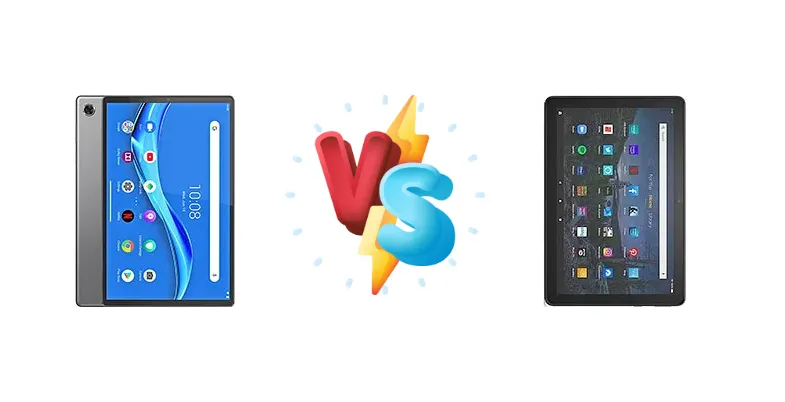
The sub-$200 tablet market is fiercely competitive, and the Lenovo M10 Plus and Amazon Fire HD 10 Plus (2021) are two of the leading contenders. While both aim to deliver an affordable tablet experience, they take different approaches to performance, features, and software. This comparison dives deep into the hardware and software differences to determine which tablet offers the best value.
🏆 Quick Verdict
For users prioritizing raw performance and a more standard Android experience, the Amazon Fire HD 10 Plus (2021) is the better choice, thanks to its Helio P60T chipset. However, the Lenovo M10 Plus remains a viable option for basic tasks and those seeking a cleaner, less Amazon-centric interface.
| Network |
|---|
| 2G bands | N/A | N/A |
| 3G bands | N/A | - |
| 4G bands | LTE | - |
| EDGE | No | No |
| GPRS | No | No |
| Speed | HSPA 21.1/5.76 Mbps, LTE Cat4 150/50 Mbps - cellular model only | - |
| Technology | LTE | No cellular connectivity |
| Launch |
|---|
| Announced | 2020, March 27. Released 2020, March 27 | 2021, April 27. Released 2021, May 26 |
| Status | Discontinued | Discontinued |
| Body |
|---|
| Dimensions | 244.2 x 153.3 x 8.2 mm (9.61 x 6.04 x 0.32 in) | 247 x 166 x 9.2 mm (9.72 x 6.54 x 0.36 in) |
| SIM | Nano-SIM (cellular model only) | No |
| Weight | 460 g (1.01 lb) | 468 g (1.03 lb) |
| Display |
|---|
| Protection | - | Aluminosilicate glass |
| Resolution | 1200 x 1920 pixels, 16:10 ratio (~220 ppi density) | 1920 x 1200 pixels, 16:10 ratio (~224 ppi density) |
| Size | 10.3 inches, 307.6 cm2 (~82.2% screen-to-body ratio) | 10.1 inches, 295.8 cm2 (~72.1% screen-to-body ratio) |
| Type | IPS LCD, 330 nits (typ) | IPS LCD |
| Platform |
|---|
| CPU | Octa-core (4x2.3 GHz Cortex-A53 & 4x1.8 GHz Cortex-A53) | Octa-core (4x2.0 GHz Cortex-A73 & 4x2.0 GHz Cortex-A53) |
| Chipset | Mediatek MT6762 Helio P22T (12 nm) | Mediatek MT8183 Helio P60T (12 nm) |
| GPU | PowerVR GE8320 | Mali-G72 MP3 |
| OS | Android 9.0 (Pie) | Android 9.0 (Pie), Fire OS 7 |
| Memory |
|---|
| Card slot | microSDXC (dedicated slot) | microSDXC (dedicated slot) |
| Internal | 32GB 2GB RAM, 64GB 4GB RAM, 128GB 4GB RAM | 32GB 4GB RAM, 64GB 4GB RAM |
| | eMMC 5.1 | eMMC 5.1 |
| Main Camera |
|---|
| Single | 8 MP, AF | 5 MP |
| Video | 1080p@30fps | 720p |
| Selfie camera |
|---|
| Single | 5 MP | 2 MP |
| Video | - | 720p |
| Sound |
|---|
| 3.5mm jack | Yes | Yes |
| 35mm jack | Yes | Yes |
| Loudspeaker | Yes, with stereo speakers | Yes, with stereo speakers |
| Comms |
|---|
| Bluetooth | 5.0, LE | 5.0, A2DP, LE |
| NFC | No | No |
| Positioning | GPS - cellular model only | No |
| Radio | No | No |
| USB | USB Type-C 2.0 | USB Type-C 2.0, OTG |
| WLAN | Wi-Fi 802.11 a/b/g/n/ac, dual-band, Wi-Fi Direct | Wi-Fi 802.11 a/b/g/n/ac, dual-band |
| Features |
|---|
| Sensors | Accelerometer | Accelerometer |
| | - | Text-to-Speech English-language content reader |
| Battery |
|---|
| Charging | 10W wired | Wireless |
| Type | Li-Po 5000 mAh | Li-Ion |
| Misc |
|---|
| Colors | Iron Grey | Slate |
| Models | TB-X606, TB-X606F, TB-X606X, TB-X606V | T76N2P |
| Price | About 200 EUR | About 150 EUR |
Lenovo M10 Plus
- Cleaner Android experience without Amazon bloatware.
- More affordable price point (potentially).
- Simpler user interface for less tech-savvy users.
- Less powerful processor for demanding tasks.
- Slower app loading and multitasking.
- No wireless charging support.
Amazon Fire HD 10 Plus (2021)
- More powerful Mediatek Helio P60T processor.
- Wireless charging for added convenience.
- Better multitasking and gaming performance.
- Amazon Fire OS with heavy Amazon integration.
- Potential for more bloatware and ads.
- May require sideloading apps not available in the Amazon Appstore.
Display Comparison
Both tablets utilize 12nm chipsets, suggesting similar power efficiency constraints impacting display capabilities. While specific display specs (resolution, brightness) aren't provided, the focus here is on performance. The lack of information prevents a detailed comparison of panel quality, but the Fire HD 10 Plus's larger ecosystem integration suggests potential for optimized video playback. Bezels are likely comparable given the price point, and color accuracy is expected to be standard for this segment.
Camera Comparison
Given the target market, camera quality is unlikely to be a deciding factor for most buyers. Both tablets likely feature modest camera setups. Without specific sensor details, it's safe to assume image quality will be adequate for casual snapshots and video calls, but not competitive with smartphones. Focusing on the chipset difference, the P60T’s image signal processor (ISP) may offer slightly better image processing capabilities, but the impact will be minimal.
Performance
The core difference lies in the chipsets. The Amazon Fire HD 10 Plus (2021) boasts the Mediatek MT8183 Helio P60T, featuring four Cortex-A73 cores clocked at 2.0 GHz alongside four Cortex-A53 cores. This architecture represents a significant step up from the Lenovo M10 Plus’s Mediatek MT6762 Helio P22T, which uses four Cortex-A53 cores at 2.3 GHz and another four at 1.8 GHz. The A73 cores in the P60T offer substantially better single-core performance, translating to snappier app launches and smoother multitasking. While the P22T’s higher clock speed on some cores might offer a slight advantage in certain benchmarks, the P60T’s architectural superiority will be more noticeable in real-world usage. The Fire HD 10 Plus will handle more demanding apps and games with greater ease.
Battery Life
Battery capacity isn't specified, but the 12nm process node used in both chipsets suggests comparable power efficiency. However, the Amazon Fire HD 10 Plus (2021) gains a significant advantage with its support for wireless charging. This adds convenience, eliminating the need for cables. While the Lenovo M10 Plus relies on 10W wired charging, the Fire HD 10 Plus’s wireless charging capability, even at a lower wattage, provides a more versatile charging experience. The Fire HD 10 Plus’s slightly more powerful chipset may draw a bit more power, but the wireless charging convenience likely outweighs this difference for many users.
Buying Guide
Buy the Lenovo M10 Plus if you need a tablet primarily for media consumption, light web browsing, and reading, and prefer a stock Android experience without Amazon's ecosystem. Buy the Amazon Fire HD 10 Plus (2021) if you prioritize slightly faster performance for multitasking and gaming, appreciate the convenience of wireless charging, and are comfortable within the Amazon ecosystem, utilizing services like Prime Video and Kindle.
Frequently Asked Questions
❓ Does the Amazon Fire HD 10 Plus's Fire OS significantly limit app availability compared to standard Android?
Yes, the Amazon Appstore has a smaller selection of apps than the Google Play Store. While many popular apps are available, you may need to sideload apps from other sources, which requires some technical knowledge and carries security risks. The Lenovo M10 Plus, running a closer-to-stock Android, offers access to the full Google Play Store ecosystem.
❓ How does the Helio P60T in the Fire HD 10 Plus handle graphically intensive games like PUBG Mobile?
The Helio P60T is capable of running PUBG Mobile, but you'll likely need to lower the graphics settings to medium or low to achieve a smooth frame rate. The Lenovo M10 Plus’s Helio P22T will struggle with PUBG Mobile, even on the lowest settings, resulting in a less enjoyable gaming experience.
❓ Is the Amazon Fire HD 10 Plus heavily laden with ads and Amazon promotions?
Amazon Fire OS does include ads and promotions on the lock screen and within the user interface. While these can be somewhat intrusive, they are generally not overly disruptive. Users can also opt to disable some of the ad features, though not all.