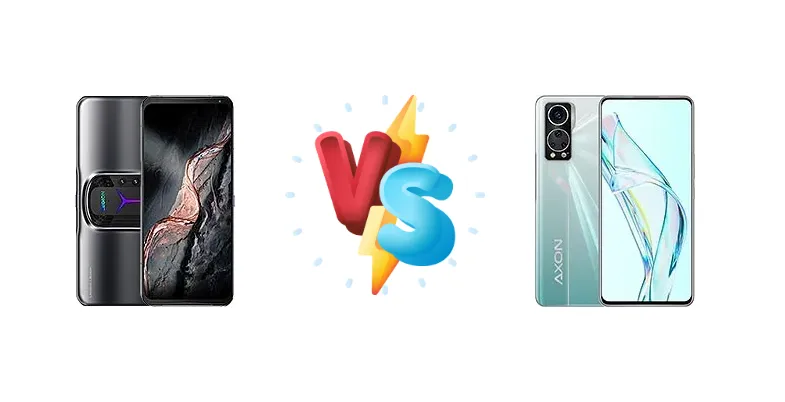
The Lenovo Legion Y90 aims to be a gaming powerhouse, while the ZTE Axon 30 5G focuses on delivering premium features at a competitive price. But which phone truly comes out on top? This comprehensive comparison dives deep into their specs, performance, and overall value to help you make the right choice.
🏆 Quick Verdict
The Lenovo Legion Y90 boasts a significantly faster Snapdragon 8 Gen 1 chipset, making it the clear winner for gaming and demanding tasks. However, the ZTE Axon 30 5G offers exceptional battery life and a compelling value proposition for users prioritizing longevity and affordability.
| Network |
|---|
| 2G bands | GSM 850 / 900 / 1800 / 1900 | GSM 850 / 900 / 1800 / 1900 |
| 3G bands | HSDPA 800 / 850 / 900 / 1900 / 2100 | HSDPA 850 / 900 / 1700(AWS) / 1900 / 2100 - International |
| 4G bands | LTE | 1, 2, 3, 4, 5, 7, 8, 12, 17, 20, 26, 28, 18, 19, 34, 38, 39, 40, 41 - Europe |
| 5G bands | SA/NSA/Sub6 | 1, 3, 28, 38, 41, 77, 78 SA/NSA - Europe |
| Speed | HSPA, LTE, 5G | HSPA, LTE, 5G |
| Technology | GSM / CDMA / HSPA / CDMA2000 / LTE / 5G | GSM / CDMA / HSPA / LTE / 5G |
| | CDMA2000 1x | 1, 3, 28, 41, 78 SA/NSA - China |
| Launch |
|---|
| Announced | 2022, March 01 | 2021, July 27 |
| Status | Available. Released 2022, March 10 | Available. Released 2021, August 03 |
| Body |
|---|
| Build | - | Glass front, plastic back, plastic frame |
| Dimensions | 177 x 78.4 x 10.1 mm (6.97 x 3.09 x 0.40 in) | 170.2 x 77.8 x 7.8 mm (6.70 x 3.06 x 0.31 in) |
| SIM | Nano-SIM + Nano-SIM | Nano-SIM + Nano-SIM |
| Weight | 252 g (8.89 oz) | 189 g (6.67 oz) |
| | Built-in two cooling fans
RGB light panel (on the back)
4 ultrasonic buttons (Gaming triggers) | - |
| Display |
|---|
| Protection | - | Corning Gorilla Glass |
| Resolution | 1080 x 2460 pixels (~388 ppi density) | 1080 x 2460 pixels (~400 ppi density) |
| Size | 6.92 inches, 113.7 cm2 (~81.9% screen-to-body ratio) | 6.92 inches, 107.0 cm2 (~80.8% screen-to-body ratio) |
| Type | AMOLED, 144Hz, HDR10+, 1300 nits (peak) | AMOLED, 1B colors, 120Hz |
| | - | Always-on display |
| Platform |
|---|
| CPU | Octa-core (1x3.00 GHz Cortex-X2 & 3x2.50 GHz Cortex-A710 & 4x1.80 GHz Cortex-A510) | Octa-core (1x3.2 GHz Kryo 585 & 3x2.42 GHz Kryo 585 & 4x1.80 GHz Kryo 585) |
| Chipset | Qualcomm SM8450 Snapdragon 8 Gen 1 (4 nm) | Qualcomm SM8250-AC Snapdragon 870 5G (7 nm) |
| GPU | Adreno 730 | Adreno 650 |
| OS | Android 12, ZUI 13 | Android 11, MyOS 11 |
| Memory |
|---|
| Card slot | No | microSDXC (uses shared SIM slot) |
| Internal | 256GB 12GB RAM, 256GB 16GB RAM, 640GB 18GB RAM | 128GB 6GB RAM, 128GB 8GB RAM, 256GB 8GB RAM, 256GB 12GB RAM |
| | UFS 3.1
640GB (512GB UFS + 128GB SSD) | UFS 3.1 |
| Main Camera |
|---|
| Dual | 64 MP, f/1.9, 25mm (wide), 1/1.32", 1.0µm, PDAF
13 MP, 120˚ (ultrawide) | - |
| Features | Dual-LED flash, panorama, HDR | Dual-LED flash, HDR, panorama |
| Quad | - | 64 MP, f/1.8, 25mm (wide), 1/1.73", 0.8µm, PDAF
8 MP, f/2.2, 120˚, 16mm (ultrawide)
5 MP (macro)
Auxiliary lens |
| Single | - | 16 MP, f/2.5, (wide), under display |
| Video | 8K@24fps, 4K@30/60fps, 1080p@30/60/240fps, gyro-EIS, HDR10+ rec. | 4K@30/60fps, 1080p@30fps, gyro-EIS, HDR, 10‑bit video |
| Selfie camera |
|---|
| Features | HDR | HDR |
| Single | 16 MP | 16 MP, f/2.5, (wide), under display |
| Video | 4K@30/60fps, 1080p@30/60/120fps | 1080p@30fps |
| Sound |
|---|
| 3.5mm jack | No | No |
| 35mm jack | No | No |
| Loudspeaker | Yes, with stereo speakers | Yes |
| | - | 24-bit/192kHz audio |
| Comms |
|---|
| Bluetooth | 5.2, A2DP, LE | 5.1, A2DP, LE |
| NFC | Yes | Yes |
| Positioning | GPS (L1+L5), GLONASS, GALILEO, BDS, QZSS | GPS, GLONASS, GALILEO, BDS |
| Radio | No | No |
| USB | USB Type-C 3.1 Gen2, USB Type-C 2.0, OTG | USB Type-C 3.0, OTG |
| WLAN | Wi-Fi 802.11 a/b/g/n/ac/6, dual-band, Wi-Fi Direct | Wi-Fi 802.11 a/b/g/n/ac/6, dual-band, Wi-Fi Direct |
| Features |
|---|
| Sensors | Fingerprint (under display, optical), accelerometer, gyro, proximity, compass | Fingerprint (under display, optical), accelerometer, gyro, proximity, compass |
| Battery |
|---|
| Charging | 68W wired, 100% in 35 min | 65W wired, PD, QC4 |
| Type | Li-Po 5600 mAh | Li-Ion 4200 mAh |
| Misc |
|---|
| Colors | Gray | Black, Aqua |
| Models | L71061 | A2322, A2322G |
| Price | About 570 EUR | About 500 EUR |
| Tests |
|---|
| Battery life | - |
Endurance rating 86h
|
| Camera | - |
Photo / Video |
| Display | - |
Contrast ratio: Infinite (nominal) |
| Loudspeaker | - |
-27.7 LUFS (Good)
|
| Performance | - |
AnTuTu: 701991 (v9)
GeekBench: 3160 (v5.1)
GFXBench: 59fps (ES 3.1 onscreen) |
Lenovo Legion Y90
- Blazing-fast Snapdragon 8 Gen 1
- High refresh rate display (assumed)
- Fast 68W charging
- Potentially superior cooling system for sustained performance
- Likely shorter battery life than Axon 30 5G
- Potentially higher price
- Camera details are limited
ZTE Axon 30 5G
- Exceptional battery life (86h endurance rating)
- Unique under-display selfie camera
- Competitive price
- Good display contrast
- Less powerful Snapdragon 870 chipset
- Lower peak brightness compared to some competitors
- Camera details are limited
Display Comparison
The Lenovo Legion Y90 likely features a high refresh rate display (144Hz or higher, assumed) for smoother gaming, while the ZTE Axon 30 5G has a reported 438 nits brightness and an 'infinite' contrast ratio (likely AMOLED). While the Axon 30 5G's contrast is impressive, the Y90's higher refresh rate will provide a more responsive gaming experience.
Camera Comparison
Camera details are limited for both devices. The Axon 30 5G is known for its under-display selfie camera, which is a unique feature. Both phones likely offer competent camera systems, but neither is expected to be a class leader. Image quality will depend on software processing and sensor size, which are not specified.
Performance
Here, the Legion Y90 takes a commanding lead. The Snapdragon 8 Gen 1 is considerably more powerful than the Snapdragon 870 in the Axon 30 5G. Expect faster app loading, smoother multitasking, and significantly better performance in graphically intensive games. The Y90's cooling system will also be crucial to maintain performance under sustained load.
Battery Life
The ZTE Axon 30 5G shines in this category with an impressive endurance rating of 86 hours. The Legion Y90, while offering 68W fast charging (35-minute full charge), may not match the Axon 30 5G's overall battery longevity due to its more power-hungry chipset.
Buying Guide
The Lenovo Legion Y90 is ideal for mobile gamers and power users who demand top-tier performance. The ZTE Axon 30 5G is a great choice for users seeking a well-rounded smartphone with excellent battery life and a good camera, without breaking the bank.
Frequently Asked Questions
❓ Is the Lenovo Legion Y90 good for everyday use?
Yes, the Legion Y90's powerful processor makes it capable of handling everyday tasks with ease. However, its focus is on gaming, so battery life might be a consideration.
❓ Does the ZTE Axon 30 5G have a good camera?
The Axon 30 5G has a decent camera, but it's not a standout feature. Its unique under-display selfie camera is a highlight.