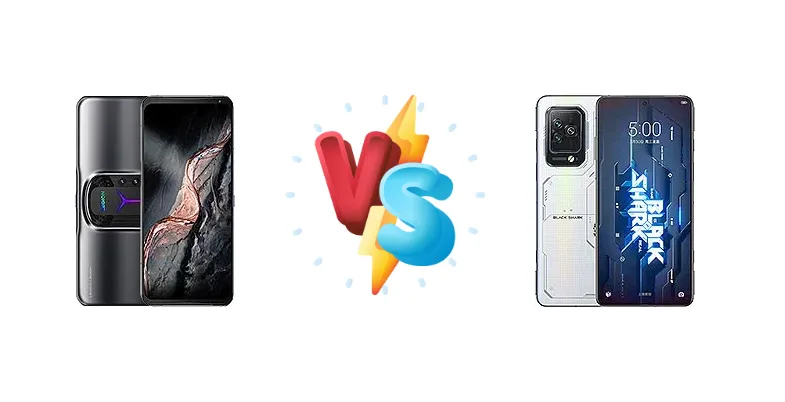
The mobile gaming landscape is fierce, and these two contenders – the Lenovo Legion Y90 and the Xiaomi Black Shark 5 Pro – are vying for the top spot. Both pack the powerful Snapdragon 8 Gen 1, but their approaches to gaming differ significantly. Let's dive into a head-to-head comparison to see which phone emerges victorious.
🏆 Quick Verdict
The Xiaomi Black Shark 5 Pro takes the crown thanks to its blistering 120W charging and potentially superior cooling solutions (though not explicitly stated). While the Legion Y90 is a strong contender, the Black Shark's charging speed and established gaming features give it the edge for serious mobile gamers.
| Network |
|---|
| 2G bands | GSM 850 / 900 / 1800 / 1900 | GSM 850 / 900 / 1800 / 1900 |
| 3G bands | HSDPA 800 / 850 / 900 / 1900 / 2100 | HSDPA 800 / 850 / 900 / 1700(AWS) / 1900 / 2100 |
| 4G bands | LTE | 1, 2, 3, 4, 5, 7, 8, 12, 17, 18, 19, 26, 28, 34, 38, 39, 40, 41 |
| 5G bands | SA/NSA/Sub6 | 1, 3, 8, 28, 41, 77, 78, 79 SA/NSA |
| Speed | HSPA, LTE, 5G | HSPA, LTE, 5G |
| Technology | GSM / CDMA / HSPA / CDMA2000 / LTE / 5G | GSM / CDMA / HSPA / EVDO / LTE / 5G |
| | CDMA2000 1x | - |
| Launch |
|---|
| Announced | 2022, March 01 | 2022, March 30 |
| Status | Available. Released 2022, March 10 | Available. Released 2022, April 04 |
| Body |
|---|
| Dimensions | 177 x 78.4 x 10.1 mm (6.97 x 3.09 x 0.40 in) | 163.9 x 76.5 x 9.5 mm (6.45 x 3.01 x 0.37 in) |
| SIM | Nano-SIM + Nano-SIM | Nano-SIM + Nano-SIM |
| Weight | 252 g (8.89 oz) | 220 g (7.76 oz) |
| | Built-in two cooling fans
RGB light panel (on the back)
4 ultrasonic buttons (Gaming triggers) | - |
| Display |
|---|
| Resolution | 1080 x 2460 pixels (~388 ppi density) | 1080 x 2400 pixels, 20:9 ratio (~395 ppi density) |
| Size | 6.92 inches, 113.7 cm2 (~81.9% screen-to-body ratio) | 6.67 inches, 107.4 cm2 (~85.7% screen-to-body ratio) |
| Type | AMOLED, 144Hz, HDR10+, 1300 nits (peak) | OLED, 1B colors, 144Hz, HDR10+ |
| Platform |
|---|
| CPU | Octa-core (1x3.00 GHz Cortex-X2 & 3x2.50 GHz Cortex-A710 & 4x1.80 GHz Cortex-A510) | Octa-core (1x3.00 GHz Cortex-X2 & 3x2.50 GHz Cortex-A710 & 4x1.80 GHz Cortex-A510) |
| Chipset | Qualcomm SM8450 Snapdragon 8 Gen 1 (4 nm) | Qualcomm SM8450 Snapdragon 8 Gen 1 (4 nm) |
| GPU | Adreno 730 | Adreno 730 |
| OS | Android 12, ZUI 13 | Android 12, Joy UI 13 |
| Memory |
|---|
| Card slot | No | No |
| Internal | 256GB 12GB RAM, 256GB 16GB RAM, 640GB 18GB RAM | 128GB 8GB RAM, 256GB 8GB RAM, 256GB 12GB RAM, 512GB 16GB RAM |
| | UFS 3.1
640GB (512GB UFS + 128GB SSD) | - |
| Main Camera |
|---|
| Dual | 64 MP, f/1.9, 25mm (wide), 1/1.32", 1.0µm, PDAF
13 MP, 120˚ (ultrawide) | - |
| Features | Dual-LED flash, panorama, HDR | LED flash, HDR, panorama |
| Single | - | 16 MP, (wide), 1/3.06", 1.0µm |
| Triple | - | 108 MP, f/1.8, (wide), 1/1.52", 0.7µm, PDAF
13 MP, f/2.4, 120˚ (ultrawide), 1/3.06", 1.12µm
5 MP, f/2.4, (telephoto macro), AF |
| Video | 8K@24fps, 4K@30/60fps, 1080p@30/60/240fps, gyro-EIS, HDR10+ rec. | 4K@30/60fps, 1080p@30/60/240fps, 1080p@960fps; HDR10+ |
| Selfie camera |
|---|
| Features | HDR | HDR |
| Single | 16 MP | 16 MP, (wide), 1/3.06", 1.0µm |
| Video | 4K@30/60fps, 1080p@30/60/120fps | 1080p@30fps |
| Sound |
|---|
| 3.5mm jack | No | No |
| 35mm jack | No | No |
| Loudspeaker | Yes, with stereo speakers | Yes, with stereo speakers |
| Comms |
|---|
| Bluetooth | 5.2, A2DP, LE | 5.2, A2DP, LE, aptX HD, aptX Adaptive |
| NFC | Yes | Yes |
| Positioning | GPS (L1+L5), GLONASS, GALILEO, BDS, QZSS | GPS, GLONASS, GALILEO, QZSS, BDS |
| Radio | No | No |
| USB | USB Type-C 3.1 Gen2, USB Type-C 2.0, OTG | USB Type-C 2.0, video output |
| WLAN | Wi-Fi 802.11 a/b/g/n/ac/6, dual-band, Wi-Fi Direct | Wi-Fi 802.11 a/b/g/n/ac/6, dual-band, Wi-Fi Direct |
| Features |
|---|
| Sensors | Fingerprint (under display, optical), accelerometer, gyro, proximity, compass | Fingerprint (side-mounted), accelerometer, gyro, proximity, compass, barometer (China only) |
| Battery |
|---|
| Charging | 68W wired, 100% in 35 min | 120W wired, 100% in 15 min |
| Type | Li-Po 5600 mAh | Li-Po 4650 mAh |
| Misc |
|---|
| Colors | Gray | Black, White |
| Models | L71061 | SHARK KTUS-H0 |
| Price | About 570 EUR | About 720 EUR |
| Tests |
|---|
| Battery life | - |
Endurance rating 83h
|
| Camera | - |
Photo / Video |
| Display | - |
Contrast ratio: Infinite (nominal) |
| Performance | - |
AnTuTu: 876704 (v8), 1007133 (v9)
GeekBench: 3665 (v5.1)
GFXBench: 82fps (ES 3.1 onscreen) |
Lenovo Legion Y90
- Sleek and modern design
- Potentially refined software experience
- Fast 68W charging
- Slower charging than Black Shark 5 Pro
- Cooling system details unclear
- Camera specs limited
Xiaomi Black Shark 5 Pro
- Blistering 120W charging
- Potentially superior cooling system
- Excellent battery life (83h endurance)
- Established gaming features
- More 'gamer' aesthetic may not appeal to everyone
- Camera specs limited
- Display brightness not exceptionally high
Display Comparison
Both phones feature high-refresh-rate AMOLED displays, offering vibrant colors and smooth visuals. The Black Shark 5 Pro boasts a measured 682 nits max brightness, while the Legion Y90's brightness is likely comparable. The Black Shark's 'infinite' contrast ratio is a nominal claim, but suggests excellent blacks. The Legion Y90 may have a slightly more refined color calibration.
Camera Comparison
Camera details are limited in the provided specs. Both phones likely offer competent camera systems, but neither is likely a primary focus. Expect standard photo and video capabilities. Image quality will likely be similar, with slight variations in processing.
Performance
Powered by the Snapdragon 8 Gen 1, both phones deliver flagship-level performance. However, sustained performance is key for gaming. The Black Shark 5 Pro's cooling system (rumored to be more advanced) could allow it to maintain peak performance for longer periods. Both phones will handle demanding games with ease, but thermal management will be the deciding factor in extended gaming sessions.
Battery Life
The Black Shark 5 Pro boasts an impressive endurance rating of 83 hours, suggesting excellent battery life. The Legion Y90's 68W charging is fast, but the Black Shark 5 Pro's 120W charging is significantly faster, offering a full charge in just 15 minutes compared to the Legion Y90's 35 minutes. This is a major advantage for gamers who need quick top-ups.
Buying Guide
The Lenovo Legion Y90 is ideal for gamers who prioritize a sleek design and potentially a more refined software experience. The Xiaomi Black Shark 5 Pro is for hardcore gamers who demand the fastest charging speeds and are comfortable with a more overtly 'gaming' aesthetic and potentially more aggressive cooling.
Frequently Asked Questions
❓ Which phone has better cooling?
While not explicitly stated, the Xiaomi Black Shark 5 Pro is generally believed to have a more advanced cooling system, potentially allowing for sustained peak performance.
❓ Is the Legion Y90 worth considering if I'm not a hardcore gamer?
Yes, the Legion Y90 is a solid all-around phone with a sleek design and flagship performance. However, if charging speed is a priority, the Black Shark 5 Pro is the clear winner.