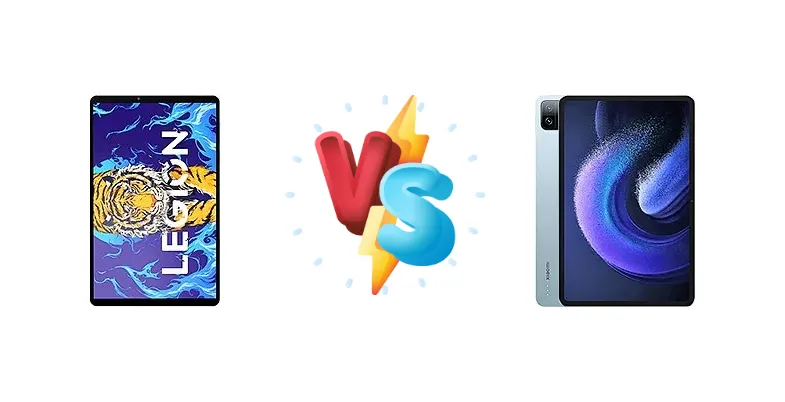
The Lenovo Legion Y700 and Xiaomi Pad 6 are both powerful Android devices, but cater to different needs. The Y700 aims for mobile gaming dominance, while the Pad 6 prioritizes a premium tablet experience. Let's dive into a head-to-head comparison to see which one comes out on top.
🏆 Quick Verdict
The Lenovo Legion Y700 takes the crown for raw gaming performance thanks to its cooling system and focus on gaming features. However, the Xiaomi Pad 6 offers a superior display, longer battery life, and a more refined overall tablet experience, making it a better all-rounder for most users.
| Network |
|---|
| 2G bands | GSM 850 / 900 / 1800 / 1900 | N/A |
| 3G bands | HSDPA 850 / 900 / 1900 / 2100 | N/A |
| 4G bands | LTE | - |
| EDGE | - | N/A |
| GPRS | - | N/A |
| Speed | HSPA, LTE - cellular model only | - |
| Technology | GSM / HSPA / LTE | No cellular connectivity |
| Launch |
|---|
| Announced | 2022, March 01 | 2023, April 18 |
| Status | Available. Released 2022, March 10 | Available. Released 2023, April 18 |
| Body |
|---|
| Build | - | Glass front (Gorilla Glass 3), aluminum frame, aluminum back |
| Dimensions | 207.1 x 128.1 x 7.9 mm (8.15 x 5.04 x 0.31 in) | 254 x 165.2 x 6.5 mm (10.0 x 6.50 x 0.26 in) |
| SIM | Nano-SIM (cellular model only) | No |
| Weight | 375 g (13.23 oz) | 490 g (1.08 lb) |
| | - | Stylus support (magnetic) |
| Display |
|---|
| Protection | - | Corning Gorilla Glass 3 |
| Resolution | 1600 x 2560 pixels, 16:10 ratio (~343 ppi density) | 1800 x 2880 pixels, 16:10 ratio (~309 ppi density) |
| Size | 8.8 inches, 224.5 cm2 (~84.6% screen-to-body ratio) | 11.0 inches, 350.9 cm2 (~83.6% screen-to-body ratio) |
| Type | IPS LCD, 120Hz, Dolby Vision, HDR10, 500 nits (typ) | IPS LCD, 1B colors, 144Hz, HDR10, Dolby Vision, 550 nits |
| Platform |
|---|
| CPU | Octa-core (1x3.2 GHz Kryo 585 & 3x2.42 GHz Kryo 585 & 4x1.80 GHz Kryo 585) | Octa-core (1x3.2 GHz Kryo 585 & 3x2.42 GHz Kryo 585 & 4x1.80 GHz Kryo 585) |
| Chipset | Qualcomm SM8250-AC Snapdragon 870 5G (7 nm) | Qualcomm SM8250-AC Snapdragon 870 5G (7 nm) |
| GPU | Adreno 650 | Adreno 650 |
| OS | Android 12, ZUI 13 | Android 13, MIUI Pad 14 |
| Memory |
|---|
| Card slot | microSDXC (dedicated slot) | No |
| Internal | 128GB 8GB RAM, 256GB 12GB RAM | 128GB 6GB RAM, 128GB 8GB RAM, 256GB 8GB RAM |
| | UFS 3.1 | UFS 3.1 |
| Main Camera |
|---|
| Features | LED flash | Dual-LED flash, HDR, panorama |
| Single | 13 MP | 13 MP, f/2.2, PDAF |
| Video | 1080p@30fps | 4K@30fps, 1080p@30/60fps |
| Selfie camera |
|---|
| Single | 8 MP | 8 MP, f/2.2, 1/4.0", 1.12µm |
| Video | 1080p@30fps | 1080p@30fps |
| Sound |
|---|
| 3.5mm jack | Yes | No |
| 35mm jack | Yes | No |
| Loudspeaker | Yes, with stereo speakers | Yes, with stereo speakers (4 speakers) |
| | Tuned by JBL | 24-bit/192kHz audio |
| Comms |
|---|
| Bluetooth | 5.1, A2DP, LE | 5.2, A2DP, LE |
| NFC | No | No |
| Positioning | No | Unspecified |
| Radio | Unspecified | No |
| USB | USB Type-C 3.1 Gen2 | USB Type-C 3.2, accessory connector |
| WLAN | Wi-Fi 802.11 a/b/g/n/ac/6, dual-band, Wi-Fi Direct | Wi-Fi 802.11 a/b/g/n/a/6, dual-band, Wi-Fi Direct |
| Features |
|---|
| Sensors | Accelerometer, gyro, proximity, compass | Accelerometer, gyro, proximity (accessories only) |
| Battery |
|---|
| Charging | 45W wired, 100% in 45 min | 33W wired, PD3.0, QC4 |
| Type | Li-Po 6550 mAh | Li-Po 8840 mAh |
| Misc |
|---|
| Colors | Gray | Black, Blue, Gold |
| Models | TB-9707F | 23043RP34C, 23043RP34G, 23043RP34I |
| Price | About 360 EUR | About 400 EUR |
Lenovo Legion Y700
- Exceptional gaming performance
- Advanced cooling system
- Fast charging (45W)
- Dedicated gaming features
- Less impressive display
- Shorter battery life
- Potentially bulky design
Xiaomi Pad 6
- Excellent display quality
- Long battery life (9:39h)
- Premium design and build
- PD3.0 and QC4 charging support
- Performance throttling under sustained load
- Less focused on gaming than Y700
- Charging speed slower than Y700 (33W)
Display Comparison
The Xiaomi Pad 6 boasts a significantly better display. Its 1060:1 contrast ratio and 500 nits brightness provide a vibrant and immersive viewing experience. While the Legion Y700 has a decent display, it lacks the same level of color accuracy and brightness. The Pad 6's display is a clear winner for media consumption and creative tasks.
Camera Comparison
Camera quality is generally not a primary focus for tablets. The Xiaomi Pad 6 likely has slightly better cameras, but neither device excels in this area. Expect decent image quality for casual snapshots, but don't expect flagship-level performance.
Performance
Both devices share the same Snapdragon 870 chipset, offering excellent performance. However, the Legion Y700's advanced cooling system allows it to sustain peak performance for longer periods, making it better suited for demanding games. The Pad 6 might experience some thermal throttling during extended gaming sessions.
Battery Life
The Xiaomi Pad 6 shines in battery life, achieving an impressive 9:39 hours of active use. The Lenovo Legion Y700, while offering a respectable battery, will likely drain faster due to its more power-intensive cooling system and gaming-focused usage.
Buying Guide
The Lenovo Legion Y700 is ideal for serious mobile gamers who prioritize performance above all else. The Xiaomi Pad 6 is perfect for students, creatives, and anyone seeking a premium Android tablet for productivity, entertainment, and general use.
Frequently Asked Questions
❓ Is the Lenovo Legion Y700 good for everyday use?
Yes, the Legion Y700 is capable for everyday tasks, but its focus is on gaming. The Xiaomi Pad 6 is a more well-rounded option for general use.
❓ Can the Xiaomi Pad 6 handle demanding games?
Yes, the Xiaomi Pad 6 can handle many demanding games, but it may experience some thermal throttling during extended play sessions compared to the Legion Y700.
❓ Which tablet has faster charging?
The Lenovo Legion Y700 has faster charging at 45W compared to the Xiaomi Pad 6's 33W.