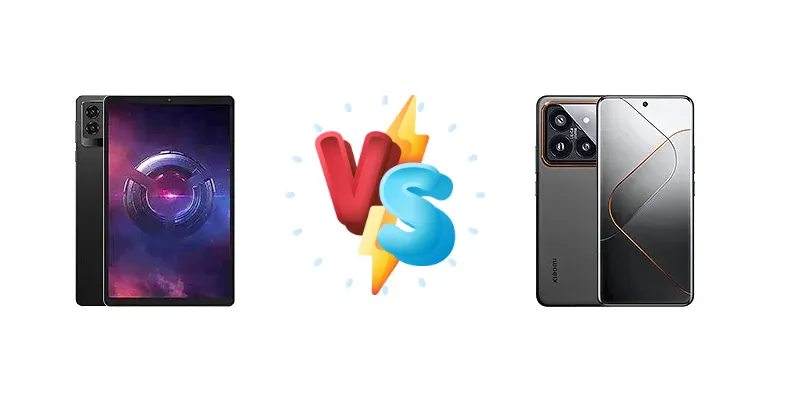
Both the Lenovo Legion Y700 (2025) and the Xiaomi 14 Pro represent the pinnacle of Android smartphone technology, powered by the Qualcomm Snapdragon 8 Gen 3. However, they diverge significantly in their core philosophies: the Legion Y700 focuses on sustained performance and longevity, while the Xiaomi 14 Pro prioritizes rapid replenishment and convenience. This comparison dissects these differences to help you choose the right flagship.
🏆 Quick Verdict
For the dedicated mobile gamer prioritizing extended play sessions, the Lenovo Legion Y700 (2025) is the clear winner thanks to its exceptional 103:52h battery endurance. However, users who value the convenience of incredibly fast charging – topping up to 100% in just 18 minutes – will find the Xiaomi 14 Pro more appealing.
| Network |
|---|
| 2G bands | N/A | GSM 850 / 900 / 1800 / 1900 |
| 3G bands | N/A | HSDPA 800 / 850 / 900 / 1700(AWS) / 1900 / 2100 |
| 4G bands | N/A | 1, 3, 4, 5, 7, 8, 18, 19, 26, 28, 34, 38, 39, 40, 41, 42, 48, 66 |
| 5G bands | - | 1, 3, 5, 7, 8, 28, 38, 40, 41, 48, 66, 77, 78, 79 SA/NSA |
| EDGE | No | - |
| GPRS | No | - |
| Speed | - | HSPA, LTE, 5G |
| Technology | No cellular connectivity | GSM / CDMA / HSPA / CDMA2000 / LTE / 5G |
| Launch |
|---|
| Announced | 2024, October 16 | 2023, October 26 |
| Status | Available. Released 2024, October | Available. Released 2023, November 01 |
| Body |
|---|
| Build | Glass front, aluminum frame, aluminum back | Glass front, aluminum frame or titanium frame, glass back |
| Dimensions | 208.5 x 129.5 x 7.8 mm (8.21 x 5.10 x 0.31 in) | 161.4 x 75.3 x 8.5 mm |
| SIM | No | Nano-SIM + Nano-SIM |
| Weight | 350 g (12.35 oz) | 223 g or 230 g (7.87 oz) |
| Display |
|---|
| Protection | Mohs level 5 | Shatterproof glass |
| Resolution | 1600 x 2560 pixels, 16:10 ratio (~343 ppi density) | 1440 x 3200 pixels, 20:9 ratio (~522 ppi density) |
| Size | 8.8 inches, 224.5 cm2 (~83.2% screen-to-body ratio) | 6.73 inches, 108.9 cm2 (~89.6% screen-to-body ratio) |
| Type | IPS LCD, 165Hz, Dolby Vision, HDR10, 500 nits (typ), 900 nits (HBM) | LTPO AMOLED, 68B colors, 120Hz, Dolby Vision, HDR10+, 3000 nits (peak) |
| Platform |
|---|
| CPU | Octa-core (1x3.3 GHz Cortex-X4 & 3x3.2 GHz Cortex-A720 & 2x3.0 GHz Cortex-A720 & 2x2.3 GHz Cortex-A520) | Octa-core (1x3.3 GHz Cortex-X4 & 3x3.2 GHz Cortex-A720 & 2x3.0 GHz Cortex-A720 & 2x2.3 GHz Cortex-A520) |
| Chipset | Qualcomm SM8650-AB Snapdragon 8 Gen 3 (4 nm) | Qualcomm SM8650-AB Snapdragon 8 Gen 3 (4 nm) |
| GPU | Adreno 750 | Adreno 750 |
| OS | Android 14, up to 3 major Android upgrades | Android 14, HyperOS |
| Memory |
|---|
| Card slot | No | No |
| Internal | 256GB 12GB RAM, 512GB 16GB RAM | 256GB 12GB RAM, 512GB 16GB RAM, 1TB 16GB RAM |
| Main Camera |
|---|
| Dual | 13 MP, (wide)
2 MP (macro) | - |
| Features | LED flash | Laser AF, color spectrum sensor, Leica lens, Dual-LED dual-tone flash, HDR, panorama |
| Triple | - | 50 MP, f/1.4-f/4.0, 23mm (wide), 1/1.31", 1.2µm, dual pixel PDAF, OIS
50 MP, f/2.0, 75mm (telephoto), PDAF (10cm - ∞), OIS, 3.2x optical zoom
50 MP, f/2.2, 14mm, 115˚ (ultrawide), AF |
| Video | 1080p@30fps | 8K@24fps (HDR), 4K@24/30/60fps (HDR10+, 10-bit Dolby Vision HDR, 10-bit LOG), 1080p@30/60/120/240/960fps, 720p@1920fps, gyro-EIS |
| Selfie camera |
|---|
| Features | - | HDR, panorama |
| Single | 8 MP | 32 MP, f/2.0, 22mm (wide), 0.7µm |
| Video | 1080p@30fps | 4K@30/60fps, 1080p@30/60fps, gyro-EIS |
| Sound |
|---|
| 35mm jack | No | No |
| Loudspeaker | Yes, with stereo speakers | Yes, with stereo speakers |
| Comms |
|---|
| Bluetooth | 5.4, A2DP, LE | 5.4, A2DP, LE, aptX HD, aptX Adaptive |
| Infrared port | - | Yes |
| NFC | No | Yes |
| Positioning | No | GPS (L1+L5), GLONASS (G1), BDS (B1I+B1c+B2a), GALILEO (E1+E5a), QZSS (L1+L5), NavIC (L5) |
| Radio | Unspecified | No |
| USB | 1x USB Type-C & 1x USB Type-C 3.1 Gen2, DisplayPort 1.4 | USB Type-C 3.2 Gen 2, OTG |
| WLAN | Wi-Fi 802.11 a/b/g/n/ac/6/7, dual-band or tri-band, Wi-Fi Direct | Wi-Fi 802.11 a/b/g/n/ac/6e/7, dual-band, Wi-Fi Direct |
| Features |
|---|
| Sensors | Accelerometer, gyro, proximity, compass | Fingerprint (under display, optical), accelerometer, proximity, gyro, compass, barometer |
| Battery |
|---|
| Charging | 68W wired
Bypass charging | 120W wired, PD3.0, QC4, 100% in 18 min
50W wireless, 100% in 40 min
10W reverse wireless |
| Type | Li-Po 6550 mAh | Li-Po 4880 mAh |
| Misc |
|---|
| Colors | Eclipse Black | Black, Silver, Titanium, Green |
| Models | TB321FU | 23116PN5BC |
| Price | $ 389.99 | About 650 EUR |
| EU LABEL |
|---|
| Battery | 103:52h endurance, 1000 cycles | - |
| Energy | Class D | - |
| Free fall | Class E (13 falls) | - |
| Repairability | Class B | - |
Lenovo Legion Y700 (2025)
- Exceptional battery endurance (103:52h)
- 1000 battery charge cycles for long-term reliability
- Potentially superior thermal management for sustained gaming
- Bypass charging for reduced battery stress during gaming
- Slower charging speed (68W)
- Camera likely less advanced than Xiaomi 14 Pro
Xiaomi 14 Pro
- Blazing-fast 120W wired charging (18 minutes to full)
- Convenient 50W wireless charging
- Likely superior camera system
- Reverse wireless charging capability
- Shorter battery life compared to Legion Y700
- Potential for more thermal throttling under sustained load
Display Comparison
While both devices are expected to feature high-refresh-rate AMOLED displays, the provided data doesn't detail specifics like resolution or peak brightness. However, given Xiaomi's history with display technology, the 14 Pro likely boasts a higher peak brightness and potentially a more color-accurate panel. The Legion Y700, geared towards gaming, may prioritize refresh rate and response time. The absence of PWM frequency data prevents a direct comparison of flicker reduction.
Camera Comparison
The provided data lacks camera specifications. However, Xiaomi typically excels in camera technology, and the 14 Pro is likely to feature a more advanced camera system with larger sensors and more sophisticated image processing. The Legion Y700, while likely capable, will likely prioritize gaming features over camera prowess. Without sensor size or aperture information, a detailed comparison is impossible, but expect Xiaomi to have the edge in image quality.
Performance
Both the Lenovo Legion Y700 (2025) and the Xiaomi 14 Pro utilize the Qualcomm SM8650-AB Snapdragon 8 Gen 3 (4nm). Critically, the CPU configurations are identical: 1x3.3 GHz Cortex-X4, 3x3.2 GHz Cortex-A720, 2x3.0 GHz Cortex-A720, and 2x2.3 GHz Cortex-A520. This means raw processing power will be nearly indistinguishable. The key differentiator will be thermal management. Lenovo's Legion series is known for robust cooling solutions, potentially allowing the Y700 to sustain peak performance for longer periods than the Xiaomi 14 Pro, despite both using the same chipset. RAM specifications are not provided, but both are expected to utilize LPDDR5x for fast memory access.
Battery Life
This is where the most significant difference lies. The Lenovo Legion Y700 (2025) boasts an impressive 103:52h endurance, suggesting a large battery capacity optimized for longevity and 1000 charge cycles. In contrast, the Xiaomi 14 Pro focuses on speed, offering 120W wired charging (0-100% in 18 minutes), 50W wireless charging (0-100% in 40 minutes), and 10W reverse wireless charging. While the Xiaomi 14 Pro’s battery capacity isn’t specified, the emphasis on fast charging suggests a smaller capacity, trading endurance for convenience. The Legion Y700’s 68W charging is significantly slower, but the extended battery life mitigates this drawback.
Buying Guide
Buy the Lenovo Legion Y700 (2025) if you need a phone that can reliably handle hours of demanding gaming without needing a recharge, and appreciate the longevity offered by 1000 battery cycles. Buy the Xiaomi 14 Pro if you prefer the flexibility of incredibly fast wired and wireless charging, and don't mind potentially shorter battery life in exchange for quicker top-ups.
Frequently Asked Questions
❓ Does the Lenovo Legion Y700 (2025) support bypass charging while gaming, and how does this benefit performance?
Yes, the Legion Y700 (2025) features bypass charging. This means the phone receives power directly from the adapter, bypassing the battery during gaming. This reduces heat generation within the battery, minimizing thermal throttling and allowing for sustained peak performance during long gaming sessions.
❓ How does the 120W charging on the Xiaomi 14 Pro impact battery health over the long term?
While 120W charging is incredibly fast, it can potentially contribute to faster battery degradation over time. However, Xiaomi employs sophisticated charging algorithms and thermal management to mitigate this effect. The Legion Y700's slower 68W charging and 1000 charge cycles are designed for maximum battery longevity, but the convenience of the Xiaomi 14 Pro's charging speed may be worth the trade-off for some users.
❓ Given both phones have the Snapdragon 8 Gen 3, will I notice a difference in gaming performance?
While the core processing power is similar, the Lenovo Legion Y700 (2025) is likely to offer more sustained gaming performance due to its potentially superior thermal management system. The Xiaomi 14 Pro may experience more throttling under prolonged heavy load, even with the same chipset.