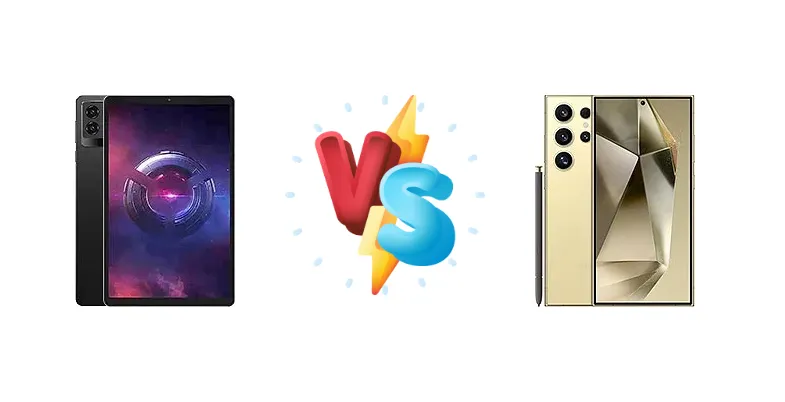
The Lenovo Legion Y700 (2025) and the Samsung Galaxy S24 Ultra represent distinct approaches to the Android flagship experience. The Legion Y700 aggressively targets mobile gamers with a focus on sustained performance and battery life, while the S24 Ultra aims for a more holistic premium experience, emphasizing camera technology, display quality, and broader feature sets. This comparison dissects their core strengths to determine which device reigns supreme for different user profiles.
🏆 Quick Verdict
For the average user prioritizing a versatile, premium experience, the Samsung Galaxy S24 Ultra is the better choice. Its superior camera system, brighter display, and broader software features outweigh the Legion Y700’s exceptional battery life. However, dedicated mobile gamers will find the Legion Y700’s endurance and optimized chipset a compelling advantage.
| Network |
|---|
| 2G bands | N/A | GSM 850 / 900 / 1800 / 1900 |
| 3G bands | N/A | HSDPA 850 / 900 / 1700(AWS) / 1900 / 2100 |
| 4G bands | N/A | 1, 2, 3, 4, 5, 7, 8, 12, 13, 17, 18, 19, 20, 25, 26, 28, 32, 38, 39, 40, 41, 66 - International |
| 5G bands | - | 1, 2, 3, 5, 7, 8, 12, 20, 25, 26, 28, 38, 40, 41, 66, 75, 77, 78 SA/NSA/Sub6 - International |
| EDGE | No | - |
| GPRS | No | - |
| Speed | - | HSPA, LTE (up to 7CA), 5G |
| Technology | No cellular connectivity | GSM / CDMA / HSPA / EVDO / LTE / 5G |
| Launch |
|---|
| Announced | 2024, October 16 | 2024, January 17 |
| Status | Available. Released 2024, October | Available. Released 2024, January 24 |
| Body |
|---|
| Build | Glass front, aluminum frame, aluminum back | Glass front (Corning Gorilla Armor), glass back (Corning Gorilla Armor), titanium frame (grade 2) |
| Dimensions | 208.5 x 129.5 x 7.8 mm (8.21 x 5.10 x 0.31 in) | 162.3 x 79 x 8.6 mm (6.39 x 3.11 x 0.34 in) |
| SIM | No | · Nano-SIM + Nano-SIM + eSIM + eSIM (max 2 at a time) - INT· Nano-SIM + eSIM + eSIM (max 2 at a time) - USA· Nano-SIM + Nano-SIM - CN |
| Weight | 350 g (12.35 oz) | 232 g or 233 g (8.18 oz) |
| Display |
|---|
| Protection | Mohs level 5 | Corning Gorilla Armor |
| Resolution | 1600 x 2560 pixels, 16:10 ratio (~343 ppi density) | 1440 x 3120 pixels, 19.5:9 ratio (~505 ppi density) |
| Size | 8.8 inches, 224.5 cm2 (~83.2% screen-to-body ratio) | 6.8 inches, 113.5 cm2 (~88.5% screen-to-body ratio) |
| Type | IPS LCD, 165Hz, Dolby Vision, HDR10, 500 nits (typ), 900 nits (HBM) | Dynamic LTPO AMOLED 2X, 120Hz, HDR10+, 2600 nits (peak) |
| Platform |
|---|
| CPU | Octa-core (1x3.3 GHz Cortex-X4 & 3x3.2 GHz Cortex-A720 & 2x3.0 GHz Cortex-A720 & 2x2.3 GHz Cortex-A520) | 8-core (1x3.39GHz Cortex-X4 & 3x3.1GHz Cortex-A720 & 2x2.9GHz Cortex-A720 & 2x2.2GHz Cortex-A520) |
| Chipset | Qualcomm SM8650-AB Snapdragon 8 Gen 3 (4 nm) | Qualcomm SM8650-AC Snapdragon 8 Gen 3 (4 nm) |
| GPU | Adreno 750 | Adreno 750 (1 GHz) |
| OS | Android 14, up to 3 major Android upgrades | Android 14, up to 7 major Android upgrades, One UI 8.0 |
| Memory |
|---|
| Card slot | No | No |
| Internal | 256GB 12GB RAM, 512GB 16GB RAM | 256GB 12GB RAM, 512GB 12GB RAM, 1TB 12GB RAM |
| Main Camera |
|---|
| Dual | 13 MP, (wide)
2 MP (macro) | - |
| Features | LED flash | Laser AF, LED flash, auto-HDR, panorama |
| Quad | - | 200 MP, f/1.7, 24mm (wide), 1/1.3", 0.6µm, multi-directional PDAF, OIS
10 MP, f/2.4, 67mm (telephoto), 1/3.52", 1.12µm, PDAF, OIS, 3x optical zoom
50 MP, f/3.4, 111mm (periscope telephoto), 1/2.52", 0.7µm, PDAF, OIS, 5x optical zoom
12 MP, f/2.2, 13mm, 120˚ (ultrawide), 1/2.55", 1.4µm, dual pixel PDAF, Super Steady video |
| Video | 1080p@30fps | 8K@24/30fps, 4K@30/60/120fps, 1080p@30/60/120/240fps, HDR10+, stereo sound rec., gyro-EIS |
| Selfie camera |
|---|
| Features | - | HDR, HDR10+ |
| Single | 8 MP | 12 MP, f/2.2, 26mm (wide), 1/3.2", 1.12µm, dual pixel PDAF |
| Video | 1080p@30fps | 4K@30/60fps, 1080p@30fps |
| Sound |
|---|
| 35mm jack | No | No |
| Loudspeaker | Yes, with stereo speakers | Yes, with stereo speakers |
| Comms |
|---|
| Bluetooth | 5.4, A2DP, LE | 5.3, A2DP, LE |
| NFC | No | Yes |
| Positioning | No | GPS, GLONASS, BDS, GALILEO, QZSS |
| Radio | Unspecified | No |
| USB | 1x USB Type-C & 1x USB Type-C 3.1 Gen2, DisplayPort 1.4 | USB Type-C 3.2, DisplayPort 1.2, OTG |
| WLAN | Wi-Fi 802.11 a/b/g/n/ac/6/7, dual-band or tri-band, Wi-Fi Direct | Wi-Fi 802.11 a/b/g/n/ac/6e/7, tri-band, Wi-Fi Direct |
| Features |
|---|
| Sensors | Accelerometer, gyro, proximity, compass | Fingerprint (under display, ultrasonic), accelerometer, gyro, proximity, compass, barometer |
| Battery |
|---|
| Charging | 68W wired
Bypass charging | 45W wired, PD3.0, 65% in 30 min
15W wireless (Qi)
4.5W reverse wireless |
| Type | Li-Po 6550 mAh | Li-Ion 5000 mAh |
| Misc |
|---|
| Colors | Eclipse Black | Titanium Black, Titanium Gray, Titanium Violet, Titanium Yellow, Titanium Blue, Titanium Green, Titanium Orange |
| Models | TB321FU | SM-S928B, SM-S928B/DS, SM-S928U, SM-S928U1, SM-S928W, SM-S928N, SM-S9280, SM-S928E, SM-S928E/DS |
| Price | $ 389.99 | $ 514.94 / C$ 929.99 / £ 630.00 / € 658.53 / ₹ 84,999 |
| SAR | - | 1.26 W/kg (head) 0.62 W/kg (body) |
| SAR EU | - | 1.06 W/kg (head) 1.30 W/kg (body) |
| EU LABEL |
|---|
| Battery | 103:52h endurance, 1000 cycles | - |
| Energy | Class D | - |
| Free fall | Class E (13 falls) | - |
| Repairability | Class B | - |
Lenovo Legion Y700 (2025)
- Exceptional battery life (103:52h endurance)
- Optimized Snapdragon 8 Gen 3 for sustained gaming
- 68W fast wired charging with bypass charging
- Camera likely inferior to S24 Ultra
- Display brightness likely lower than S24 Ultra
Samsung Galaxy S24 Ultra
- Best-in-class camera system
- Extremely bright display (1447 nits)
- Versatile feature set and software ecosystem
- Significantly shorter battery life (13:49h)
- Potentially more thermal throttling under sustained load
Display Comparison
The Samsung Galaxy S24 Ultra boasts a significantly brighter display, peaking at 1447 nits, ensuring excellent visibility even in direct sunlight. While the Legion Y700’s display specifications are not provided, it’s reasonable to assume it prioritizes refresh rate and color accuracy for gaming, but likely falls short of the S24 Ultra’s peak brightness. The S24 Ultra’s panel likely utilizes LTPO technology for adaptive refresh rates, further enhancing power efficiency. Bezels are expected to be minimal on the S24 Ultra, contributing to a more immersive viewing experience.
Camera Comparison
The S24 Ultra’s camera system is a clear differentiator. While specific details are omitted, Samsung’s flagship consistently delivers exceptional photo and video quality, leveraging advanced image processing and likely a large main sensor. The Legion Y700, geared towards gaming, likely features a competent camera, but it won’t match the S24 Ultra’s versatility or image quality. The S24 Ultra’s OIS and lens apertures are expected to be superior, resulting in better low-light performance and sharper images. The inclusion of a 2MP macro camera on the S24 Ultra is a common, but often underutilized, feature.
Performance
Both devices are powered by the Qualcomm SM8650-AB/AC Snapdragon 8 Gen 3 (4nm), but subtle CPU clock speed differences exist. The S24 Ultra’s CPU reaches 3.39GHz, slightly exceeding the Legion Y700’s 3.3 GHz peak. While this difference is marginal, it could translate to slightly faster single-core performance. Both utilize a similar core configuration (1x Cortex-X4, 3x Cortex-A720, 2x Cortex-A720, 2x Cortex-A520). The Legion Y700’s cooling system, though unspecified, is likely optimized for sustained gaming, potentially mitigating thermal throttling better than the S24 Ultra’s more general-purpose thermal design. The impact of LPDDR5x RAM speed is not specified, but is likely similar between the two.
Battery Life
The Lenovo Legion Y700 (2025) truly shines in battery endurance, achieving an impressive 103:52h of usage. This dwarfs the S24 Ultra’s 13:49h active use score. While the S24 Ultra offers faster charging at 45W with 65% charge in 30 minutes, and wireless charging options (15W Qi, 4.5W reverse wireless), the Legion Y700’s 68W wired charging and 1000 charge cycle rating suggest a focus on long-term battery health and rapid replenishment. The S24 Ultra’s PD3.0 support adds charging flexibility, but the Legion Y700’s sheer endurance is a significant advantage for gamers.
Buying Guide
Buy the Lenovo Legion Y700 (2025) if you need uncompromising battery life for extended gaming sessions, prioritize sustained performance over camera versatility, and value a more focused gaming experience. Buy the Samsung Galaxy S24 Ultra if you prefer a best-in-class camera system, a stunningly bright and vibrant display, and a feature-rich ecosystem with broader everyday usability.
Frequently Asked Questions
❓ Does the Lenovo Legion Y700 (2025) support external displays for desktop gaming?
While not explicitly stated, given its focus on gaming, the Legion Y700 likely supports DisplayPort output via USB-C, enabling connection to external monitors for a larger gaming experience. However, the S24 Ultra also supports this functionality, making it a comparable feature.
❓ How does the 68W charging on the Legion Y700 compare to the S24 Ultra’s 45W in real-world scenarios?
Although the S24 Ultra charges faster initially (65% in 30 minutes), the Legion Y700’s 68W charging, combined with its larger battery capacity and 1000 charge cycle rating, suggests a focus on long-term battery health and sustained charging performance. The S24 Ultra’s faster initial charge is convenient, but the Legion Y700 may offer more consistent charging over its lifespan.
❓ Will the Snapdragon 8 Gen 3 in the Legion Y700 overheat during prolonged gaming sessions?
The Legion Y700’s thermal management system, while unspecified, is likely optimized for sustained gaming. This suggests a more robust cooling solution than the S24 Ultra, potentially mitigating thermal throttling and maintaining consistent performance during extended gameplay. However, the S24 Ultra’s slightly lower CPU clock speed may also contribute to lower heat generation.