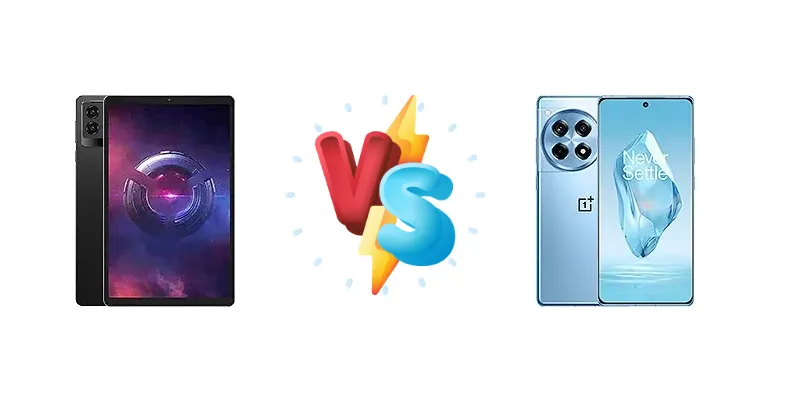
The Lenovo Legion Y700 (2025) and OnePlus 12R represent distinct approaches to the high-performance Android smartphone market. The Legion Y700 aims for sustained gaming sessions with a focus on battery longevity, while the OnePlus 12R prioritizes quick top-ups and a bright, vibrant display. This comparison dissects their core components to determine which device best suits your needs.
🏆 Quick Verdict
For the dedicated mobile gamer prioritizing uninterrupted playtime, the Lenovo Legion Y700 (2025) is the clear winner. Its exceptional 103:52h endurance and 1000 battery cycles significantly outweigh the OnePlus 12R’s faster 100W charging, especially for those frequently away from power outlets.
| Network |
|---|
| 2G bands | N/A | GSM 850 / 900 / 1800 / 1900 |
| 3G bands | N/A | HSDPA 850 / 900 / 1700(AWS) / 1900 / 2100 |
| 4G bands | N/A | 1, 2, 3, 4, 5, 7, 8, 12, 17, 18, 19, 20, 26, 28, 32, 38, 39, 40, 41, 66 |
| 5G bands | - | 1, 2, 3, 5, 7, 8, 12, 20, 28, 38, 40, 41, 66, 77, 78 SA/NSA |
| EDGE | No | - |
| GPRS | No | - |
| Speed | - | HSPA, LTE, 5G |
| Technology | No cellular connectivity | GSM / CDMA / HSPA / LTE / 5G |
| Launch |
|---|
| Announced | 2024, October 16 | 2024, January 23 |
| Status | Available. Released 2024, October | Available. Released 2024, February 06 |
| Body |
|---|
| Build | Glass front, aluminum frame, aluminum back | Glass front (Gorilla Glass Victus 2), aluminum frame, glass back |
| Dimensions | 208.5 x 129.5 x 7.8 mm (8.21 x 5.10 x 0.31 in) | 163.3 x 75.3 x 8.8 mm (6.43 x 2.96 x 0.35 in) |
| SIM | No | · Nano-SIM + Nano-SIM + eSIM (max 2 at a time)· Nano-SIM + Nano-SIM |
| Weight | 350 g (12.35 oz) | 207 g (7.30 oz) |
| Display |
|---|
| Protection | Mohs level 5 | Corning Gorilla Glass Victus 2 |
| Resolution | 1600 x 2560 pixels, 16:10 ratio (~343 ppi density) | 1264 x 2780 pixels (~450 ppi density) |
| Size | 8.8 inches, 224.5 cm2 (~83.2% screen-to-body ratio) | 6.78 inches, 111.7 cm2 (~90.9% screen-to-body ratio) |
| Type | IPS LCD, 165Hz, Dolby Vision, HDR10, 500 nits (typ), 900 nits (HBM) | LTPO4 AMOLED, 1B colors, 120Hz, HDR10+, Dolby Vision, 1600 nits (HBM), 4500 nits (peak) |
| Platform |
|---|
| CPU | Octa-core (1x3.3 GHz Cortex-X4 & 3x3.2 GHz Cortex-A720 & 2x3.0 GHz Cortex-A720 & 2x2.3 GHz Cortex-A520) | Octa-core (1x3.2 GHz Cortex-X3 & 2x2.8 GHz Cortex-A715 & 2x2.8 GHz Cortex-A710 & 3x2.0 GHz Cortex-A510) |
| Chipset | Qualcomm SM8650-AB Snapdragon 8 Gen 3 (4 nm) | Qualcomm SM8550-AB Snapdragon 8 Gen 2 (4 nm) |
| GPU | Adreno 750 | Adreno 740 |
| OS | Android 14, up to 3 major Android upgrades | Android 14, up to 3 major Android upgrades, OxygenOS 15 |
| Memory |
|---|
| Card slot | No | No |
| Internal | 256GB 12GB RAM, 512GB 16GB RAM | 128GB 8GB RAM, 256GB 8GB RAM, 256GB 12GB RAM, 256GB 16GB RAM |
| Main Camera |
|---|
| Dual | 13 MP, (wide)
2 MP (macro) | - |
| Features | LED flash | Laser AF, color spectrum sensor, LED flash, HDR, panorama |
| Triple | - | 50 MP, f/1.8, 24mm (wide), 1/1.56", 1.0µm, multi-directional PDAF, OIS
8 MP, f/2.2, 16mm, 112˚ (ultrawide), 1/4.0", 1.12µm
2 MP (macro) |
| Video | 1080p@30fps | 4K@30/60fps, 1080p@30/60/120/240fps, gyro-EIS, OIS |
| Selfie camera |
|---|
| Features | - | HDR, panorama |
| Single | 8 MP | 16 MP, f/2.4, 26mm (wide), 1/3", 1.0µm |
| Video | 1080p@30fps | 1080p@30fps, gyro-EIS |
| Sound |
|---|
| 35mm jack | No | No |
| Loudspeaker | Yes, with stereo speakers | Yes, with stereo speakers |
| Comms |
|---|
| Bluetooth | 5.4, A2DP, LE | 5.3, A2DP, LE, aptX HD |
| Infrared port | - | Yes |
| NFC | No | Yes |
| Positioning | No | GPS, GALILEO, GLONASS, BDS, QZSS |
| Radio | Unspecified | No |
| USB | 1x USB Type-C & 1x USB Type-C 3.1 Gen2, DisplayPort 1.4 | USB Type-C 2.0 |
| WLAN | Wi-Fi 802.11 a/b/g/n/ac/6/7, dual-band or tri-band, Wi-Fi Direct | Wi-Fi 802.11 a/b/g/n/ac/6/7, dual-band |
| Features |
|---|
| Sensors | Accelerometer, gyro, proximity, compass | Fingerprint (under display, optical), accelerometer, gyro, proximity, compass |
| Battery |
|---|
| Charging | 68W wired
Bypass charging | 100W wired, 100% in 26 min |
| Type | Li-Po 6550 mAh | Li-Ion 5500 mAh |
| Misc |
|---|
| Colors | Eclipse Black | Iron Gray, Cool Blue, Electric Violet, Sunset Dune |
| Models | TB321FU | CPH2609, CPH2585, CPH2611 |
| Price | $ 389.99 | € 410.84 / $ 399.95 / £ 649.00 |
| SAR | - | 1.19 W/kg (head) 0.82 W/kg (body) |
| EU LABEL |
|---|
| Battery | 103:52h endurance, 1000 cycles | - |
| Energy | Class D | - |
| Free fall | Class E (13 falls) | - |
| Repairability | Class B | - |
Lenovo Legion Y700 (2025)
- Exceptional battery life (103:52h)
- Long-term battery health (1000 cycles)
- Latest Snapdragon 8 Gen 3 chipset
- Display specs unknown
- Charging speed slower than OnePlus 12R
OnePlus 12R
- Very fast 100W charging (26 min to 100%)
- Bright display (1181 nits)
- Snapdragon 8 Gen 2 provides excellent performance
- Significantly shorter battery life (14:32h)
- Battery cycle life not specified
Display Comparison
The OnePlus 12R boasts a significantly brighter display, peaking at 1181 nits, making it ideal for outdoor visibility. While the Legion Y700’s display specs are not provided, the OnePlus 12R’s brightness advantage is substantial. The OnePlus 12R’s panel likely utilizes LTPO technology for variable refresh rates, contributing to power efficiency, though this isn't confirmed. The Legion Y700’s display characteristics remain unknown, but a gaming-focused device would likely prioritize refresh rate and response time.
Camera Comparison
Neither device is positioned as a camera-centric phone, but the OnePlus 12R likely offers a more versatile camera system. Without specific details on the Legion Y700’s camera, it’s reasonable to assume it prioritizes functionality over flagship-level image quality. The OnePlus 12R’s camera specs (not provided in context) are likely to include features like OIS and a larger main sensor, offering better low-light performance and image stabilization. The inclusion of a 2MP macro camera on the OnePlus 12R is a common, but often underutilized, feature.
Performance
The Lenovo Legion Y700 (2025) is powered by the Qualcomm SM8650-AB Snapdragon 8 Gen 3 (4nm), a generational leap over the OnePlus 12R’s Snapdragon 8 Gen 2 (4nm). The Gen 3 features a new CPU architecture with a 1x3.3 GHz Cortex-X4 prime core, promising improved single-core performance compared to the 1x3.2 GHz Cortex-X3 in the 12R. The Legion Y700’s CPU configuration (1+3+2+2) also suggests a more balanced approach to performance and efficiency. While both chipsets are fabricated on a 4nm process, the architectural improvements in the Gen 3 should translate to better sustained performance and potentially lower thermal throttling during extended gaming sessions.
Battery Life
The Lenovo Legion Y700 (2025) truly shines in battery endurance, achieving an astonishing 103:52h of use. This is dramatically longer than the OnePlus 12R’s 14:32h. While the OnePlus 12R compensates with 100W wired charging, reaching 100% in just 26 minutes, the Legion Y700’s longevity minimizes the need for frequent charging. Furthermore, the Legion Y700 boasts a 1000-cycle battery lifespan, indicating superior long-term battery health compared to the OnePlus 12R, which lacks this specification.
Buying Guide
Buy the Lenovo Legion Y700 (2025) if you need a phone that can withstand hours of demanding gaming without needing a recharge, and value long-term battery health. Buy the OnePlus 12R if you prefer a brighter display, faster charging speeds, and a more mainstream smartphone experience with less emphasis on dedicated gaming features.
Frequently Asked Questions
❓ Will the Snapdragon 8 Gen 3 in the Legion Y700 (2025) noticeably improve gaming performance compared to the 8 Gen 2 in the OnePlus 12R?
Yes, the Snapdragon 8 Gen 3 offers architectural improvements, particularly in the CPU and GPU, leading to higher frame rates and smoother gameplay in demanding titles. The new Cortex-X4 prime core and enhanced GPU architecture will provide a tangible performance boost, especially in sustained gaming scenarios.
❓ How does the 68W charging on the Legion Y700 (2025) compare to the 100W charging on the OnePlus 12R in real-world usage?
While 100W charging on the OnePlus 12R is significantly faster (0-100% in 26 minutes), the Legion Y700’s exceptional battery life means you’ll likely need to charge it less frequently. The slower charging speed is a trade-off for the dramatically increased endurance.
❓ Is the 1000 battery cycle lifespan of the Legion Y700 (2025) a significant advantage?
Absolutely. A 1000-cycle lifespan indicates the battery will retain a substantial portion of its capacity after being fully charged and discharged 1000 times. This translates to years of reliable performance and reduced battery degradation compared to phones without this specification.