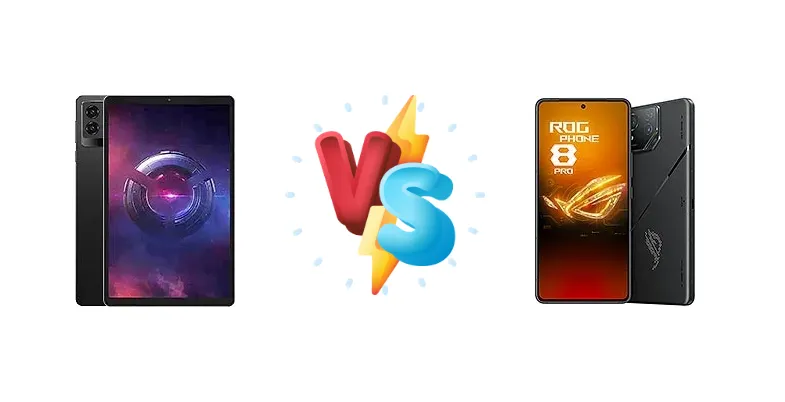
The Lenovo Legion Y700 (2025) and Asus ROG Phone 8 Pro represent two distinct approaches to the gaming smartphone. The Legion Y700 focuses on maximizing battery endurance for extended play sessions, while the ROG Phone 8 Pro prioritizes a premium display experience and feature-rich ecosystem. Both are powered by the Snapdragon 8 Gen 3, but their implementations differ significantly.
🏆 Quick Verdict
For the average gamer prioritizing uninterrupted playtime, the Lenovo Legion Y700 (2025) emerges as the winner. Its exceptional 103:52h endurance significantly outpaces the ROG Phone 8 Pro’s 14:43h active use score. While the ROG Phone 8 Pro boasts a brighter display, the Y700’s longevity is more crucial for dedicated mobile gamers.
| Network |
|---|
| 2G bands | N/A | GSM 850 / 900 / 1800 / 1900 |
| 3G bands | N/A | HSDPA 850 / 900 / 1700(AWS) / 1800 / 1900 / 2100 - International |
| 4G bands | N/A | 1, 2, 3, 4, 5, 7, 8, 12, 17, 18, 19, 20, 25, 26, 28, 32, 34, 38, 39, 40, 41, 42, 43, 48, 66 - International |
| 5G bands | - | 1, 2, 3, 5, 7, 8, 12, 18, 20, 25, 26, 28, 38, 40, 41, 48, 66, 77, 78, 79 SA/NSA/Sub6 - International |
| EDGE | No | - |
| GPRS | No | - |
| Speed | - | HSPA, LTE (Up to 7CA), 5G |
| Technology | No cellular connectivity | GSM / CDMA / HSPA / LTE / 5G |
| Launch |
|---|
| Announced | 2024, October 16 | 2024, January 08 |
| Status | Available. Released 2024, October | Available. Released 2024, January 18 |
| Body |
|---|
| Build | Glass front, aluminum frame, aluminum back | Glass front (Gorilla Glass Victus 2), glass back (Gorilla Glass), aluminum frame |
| Dimensions | 208.5 x 129.5 x 7.8 mm (8.21 x 5.10 x 0.31 in) | 163.8 x 76.8 x 8.9 mm (6.45 x 3.02 x 0.35 in) |
| SIM | No | Nano-SIM + Nano-SIM |
| Weight | 350 g (12.35 oz) | 225 g (7.94 oz) |
| Display |
|---|
| Protection | Mohs level 5 | Corning Gorilla Glass Victus 2 |
| Resolution | 1600 x 2560 pixels, 16:10 ratio (~343 ppi density) | 1080 x 2400 pixels, 20:9 ratio (~388 ppi density) |
| Size | 8.8 inches, 224.5 cm2 (~83.2% screen-to-body ratio) | 6.78 inches, 111.0 cm2 (~88.2% screen-to-body ratio) |
| Type | IPS LCD, 165Hz, Dolby Vision, HDR10, 500 nits (typ), 900 nits (HBM) | LTPO AMOLED, 1B colors, 165Hz, HDR10, 1600 nits (HBM), 2500 nits (peak) |
| Platform |
|---|
| CPU | Octa-core (1x3.3 GHz Cortex-X4 & 3x3.2 GHz Cortex-A720 & 2x3.0 GHz Cortex-A720 & 2x2.3 GHz Cortex-A520) | Octa-core (1x3.3 GHz Cortex-X4 & 3x3.2 GHz Cortex-A720 & 2x3.0 GHz Cortex-A720 & 2x2.3 GHz Cortex-A520) |
| Chipset | Qualcomm SM8650-AB Snapdragon 8 Gen 3 (4 nm) | Qualcomm SM8650-AB Snapdragon 8 Gen 3 (4 nm) |
| GPU | Adreno 750 | Adreno 750 |
| OS | Android 14, up to 3 major Android upgrades | Android 14, up to 2 major Android upgrades |
| Memory |
|---|
| Card slot | No | No |
| Internal | 256GB 12GB RAM, 512GB 16GB RAM | 512GB 16GB RAM, 1TB 24GB RAM |
| Main Camera |
|---|
| Dual | 13 MP, (wide)
2 MP (macro) | - |
| Features | LED flash | LED flash, HDR, panorama |
| Triple | - | 50 MP, f/1.9, 24mm (wide), 1/1.56", 1.0µm, PDAF, gimbal OIS
32 MP, f/2.4, (telephoto), 1/3.2", 0.7µm, PDAF, OIS, 3x optical zoom
13 MP, f/2.2, 13mm, 120˚ (ultrawide) |
| Video | 1080p@30fps | 8K@24fps, 4K@30/60fps, 1080p@30/60/120/240fps, 720p@480fps; gyro-EIS, HDR10+ |
| Selfie camera |
|---|
| Features | - | Panorama, HDR |
| Single | 8 MP | 32 MP, f/2.5, 22mm (wide), 1/3.2", 0.7µm |
| Video | 1080p@30fps | 1080p@30fps |
| Sound |
|---|
| 35mm jack | No | Yes |
| Loudspeaker | Yes, with stereo speakers | Yes, with stereo speakers |
| Comms |
|---|
| Bluetooth | 5.4, A2DP, LE | 5.4, A2DP, LE, aptX HD, aptX Adaptive, aptX Lossless |
| NFC | No | Yes |
| Positioning | No | GPS (L1+L5), BDS (B1I+B1c+B2a), GALILEO (E1+E5a), QZSS (L1+L5), NavIC (L5), GLONASS |
| Radio | Unspecified | No |
| USB | 1x USB Type-C & 1x USB Type-C 3.1 Gen2, DisplayPort 1.4 | USB Type-C (side), DisplayPort 1.4; USB Type-C (bottom), OTG |
| WLAN | Wi-Fi 802.11 a/b/g/n/ac/6/7, dual-band or tri-band, Wi-Fi Direct | Wi-Fi 802.11 a/b/g/n/ac/6e/7, tri-band, Wi-Fi Direct |
| Features |
|---|
| Sensors | Accelerometer, gyro, proximity, compass | Fingerprint (under display, optical), accelerometer, gyro, proximity, compass |
| Battery |
|---|
| Charging | 68W wired
Bypass charging | 65W wired, PD3.0, PPS, QC5, 100% in 39 min - International
30W wired, PD3.0, PPS - India
15W wireless (Qi)
10W reverse wired |
| Type | Li-Po 6550 mAh | 5500 mAh |
| Misc |
|---|
| Colors | Eclipse Black | Phantom Black |
| Models | TB321FU | AI2401, AI2401_A, AI2401_D |
| Price | $ 389.99 | $ 1,157.98 / £ 1,693.75 / € 632.66 |
| EU LABEL |
|---|
| Battery | 103:52h endurance, 1000 cycles | - |
| Energy | Class D | - |
| Free fall | Class E (13 falls) | - |
| Repairability | Class B | - |
Lenovo Legion Y700 (2025)
- Exceptional battery life (103:52h endurance)
- 1000 cycle battery lifespan for long-term health
- 68W fast wired charging with bypass charging
- Display specifications are unknown
- Camera details are missing
Asus ROG Phone 8 Pro
- Extremely bright display (1765 nits)
- Versatile charging options (wired, wireless, reverse)
- Potentially more refined camera system
- Significantly shorter battery life (14:43h)
- Wired charging speed varies by region (30W in India)
Display Comparison
The Asus ROG Phone 8 Pro immediately stands out with its measured peak brightness of 1765 nits, offering excellent visibility even in direct sunlight. While the Legion Y700’s display specifications are not provided, the ROG Phone’s panel likely utilizes LTPO technology for adaptive refresh rates, conserving battery life. The ROG Phone’s superior brightness is a clear advantage for outdoor gaming and media consumption, but comes at the cost of increased power draw. The Legion Y700’s focus on endurance suggests a potentially more power-efficient display panel, even if it doesn’t reach the same peak brightness.
Camera Comparison
The context data for the Legion Y700 lacks camera details, making a direct comparison difficult. The ROG Phone 8 Pro is listed as having a Photo/Video camera, but lacks specifics on sensor size, aperture, or OIS. Given the ROG Phone’s broader smartphone aspirations, it’s likely to offer a more versatile and capable camera system than the Legion Y700, which is primarily focused on gaming. However, without detailed specifications, it’s impossible to definitively assess the ROG Phone’s camera performance. We can assume the ROG Phone will have a more robust image processing pipeline.
Performance
Both devices are equipped with the Qualcomm SM8650-AB Snapdragon 8 Gen 3 (4 nm) chipset and an Octa-core CPU configuration (1x3.3 GHz Cortex-X4, 3x3.2 GHz Cortex-A720, 2x3.0 GHz Cortex-A720, 2x2.3 GHz Cortex-A520), ensuring comparable raw processing power. However, sustained performance will hinge on thermal management, a detail not provided for either device. The ROG Phone series historically employs advanced cooling solutions, potentially giving it an edge in prolonged, demanding gaming scenarios. Both devices likely utilize LPDDR5x RAM, but the specific speed and configuration could impact performance. The 4nm process node of the Snapdragon 8 Gen 3 contributes to improved thermal efficiency compared to previous generations, mitigating throttling.
Battery Life
The Lenovo Legion Y700 (2025) dominates in battery endurance with a remarkable 103:52h score, significantly exceeding the Asus ROG Phone 8 Pro’s 14:43h active use score. This difference is substantial and highlights the Y700’s core strength. The Y700 supports 68W wired charging with bypass charging, while the ROG Phone 8 Pro offers 65W wired (with varying speeds depending on region – 65W International, 30W India), 15W wireless, and 10W reverse wired charging. The ROG Phone’s charging versatility is a benefit, but the Y700’s longer runtime reduces the frequency of charging. The Y700 also boasts a 1000 cycle battery lifespan, suggesting greater long-term battery health.
Buying Guide
Buy the Lenovo Legion Y700 (2025) if you need a gaming phone that can last through multiple gaming sessions on a single charge, and value long-term battery health with its 1000 cycle rating. Buy the Asus ROG Phone 8 Pro if you prioritize a stunningly bright display with a peak of 1765 nits, and want a more versatile smartphone experience with features like wireless charging and potentially a more refined camera system (details pending further review).
Frequently Asked Questions
❓ Does the Legion Y700 (2025) support high refresh rate gaming, even with its focus on battery life?
While the Legion Y700 (2025) prioritizes endurance, the Snapdragon 8 Gen 3 chipset is fully capable of driving high refresh rate displays. It's likely the device dynamically adjusts the refresh rate to balance performance and battery consumption, offering a smooth gaming experience when needed.
❓ How does the regional charging speed difference (65W vs 30W) on the ROG Phone 8 Pro impact the user experience in India?
The 30W wired charging speed in India for the ROG Phone 8 Pro is significantly slower than the 65W available in other regions. This translates to a longer 0-100% charge time, potentially requiring overnight charging for full recovery, diminishing some of the convenience of fast charging.
❓ Is the lack of detailed camera specs on the Legion Y700 (2025) a major drawback for casual users?
If you frequently use your phone for photography, the lack of camera details on the Legion Y700 (2025) is a concern. However, if your primary focus is gaming, the camera is likely a secondary consideration, and the Y700 may suffice for basic snapshots.