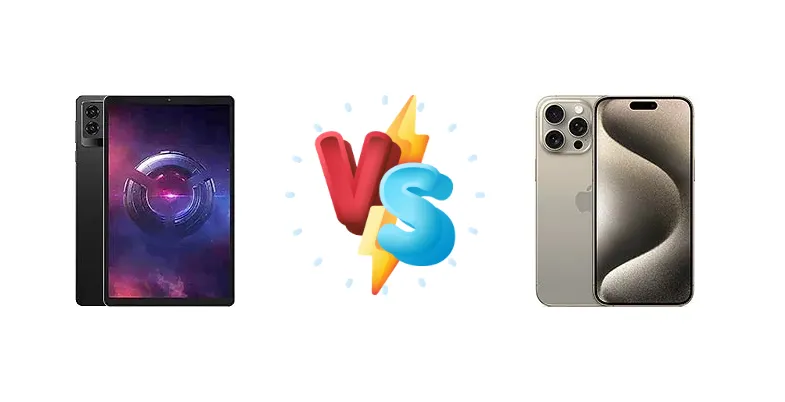
The Lenovo Legion Y700 (2025) represents a bold entry into the flagship Android space, prioritizing raw performance and battery longevity. This contrasts sharply with Apple’s iPhone 15 Pro Max, a device deeply entrenched in its ecosystem and renowned for its camera capabilities. This comparison isn’t about which phone is ‘better’ overall, but rather which aligns with distinct user priorities: uncompromised gaming and endurance versus a polished, integrated experience.
🏆 Quick Verdict
For the dedicated mobile gamer and power user, the Lenovo Legion Y700 (2025) is the clear winner. Its staggering 103:52h battery endurance and Snapdragon 8 Gen 3 chipset deliver unmatched longevity and performance. However, the iPhone 15 Pro Max remains the superior choice for users prioritizing camera quality, ecosystem integration, and a refined user experience.
| Network |
|---|
| 2G bands | N/A | GSM 850 / 900 / 1800 / 1900 |
| 3G bands | N/A | HSDPA 850 / 900 / 1700(AWS) / 1900 / 2100 |
| 4G bands | N/A | 1, 2, 3, 4, 5, 7, 8, 12, 13, 17, 18, 19, 20, 25, 26, 28, 30, 32, 34, 38, 39, 40, 41, 42, 46, 48, 53, 66 - A3106 |
| 5G bands | - | 1, 2, 3, 5, 7, 8, 12, 20, 25, 26, 28, 30, 38, 40, 41, 48, 53, 66, 70, 77, 78, 79 SA/NSA/Sub6 - A3106 |
| EDGE | No | - |
| GPRS | No | - |
| Speed | - | HSPA, LTE, 5G, EV-DO Rev.A 3.1 Mbps |
| Technology | No cellular connectivity | GSM / CDMA / HSPA / EVDO / LTE / 5G |
| Launch |
|---|
| Announced | 2024, October 16 | 2023, September 12 |
| Status | Available. Released 2024, October | Available. Released 2023, September 22 |
| Body |
|---|
| Build | Glass front, aluminum frame, aluminum back | Glass front, glass back, titanium frame (grade 5) |
| Dimensions | 208.5 x 129.5 x 7.8 mm (8.21 x 5.10 x 0.31 in) | 159.9 x 76.7 x 8.3 mm (6.30 x 3.02 x 0.33 in) |
| SIM | No | · Nano-SIM + eSIM + eSIM (max 2 at a time; International)· eSIM + eSIM (8 or more, max 2 at a time; USA)· Nano-SIM + Nano-SIM (China) |
| Weight | 350 g (12.35 oz) | 221 g (7.80 oz) |
| Display |
|---|
| Protection | Mohs level 5 | Ceramic Shield glass |
| Resolution | 1600 x 2560 pixels, 16:10 ratio (~343 ppi density) | 1290 x 2796 pixels, 19.5:9 ratio (~460 ppi density) |
| Size | 8.8 inches, 224.5 cm2 (~83.2% screen-to-body ratio) | 6.7 inches, 110.2 cm2 (~89.8% screen-to-body ratio) |
| Type | IPS LCD, 165Hz, Dolby Vision, HDR10, 500 nits (typ), 900 nits (HBM) | LTPO Super Retina XDR OLED, 120Hz, HDR10, Dolby Vision, 1000 nits (typ), 2000 nits (HBM) |
| Platform |
|---|
| CPU | Octa-core (1x3.3 GHz Cortex-X4 & 3x3.2 GHz Cortex-A720 & 2x3.0 GHz Cortex-A720 & 2x2.3 GHz Cortex-A520) | Hexa-core (2x3.78 GHz + 4x2.11 GHz) |
| Chipset | Qualcomm SM8650-AB Snapdragon 8 Gen 3 (4 nm) | Apple A17 Pro (3 nm) |
| GPU | Adreno 750 | Apple GPU (6-core graphics) |
| OS | Android 14, up to 3 major Android upgrades | iOS 17, upgradable to iOS 26.1 |
| Memory |
|---|
| Card slot | No | No |
| Internal | 256GB 12GB RAM, 512GB 16GB RAM | 256GB 8GB RAM, 512GB 8GB RAM, 1TB 8GB RAM |
| Main Camera |
|---|
| Dual | 13 MP, (wide)
2 MP (macro) | - |
| Features | LED flash | Dual-LED dual-tone flash, HDR (photo/panorama) |
| Triple | - | 48 MP, f/1.8, 24mm (wide), 1/1.28", 1.22µm, dual pixel PDAF, sensor-shift OIS
12 MP, f/2.8, 120mm (periscope telephoto), 1/3.06", 1.12µm, dual pixel PDAF, 3D sensor‑shift OIS, 5x optical zoom
12 MP, f/2.2, 13mm, 120˚ (ultrawide), 1/2.55", 1.4µm, dual pixel PDAF
TOF 3D LiDAR scanner (depth) |
| Video | 1080p@30fps | 4K@24/25/30/60fps, 1080p@25/30/60/120/240fps, 10-bit HDR, Dolby Vision HDR (up to 60fps), ProRes, 3D (spatial) video, stereo sound rec. |
| Selfie camera |
|---|
| Features | - | HDR, Dolby Vision HDR |
| Single | 8 MP | 12 MP, f/1.9, 23mm (wide), 1/3.6", 1.0µm, PDAF, OIS
SL 3D, (depth/biometrics sensor) |
| Video | 1080p@30fps | 4K@24/25/30/60fps, 1080p@25/30/60/120fps, gyro-EIS |
| Sound |
|---|
| 35mm jack | No | No |
| Loudspeaker | Yes, with stereo speakers | Yes, with stereo speakers |
| Comms |
|---|
| Bluetooth | 5.4, A2DP, LE | 5.3, A2DP, LE |
| NFC | No | Yes |
| Positioning | No | GPS (L1+L5), GLONASS, GALILEO, BDS, QZSS, NavIC |
| Radio | Unspecified | No |
| USB | 1x USB Type-C & 1x USB Type-C 3.1 Gen2, DisplayPort 1.4 | USB Type-C 3.2 Gen 2, DisplayPort |
| WLAN | Wi-Fi 802.11 a/b/g/n/ac/6/7, dual-band or tri-band, Wi-Fi Direct | Wi-Fi 802.11 a/b/g/n/ac/6e, tri-band, hotspot |
| Features |
|---|
| Sensors | Accelerometer, gyro, proximity, compass | Face ID, accelerometer, gyro, proximity, compass, barometer |
| Battery |
|---|
| Charging | 68W wired
Bypass charging | Wired, PD2.0, 50% in 30 min
15W wireless (MagSafe)
15W wireless (Qi2) - requires iOS 17.2 update
4.5W reverse wired |
| Type | Li-Po 6550 mAh | Li-Ion 4441 mAh |
| Misc |
|---|
| Colors | Eclipse Black | Black Titanium, White Titanium, Blue Titanium, Natural Titanium |
| Models | TB321FU | A2849, A3105, A3106, A3108, iPhone16,2 |
| Price | $ 389.99 | € 758.79 / $ 579.87 / £ 628.29 |
| SAR | - | 1.07 W/kg (head) 1.11 W/kg (body) |
| SAR EU | - | 0.98 W/kg (head) 0.98 W/kg (body) |
| EU LABEL |
|---|
| Battery | 103:52h endurance, 1000 cycles | - |
| Energy | Class D | - |
| Free fall | Class E (13 falls) | - |
| Repairability | Class B | - |
Lenovo Legion Y700 (2025)
- Unmatched battery life (103:52h endurance)
- Powerful Snapdragon 8 Gen 3 chipset
- 68W fast wired charging with bypass charging
- Camera details are unknown, potentially lagging behind iPhone
- Ecosystem integration is limited compared to Apple
Apple iPhone 15 Pro Max
- Exceptional camera quality (photo and video)
- Seamless Apple ecosystem integration
- Bright and color-accurate display (1787 nits)
- Significantly shorter battery life compared to Legion Y700
- Slower charging speeds (68W vs 50% in 30 min)
Display Comparison
The iPhone 15 Pro Max boasts a significantly brighter display, peaking at 1787 nits, offering superior visibility in direct sunlight. While the Legion Y700’s display specs are not provided, it’s likely to be tuned for color accuracy and refresh rate optimized for gaming. The iPhone’s LTPO technology dynamically adjusts the refresh rate, conserving battery, a feature likely present in the Legion Y700 as well, though its implementation details are unknown. The iPhone’s superior brightness is a clear advantage for outdoor use.
Camera Comparison
Apple consistently excels in mobile photography and videography, and the iPhone 15 Pro Max is no exception. While specific sensor details are missing, the iPhone’s image processing pipeline is renowned for its natural color reproduction and dynamic range. The Legion Y700’s camera capabilities are not detailed, but given its gaming focus, it’s likely optimized for fast capture and potentially computational photography features geared towards gaming content creation. The iPhone’s video recording capabilities are likely to surpass the Legion Y700’s, given Apple’s industry leadership in this area.
Performance
The core battleground lies in the chipsets. The iPhone 15 Pro Max’s Apple A17 Pro, fabricated on a 3nm process, promises exceptional efficiency and performance. However, the Lenovo Legion Y700 (2025) counters with the Qualcomm Snapdragon 8 Gen 3 (4nm). While the A17 Pro’s hexa-core configuration (2x3.78 GHz + 4x2.11 GHz) focuses on single-core speed, the Snapdragon 8 Gen 3’s octa-core setup (1x3.3 GHz Cortex-X4 & 3x3.2 GHz Cortex-A720 & 2x3.0 GHz Cortex-A720 & 2x2.3 GHz Cortex-A520) offers a broader range of processing capabilities. The 4nm node of the Snapdragon 8 Gen 3 should provide excellent thermal efficiency, potentially mitigating throttling during prolonged gaming. The Legion Y700’s likely larger thermal solution further supports sustained performance.
Battery Life
The Lenovo Legion Y700 (2025) dominates in battery endurance with a remarkable 103:52h rating. This is significantly longer than the iPhone 15 Pro Max’s 16:01h active use score and 118h endurance rating. The Legion Y700’s 68W wired charging with bypass charging allows for rapid replenishment, while the iPhone 15 Pro Max offers 50% charge in 30 minutes with wired PD2.0, 15W wireless charging (MagSafe/Qi2), and 4.5W reverse wired charging. The Legion Y700’s superior endurance is a game-changer for users who prioritize unplugged usage.
Buying Guide
Buy the Lenovo Legion Y700 (2025) if you need exceptional battery life for extended gaming sessions, demand the latest Snapdragon processing power, and prioritize raw performance over brand ecosystem. Buy the Apple iPhone 15 Pro Max if you prefer a seamless user experience, a best-in-class camera system, and are heavily invested in the Apple ecosystem, accepting a trade-off in battery endurance.
Frequently Asked Questions
❓ Does the Snapdragon 8 Gen 3 in the Legion Y700 (2025) throttle under sustained gaming loads?
The Snapdragon 8 Gen 3’s 4nm process and the Legion Y700’s likely robust thermal design should minimize throttling. While some performance degradation is inevitable during extended gaming sessions, the Legion Y700 is engineered to maintain higher clock speeds for longer periods compared to devices with less effective cooling solutions.
❓ How does the iPhone 15 Pro Max’s A17 Pro chip handle graphically demanding games?
The A17 Pro’s 3nm architecture and optimized GPU deliver exceptional gaming performance. Apple’s MetalFX Upscaling technology further enhances frame rates and visual fidelity in supported games. While the Legion Y700 may offer raw horsepower, the A17 Pro provides a highly optimized gaming experience within the iOS ecosystem.
❓ Is the 15W wireless charging on the iPhone 15 Pro Max significantly slower than the 68W wired charging on the Legion Y700?
Yes, the difference is substantial. 15W wireless charging is considerably slower than 68W wired charging. While convenient, wireless charging on the iPhone 15 Pro Max is best suited for overnight top-ups, whereas the Legion Y700 can achieve a significant charge in a much shorter timeframe.
❓ What is 'bypass charging' on the Lenovo Legion Y700 (2025) and why is it beneficial?
Bypass charging allows the device to be powered directly from the charger, bypassing the battery entirely. This reduces heat generation during gaming while charging, potentially extending battery lifespan and maintaining performance.