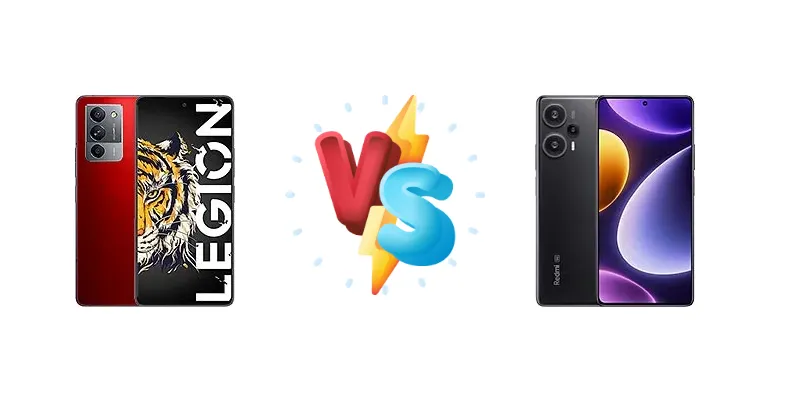
The Lenovo Legion Y70 and Xiaomi Redmi Note 12 Turbo are both compelling mid-range options, but cater to different needs. The Y70 aims for mobile gaming dominance, while the Turbo prioritizes value and everyday performance. Let's dive into a detailed comparison to see which phone comes out on top.
🏆 Quick Verdict
The Lenovo Legion Y70 boasts a significantly more powerful Snapdragon 8+ Gen 1, making it the clear winner for gaming. However, the Redmi Note 12 Turbo offers exceptional value with a capable Snapdragon 7+ Gen 2 and a sleek design, making it a strong contender for budget-conscious users.
| Network |
|---|
| 2G bands | GSM 850 / 900 / 1800 / 1900 | GSM 850 / 900 / 1800 / 1900 |
| 3G bands | HSDPA 800 / 850 / 900 / 1900 / 2100 | HSDPA 800 / 850 / 900 / 2100 |
| 4G bands | LTE | 1, 3, 5, 8, 19, 34, 38, 39, 40, 41, 42 |
| 5G bands | SA/NSA/Sub6 | 1, 3, 5, 8, 28, 38, 41, 77, 78 SA/NSA |
| Speed | HSPA, LTE, 5G | HSPA, LTE, 5G |
| Technology | GSM / CDMA / HSPA / CDMA2000 / LTE / 5G | GSM / HSPA / CDMA2000 / LTE / 5G |
| | CDMA2000 1x | CDMA2000 1x |
| Launch |
|---|
| Announced | 2022, August 18 | 2023, March 28 |
| Status | Available. Released 2022, August 23 | Available. Released 2023, March 28 |
| Body |
|---|
| Build | Glass front, aluminum frame | Glass front, plastic frame, plastic back |
| Dimensions | 163.6 x 77 x 8 mm (6.44 x 3.03 x 0.31 in) | 161.1 x 75 x 7.9 mm (6.34 x 2.95 x 0.31 in) |
| SIM | Nano-SIM + Nano-SIM | Nano-SIM + Nano-SIM |
| Weight | 209 g (7.37 oz) | 181 g (6.38 oz) |
| Display |
|---|
| Resolution | 1080 x 2400 pixels, 20:9 ratio (~395 ppi density) | 1080 x 2400 pixels, 20:9 ratio (~395 ppi density) |
| Size | 6.67 inches, 107.4 cm2 (~85.3% screen-to-body ratio) | 6.67 inches, 107.4 cm2 (~88.9% screen-to-body ratio) |
| Type | OLED, 144Hz, HDR10+, 1000 nits (peak) | OLED, 68B colors, 120Hz, Dolby Vision, HDR10+, 1000 nits (HBM) |
| Platform |
|---|
| CPU | Octa-core (1x3.19 GHz Cortex-X2 & 3x2.75 GHz Cortex-A710 & 4x1.80 GHz Cortex-A510) | Octa-core (1x2.91 GHz Cortex-X2 & 3x2.49 GHz Cortex-A710 & 4x1.8 GHz Cortex-A510) |
| Chipset | Qualcomm SM8475 Snapdragon 8+ Gen 1 (4 nm) | Qualcomm SM7475-AB Snapdragon 7+ Gen 2 (4 nm) |
| GPU | Adreno 730 | Adreno 725 |
| OS | Android 12, ZUI 14 | Android 13, MIUI 14 |
| Memory |
|---|
| Card slot | No | No |
| Internal | 128GB 8GB RAM, 256GB 12GB RAM, 512GB 16GB RAM | 256GB 8GB RAM, 256GB 12GB RAM, 256GB 16GB RAM, 512GB 12GB RAM, 1TB 16GB RAM |
| | UFS 3.1 | UFS 3.1 |
| Main Camera |
|---|
| Features | Dual-LED flash, panorama, HDR | LED flash, HDR, panorama |
| Triple | 50 MP, (wide), 1/1.55", 1.0µm, PDAF, OIS
13 MP, 120˚ (ultrawide), 1.12µm, AF
Auxiliary lens | 64 MP, f/1.8, (wide), 1/2.0", 0.7µm, PDAF, OIS
8 MP, f/2.2, 120˚ (ultrawide), 1/4.0", 1.12µm
2 MP (macro) |
| Video | 8K@30fps, 4K@30/60fps, 1080p@30/60/240fps, gyro-EIS | 4K@30fps, 1080p@30/60/120/240fps |
| Selfie camera |
|---|
| Single | 16 MP | 16 MP, f/2.5, (wide) |
| Video | Yes | 1080p@30/60fps |
| Sound |
|---|
| 3.5mm jack | No | Yes |
| 35mm jack | No | Yes |
| Loudspeaker | Yes, with stereo speakers | Yes, with stereo speakers |
| | - | 24-bit/192kHz audio |
| Comms |
|---|
| Bluetooth | 5.2, A2DP, LE | 5.3, A2DP, LE |
| Infrared port | - | Yes |
| NFC | Yes | Yes |
| Positioning | GPS (L1+L5), GLONASS, GALILEO, BDS, QZSS | GPS (L1), GLONASS (G1), BDS (B1I+B1c), GALILEO (E1), QZSS (L1) |
| Radio | No | No |
| USB | USB Type-C | USB Type-C 2.0, OTG |
| WLAN | Wi-Fi 802.11 a/b/g/n/ac/6, dual-band, Wi-Fi Direct | Wi-Fi 802.11 a/b/g/n/ac/6e, dual-band |
| Features |
|---|
| Sensors | Fingerprint (side-mounted), accelerometer, gyro, proximity, compass | Fingerprint (side-mounted), accelerometer, gyro, proximity, compass |
| Battery |
|---|
| Charging | 68W wired, 80% in 34 min | 67W wired, PD3.0, QC4 |
| Type | Li-Po 5100 mAh | Li-Po 5000 mAh |
| Misc |
|---|
| Colors | Black, Silver, Red | Black, Blue, White, Harry Potter Edition |
| Models | L71091 | 23049RAD8C |
| Price | About 440 EUR | About 270 EUR |
Lenovo Legion Y70
- Superior Performance (Snapdragon 8+ Gen 1)
- Excellent for Gaming
- Potentially Better Display
- Fast Charging (68W)
- Potentially Shorter Battery Life
- Higher Price
- May be Bulky
Xiaomi Redmi Note 12 Turbo
- Excellent Value for Money
- Smooth Performance for Everyday Use
- Fast Charging (67W)
- Sleek Design
- Less Powerful Processor
- Potentially Inferior Camera
- May Lack Advanced Gaming Features
Display Comparison
Both phones feature high refresh rate displays (likely 120Hz or higher, based on typical specs for these models) for smooth visuals. The Y70 likely has a slightly brighter panel and potentially better color accuracy due to its higher price point and gaming focus. The Turbo may prioritize power efficiency in its display.
Camera Comparison
While specific camera specs are missing, the Y70 likely has a more advanced camera system with better image processing capabilities, potentially including features like improved low-light performance and video stabilization. The Turbo will likely offer a competent camera setup suitable for casual photography.
Performance
The Snapdragon 8+ Gen 1 in the Y70 is a substantial upgrade over the Snapdragon 7+ Gen 2 in the Turbo. Expect significantly faster processing speeds, smoother gameplay, and better multitasking on the Y70. The Turbo still offers good performance for everyday tasks and moderate gaming.
Battery Life
Both phones offer fast charging (68W and 67W respectively). Battery capacity is likely similar (around 4500-5000mAh), but the Y70's more powerful processor will likely drain the battery faster under heavy load.
Buying Guide
The Lenovo Legion Y70 is ideal for gamers and power users who demand top-tier performance. The Xiaomi Redmi Note 12 Turbo is perfect for those seeking a well-rounded phone with excellent value, prioritizing everyday use and a smooth experience without breaking the bank.
Frequently Asked Questions
❓ Is the Lenovo Legion Y70 good for everyday use?
Yes, the Y70 is capable for everyday tasks, but its strengths lie in gaming and demanding applications. It might be overkill for basic users.
❓ Can the Redmi Note 12 Turbo handle demanding games?
It can handle many games, but you may need to lower graphics settings for optimal performance compared to the Y70.