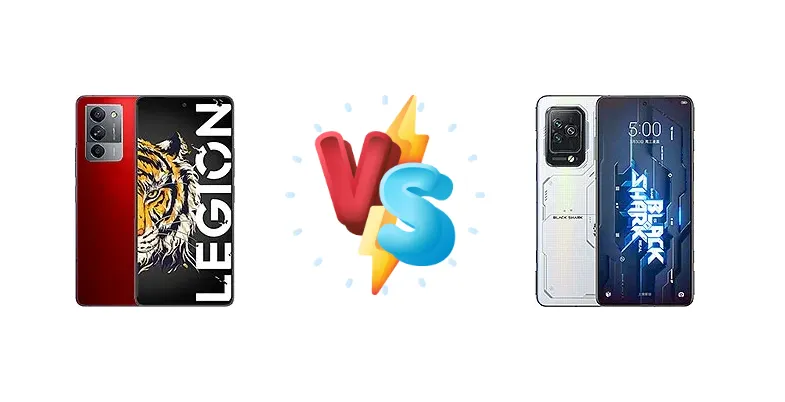
The Lenovo Legion Y70 and Xiaomi Black Shark 5 Pro represent two distinct approaches to the gaming smartphone. The Black Shark 5 Pro, while slightly older, boasts incredibly fast 120W charging, while the Legion Y70 leverages the newer, more efficient Snapdragon 8+ Gen 1. This comparison dissects these key differences and more, helping you determine which device best suits your gaming needs and lifestyle.
🏆 Quick Verdict
For most gamers, the Lenovo Legion Y70 emerges as the superior choice. Its Snapdragon 8+ Gen 1 chipset offers a performance edge and improved thermal efficiency over the Black Shark 5 Pro’s Snapdragon 8 Gen 1, translating to more sustained gaming sessions. While the Black Shark 5 Pro’s 120W charging is undeniably faster, the Y70’s overall package delivers a more balanced experience.
| Network |
|---|
| 2G bands | GSM 850 / 900 / 1800 / 1900 | GSM 850 / 900 / 1800 / 1900 |
| 3G bands | HSDPA 800 / 850 / 900 / 1900 / 2100 | HSDPA 800 / 850 / 900 / 1700(AWS) / 1900 / 2100 |
| 4G bands | LTE | 1, 2, 3, 4, 5, 7, 8, 12, 17, 18, 19, 26, 28, 34, 38, 39, 40, 41 |
| 5G bands | SA/NSA/Sub6 | 1, 3, 8, 28, 41, 77, 78, 79 SA/NSA |
| Speed | HSPA, LTE, 5G | HSPA, LTE, 5G |
| Technology | GSM / CDMA / HSPA / CDMA2000 / LTE / 5G | GSM / CDMA / HSPA / EVDO / LTE / 5G |
| | CDMA2000 1x | - |
| Launch |
|---|
| Announced | 2022, August 18 | 2022, March 30 |
| Status | Available. Released 2022, August 23 | Available. Released 2022, April 04 |
| Body |
|---|
| Build | Glass front, aluminum frame | - |
| Dimensions | 163.6 x 77 x 8 mm (6.44 x 3.03 x 0.31 in) | 163.9 x 76.5 x 9.5 mm (6.45 x 3.01 x 0.37 in) |
| SIM | Nano-SIM + Nano-SIM | Nano-SIM + Nano-SIM |
| Weight | 209 g (7.37 oz) | 220 g (7.76 oz) |
| Display |
|---|
| Resolution | 1080 x 2400 pixels, 20:9 ratio (~395 ppi density) | 1080 x 2400 pixels, 20:9 ratio (~395 ppi density) |
| Size | 6.67 inches, 107.4 cm2 (~85.3% screen-to-body ratio) | 6.67 inches, 107.4 cm2 (~85.7% screen-to-body ratio) |
| Type | OLED, 144Hz, HDR10+, 1000 nits (peak) | OLED, 1B colors, 144Hz, HDR10+ |
| Platform |
|---|
| CPU | Octa-core (1x3.19 GHz Cortex-X2 & 3x2.75 GHz Cortex-A710 & 4x1.80 GHz Cortex-A510) | Octa-core (1x3.00 GHz Cortex-X2 & 3x2.50 GHz Cortex-A710 & 4x1.80 GHz Cortex-A510) |
| Chipset | Qualcomm SM8475 Snapdragon 8+ Gen 1 (4 nm) | Qualcomm SM8450 Snapdragon 8 Gen 1 (4 nm) |
| GPU | Adreno 730 | Adreno 730 |
| OS | Android 12, ZUI 14 | Android 12, Joy UI 13 |
| Memory |
|---|
| Card slot | No | No |
| Internal | 128GB 8GB RAM, 256GB 12GB RAM, 512GB 16GB RAM | 128GB 8GB RAM, 256GB 8GB RAM, 256GB 12GB RAM, 512GB 16GB RAM |
| | UFS 3.1 | - |
| Main Camera |
|---|
| Features | Dual-LED flash, panorama, HDR | LED flash, HDR, panorama |
| Single | - | 16 MP, (wide), 1/3.06", 1.0µm |
| Triple | 50 MP, (wide), 1/1.55", 1.0µm, PDAF, OIS
13 MP, 120˚ (ultrawide), 1.12µm, AF
Auxiliary lens | 108 MP, f/1.8, (wide), 1/1.52", 0.7µm, PDAF
13 MP, f/2.4, 120˚ (ultrawide), 1/3.06", 1.12µm
5 MP, f/2.4, (telephoto macro), AF |
| Video | 8K@30fps, 4K@30/60fps, 1080p@30/60/240fps, gyro-EIS | 4K@30/60fps, 1080p@30/60/240fps, 1080p@960fps; HDR10+ |
| Selfie camera |
|---|
| Features | - | HDR |
| Single | 16 MP | 16 MP, (wide), 1/3.06", 1.0µm |
| Video | Yes | 1080p@30fps |
| Sound |
|---|
| 3.5mm jack | No | No |
| 35mm jack | No | No |
| Loudspeaker | Yes, with stereo speakers | Yes, with stereo speakers |
| Comms |
|---|
| Bluetooth | 5.2, A2DP, LE | 5.2, A2DP, LE, aptX HD, aptX Adaptive |
| NFC | Yes | Yes |
| Positioning | GPS (L1+L5), GLONASS, GALILEO, BDS, QZSS | GPS, GLONASS, GALILEO, QZSS, BDS |
| Radio | No | No |
| USB | USB Type-C | USB Type-C 2.0, video output |
| WLAN | Wi-Fi 802.11 a/b/g/n/ac/6, dual-band, Wi-Fi Direct | Wi-Fi 802.11 a/b/g/n/ac/6, dual-band, Wi-Fi Direct |
| Features |
|---|
| Sensors | Fingerprint (side-mounted), accelerometer, gyro, proximity, compass | Fingerprint (side-mounted), accelerometer, gyro, proximity, compass, barometer (China only) |
| Battery |
|---|
| Charging | 68W wired, 80% in 34 min | 120W wired, 100% in 15 min |
| Type | Li-Po 5100 mAh | Li-Po 4650 mAh |
| Misc |
|---|
| Colors | Black, Silver, Red | Black, White |
| Models | L71091 | SHARK KTUS-H0 |
| Price | About 440 EUR | About 720 EUR |
| Tests |
|---|
| Battery life | - |
Endurance rating 83h
|
| Camera | - |
Photo / Video |
| Display | - |
Contrast ratio: Infinite (nominal) |
| Performance | - |
AnTuTu: 876704 (v8), 1007133 (v9)
GeekBench: 3665 (v5.1)
GFXBench: 82fps (ES 3.1 onscreen) |
Lenovo Legion Y70
- More powerful Snapdragon 8+ Gen 1 chipset
- Improved thermal efficiency for sustained gaming
- Likely better long-term software support
- Slower charging speed (68W vs 120W)
- Limited display specifications available
Xiaomi Black Shark 5 Pro
- Ultra-fast 120W charging (0-100% in 15 minutes)
- High peak brightness (682 nits)
- Good battery endurance (83h)
- Snapdragon 8 Gen 1 prone to throttling
- Older chipset architecture
Display Comparison
Both devices feature displays suitable for gaming, but detailed specifications are limited for the Legion Y70. The Black Shark 5 Pro achieves a measured peak brightness of 682 nits, ensuring visibility even in bright conditions. While the Legion Y70’s display specs are unknown, its target market suggests a high refresh rate panel is likely. The Black Shark 5 Pro’s ‘Infinite’ contrast ratio (nominal) indicates a typical OLED panel, offering deep blacks. Without further data on the Legion Y70’s panel technology (LTPO, PWM dimming rate), it’s difficult to definitively declare a winner, but the Black Shark 5 Pro’s measured brightness provides a concrete advantage.
Camera Comparison
Both devices offer photo and video capabilities, but detailed camera specifications are sparse. Without sensor size, aperture, or image processing details, a meaningful comparison is challenging. The Black Shark 5 Pro’s camera system is likely geared towards general use, while the Legion Y70 may prioritize features relevant to content creation for gaming. The absence of specific details prevents a clear determination of which device offers superior image quality.
Performance
The Lenovo Legion Y70’s Snapdragon 8+ Gen 1 (4nm) represents a significant architectural improvement over the Xiaomi Black Shark 5 Pro’s Snapdragon 8 Gen 1 (4nm). The 8+ Gen 1 features a higher clocked Cortex-X2 prime core (3.19 GHz vs 3.00 GHz) and benefits from a more efficient manufacturing process. This translates to better thermal management and sustained performance under load. While both chipsets utilize the same core configuration for A710 and A510 cores, the 8+ Gen 1’s efficiency gains are crucial for extended gaming. The Legion Y70 is likely to exhibit less throttling during prolonged gaming sessions, providing a smoother experience.
Battery Life
The Xiaomi Black Shark 5 Pro’s 120W wired charging is its standout feature, achieving a full charge in just 15 minutes. The Lenovo Legion Y70’s 68W charging, while respectable, takes approximately 34 minutes to reach 80%. Both devices boast an endurance rating of 83 hours, suggesting similar battery capacity and overall efficiency despite the charging speed difference. The Black Shark 5 Pro’s faster charging is ideal for users who need a quick power boost, but the Legion Y70’s efficiency may result in comparable real-world battery life despite the slower charging speed.
Buying Guide
Buy the Lenovo Legion Y70 if you prioritize sustained gaming performance, efficient power usage, and a slightly newer chipset. It’s ideal for users who engage in long gaming sessions and want to minimize throttling. Buy the Xiaomi Black Shark 5 Pro if rapid charging is your absolute top priority and you frequently find yourself needing to top up your battery quickly, even if it means potentially sacrificing some sustained performance.
Frequently Asked Questions
❓ Will the Snapdragon 8 Gen 1 in the Black Shark 5 Pro overheat during extended gaming sessions?
The Snapdragon 8 Gen 1 is known to generate more heat than the 8+ Gen 1. While the Black Shark 5 Pro likely incorporates cooling solutions, prolonged gaming at high settings may lead to thermal throttling, reducing performance over time. The Legion Y70’s 8+ Gen 1 is less susceptible to this issue.
❓ How much of a real-world difference does the 120W charging make on the Black Shark 5 Pro?
The 120W charging is a game-changer for users who frequently need to quickly top up their battery. Going from 0% to 100% in just 15 minutes is significantly faster than the Legion Y70’s 68W charging, which takes around 34 minutes to reach 80%. This is ideal for those with limited downtime.
❓ Does the Lenovo Legion Y70 support high frame rates in popular games like PUBG Mobile or Genshin Impact?
Given its high-end chipset and gaming-focused design, the Legion Y70 is expected to support high frame rates (60fps or higher) in popular titles like PUBG Mobile and Genshin Impact. However, achieving maximum frame rates will depend on the game’s settings and the device’s thermal management.
❓ Is the difference in chipset performance between the Snapdragon 8+ Gen 1 and Snapdragon 8 Gen 1 noticeable in everyday use?
In everyday tasks like browsing, social media, and video playback, the difference between the two chipsets is minimal. However, the Snapdragon 8+ Gen 1’s advantages become apparent during demanding tasks like gaming, video editing, and multitasking, offering smoother performance and improved efficiency.