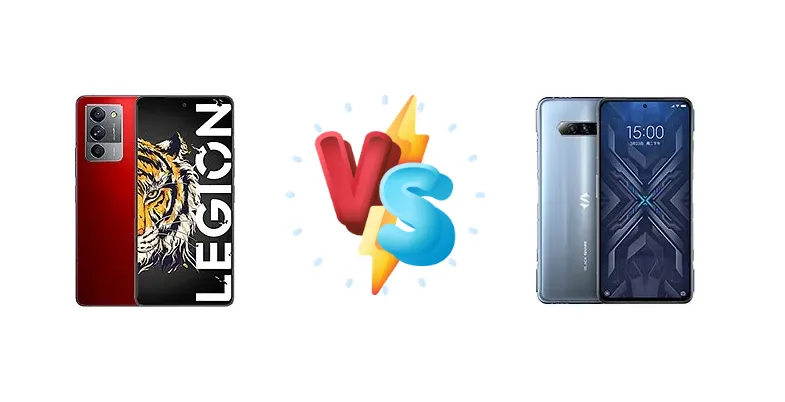
The mobile gaming scene is booming, and dedicated gaming phones are evolving rapidly. Today, we pit two contenders against each other: the Lenovo Legion Y70, boasting the Snapdragon 8+ Gen 1, and the Xiaomi Black Shark 4, known for its blazing-fast charging and endurance. Let's dive into a comprehensive comparison to see which phone emerges victorious.
🏆 Quick Verdict
The Lenovo Legion Y70 takes the performance crown with its newer Snapdragon 8+ Gen 1 chipset. However, the Black Shark 4’s 120W charging is unmatched, and its exceptional battery life remains a strong selling point. Ultimately, the Y70 is for raw power, while the Black Shark 4 prioritizes longevity and speed.
| Network |
|---|
| 2G bands | GSM 850 / 900 / 1800 / 1900 | GSM 850 / 900 / 1800 / 1900 |
| 3G bands | HSDPA 800 / 850 / 900 / 1900 / 2100 | HSDPA 800 / 850 / 900 / 1700(AWS) / 1900 / 2100 |
| 4G bands | LTE | 1, 2, 3, 4, 5, 7, 8, 18, 19, 20, 26, 28, 34, 38, 39, 40, 41 - International, China |
| 5G bands | SA/NSA/Sub6 | 1, 3, 8, 28, 41, 77, 78, 79 SA/NSA - China |
| Speed | HSPA, LTE, 5G | HSPA, LTE, 5G |
| Technology | GSM / CDMA / HSPA / CDMA2000 / LTE / 5G | GSM / CDMA / HSPA / EVDO / LTE / 5G |
| | CDMA2000 1x | CDMA2000 1xEV-DO |
| Launch |
|---|
| Announced | 2022, August 18 | 2021, March 23 |
| Status | Available. Released 2022, August 23 | Available. Released 2021, March 30 |
| Body |
|---|
| Build | Glass front, aluminum frame | - |
| Dimensions | 163.6 x 77 x 8 mm (6.44 x 3.03 x 0.31 in) | 163.8 x 76.4 x 9.9 mm (6.45 x 3.01 x 0.39 in) |
| SIM | Nano-SIM + Nano-SIM | Nano-SIM + Nano-SIM |
| Weight | 209 g (7.37 oz) | 210 g (7.41 oz) |
| | - | Physical pop-up gaming triggers |
| Display |
|---|
| Resolution | 1080 x 2400 pixels, 20:9 ratio (~395 ppi density) | 1080 x 2400 pixels, 20:9 ratio (~395 ppi density) |
| Size | 6.67 inches, 107.4 cm2 (~85.3% screen-to-body ratio) | 6.67 inches, 107.4 cm2 (~85.8% screen-to-body ratio) |
| Type | OLED, 144Hz, HDR10+, 1000 nits (peak) | Super AMOLED, 144Hz, HDR10+, 1300 nits (peak) |
| | - | Always-on display |
| Platform |
|---|
| CPU | Octa-core (1x3.19 GHz Cortex-X2 & 3x2.75 GHz Cortex-A710 & 4x1.80 GHz Cortex-A510) | Octa-core (1x3.2 GHz Kryo 585 & 3x2.42 GHz Kryo 585 & 4x1.80 GHz Kryo 585) |
| Chipset | Qualcomm SM8475 Snapdragon 8+ Gen 1 (4 nm) | Qualcomm SM8250-AC Snapdragon 870 5G (7 nm) |
| GPU | Adreno 730 | Adreno 650 |
| OS | Android 12, ZUI 14 | Android 11, Joy UI 12.5 |
| Memory |
|---|
| Card slot | No | No |
| Internal | 128GB 8GB RAM, 256GB 12GB RAM, 512GB 16GB RAM | 128GB 6GB RAM, 128GB 8GB RAM, 128GB 12GB RAM, 256GB 8GB RAM, 256GB 12GB RAM |
| | UFS 3.1 | UFS 3.1 |
| Main Camera |
|---|
| Features | Dual-LED flash, panorama, HDR | LED flash, HDR, panorama |
| Single | - | 20 MP, f/2.0, (wide), 0.8µm |
| Triple | 50 MP, (wide), 1/1.55", 1.0µm, PDAF, OIS
13 MP, 120˚ (ultrawide), 1.12µm, AF
Auxiliary lens | 48 MP, f/1.8, (wide), 1/2.0", 0.8µm, PDAF
8 MP, f/2.2, 120˚ (ultrawide), 1/4.0", 1.12µm
5 MP (macro), AF |
| Video | 8K@30fps, 4K@30/60fps, 1080p@30/60/240fps, gyro-EIS | 4K@30/60fps, 1080p@30/60/240fps, 1080p@960fps |
| Selfie camera |
|---|
| Features | - | HDR |
| Single | 16 MP | 20 MP, f/2.0, (wide), 0.8µm |
| Video | Yes | 1080p@30fps |
| Sound |
|---|
| 3.5mm jack | No | Yes |
| 35mm jack | No | Yes |
| Loudspeaker | Yes, with stereo speakers | Yes, with stereo speakers |
| | - | 24-bit/192kHz audio |
| Comms |
|---|
| Bluetooth | 5.2, A2DP, LE | 5.2, A2DP, LE, aptX HD, aptX Adaptive |
| NFC | Yes | Yes |
| Positioning | GPS (L1+L5), GLONASS, GALILEO, BDS, QZSS | GPS, GLONASS, GALILEO, QZSS, BDS |
| Radio | No | No |
| USB | USB Type-C | USB Type-C 2.0 |
| WLAN | Wi-Fi 802.11 a/b/g/n/ac/6, dual-band, Wi-Fi Direct | Wi-Fi 802.11 a/b/g/n/ac/6, dual-band, Wi-Fi Direct |
| Features |
|---|
| Sensors | Fingerprint (side-mounted), accelerometer, gyro, proximity, compass | Fingerprint (side-mounted), accelerometer, gyro, proximity, compass, barometer |
| Battery |
|---|
| Charging | 68W wired, 80% in 34 min | 120W wired, 100% in 17 min |
| Type | Li-Po 5100 mAh | Li-Po 4500 mAh |
| Misc |
|---|
| Colors | Black, Silver, Red | Mirror Black, Pale Grey, Black, Blue, Silver |
| Models | L71091 | SHARK PRS-H0, SHARK PRS-A0, SHARK KSR-A0 |
| Price | About 440 EUR | About 930 EUR |
| Tests |
|---|
| Battery life | - |
Endurance rating 96h
|
| Camera | - |
Photo / Video |
| Display | - |
Contrast ratio: Infinite (nominal) |
| Loudspeaker | - |
-27.4 LUFS (Good)
|
| Performance | - |
AnTuTu: 617456 (v8)
GeekBench: 3448 (v5.1)
GFXBench: 54fps (ES 3.1 onscreen) |
Lenovo Legion Y70
- Superior Performance (Snapdragon 8+ Gen 1)
- Potentially better camera processing
- Modern Chipset
- Shorter battery life compared to Black Shark 4
- Charging speed not as fast as Black Shark 4
- Brightness not explicitly stated
Xiaomi Black Shark 4
- Exceptional Battery Life (96h endurance)
- Blazing-Fast 120W Charging
- Good Display Brightness (694 nits)
- Older Snapdragon 870 chipset
- Potentially less refined software
- Camera performance likely average
Display Comparison
Both phones feature high refresh rate displays, crucial for smooth gaming. The Black Shark 4 boasts a measured 694 nits max brightness, offering good visibility outdoors. While the Legion Y70's brightness isn't explicitly stated, it's expected to be competitive. The Black Shark 4's 'infinite' contrast ratio is a marketing term, but suggests deep blacks. Overall, the Black Shark 4 has a slight edge in brightness.
Camera Comparison
Camera performance is generally secondary in gaming phones. Both devices offer 'Photo / Video' capabilities, but detailed camera specs and sample images are lacking. Expect decent, but not exceptional, camera quality from both phones. The Y70 likely has a slight edge due to the newer chipset's image processing capabilities.
Performance
The Lenovo Legion Y70's Snapdragon 8+ Gen 1 is significantly more powerful than the Black Shark 4's Snapdragon 870. This translates to faster frame rates in demanding games, smoother multitasking, and quicker app loading times. The Y70's newer architecture and fabrication process (4nm vs 7nm) provide a noticeable performance advantage.
Battery Life
The Black Shark 4 shines in this category. Its endurance rating of 96 hours is remarkable. While the Legion Y70's battery capacity is likely comparable, the Black Shark 4's optimization and larger battery contribute to its superior longevity. The Y70's 68W charging is fast, but the Black Shark 4's 120W charging is a game-changer, fully charging the phone in just 17 minutes.
Buying Guide
The Lenovo Legion Y70 is ideal for hardcore gamers who demand the absolute best performance and are willing to trade off some battery life. The Xiaomi Black Shark 4 is perfect for gamers who prioritize long-lasting battery, incredibly fast charging, and a more balanced overall experience.
Frequently Asked Questions
❓ Which phone is better for demanding games like Genshin Impact?
The Lenovo Legion Y70 is the clear winner for demanding games due to its significantly more powerful Snapdragon 8+ Gen 1 chipset.
❓ How long does it take to fully charge each phone?
The Xiaomi Black Shark 4 charges from 0% to 100% in approximately 17 minutes with its 120W charger, while the Lenovo Legion Y70 takes around 34 minutes with its 68W charger.