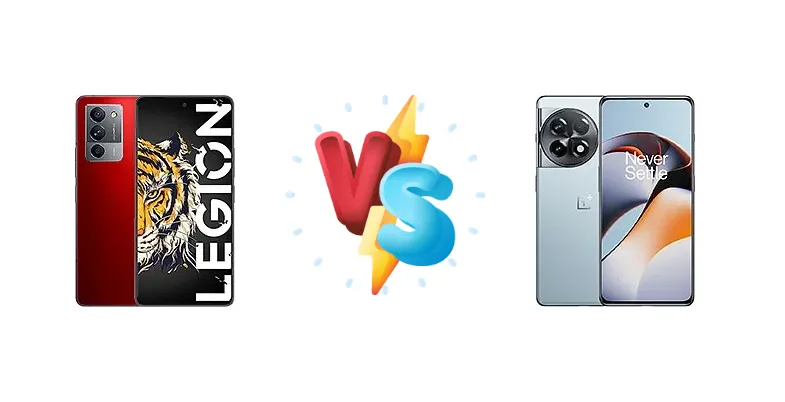
The Lenovo Legion Y70 and OnePlus 11R represent compelling options in the increasingly competitive sub-$500 smartphone market. Both leverage the proven Qualcomm Snapdragon 8+ Gen 1 chipset, but diverge in their approach to charging speed and subtle CPU clock speed variations, creating a fascinating head-to-head for performance-minded users.
🏆 Quick Verdict
For the average user prioritizing rapid replenishment, the OnePlus 11R takes the lead with its 100W charging. However, the Lenovo Legion Y70’s slightly higher CPU clock speed and gaming-focused branding make it the better choice for dedicated mobile gamers who value sustained performance.
| Network |
|---|
| 2G bands | GSM 850 / 900 / 1800 / 1900 | GSM 850 / 900 / 1800 / 1900 |
| 3G bands | HSDPA 800 / 850 / 900 / 1900 / 2100 | HSDPA 850 / 900 / 1700(AWS) / 2100 |
| 4G bands | LTE | 1, 3, 4, 5, 8, 28, 34, 38, 39, 40, 41 |
| 5G bands | SA/NSA/Sub6 | 1, 3, 5, 8, 28, 40, 41, 77, 78 SA/NSA |
| Speed | HSPA, LTE, 5G | HSPA, LTE (3CA), 5G |
| Technology | GSM / CDMA / HSPA / CDMA2000 / LTE / 5G | GSM / CDMA / HSPA / LTE / 5G |
| | CDMA2000 1x | CDMA 800 |
| Launch |
|---|
| Announced | 2022, August 18 | 2023, February 07 |
| Status | Available. Released 2022, August 23 | Available. Released 2023, February 21 |
| Body |
|---|
| Build | Glass front, aluminum frame | Glass front, glass back (Gorilla Glass 5), plastic frame |
| Dimensions | 163.6 x 77 x 8 mm (6.44 x 3.03 x 0.31 in) | 163.4 x 74.3 x 8.7 mm (6.43 x 2.93 x 0.34 in) |
| SIM | Nano-SIM + Nano-SIM | Nano-SIM + Nano-SIM |
| Weight | 209 g (7.37 oz) | 204 g (7.20 oz) |
| Display |
|---|
| Resolution | 1080 x 2400 pixels, 20:9 ratio (~395 ppi density) | 1240 x 2772 pixels, 20:9 ratio (~451 ppi density) |
| Size | 6.67 inches, 107.4 cm2 (~85.3% screen-to-body ratio) | 6.74 inches, 109.2 cm2 (~90.0% screen-to-body ratio) |
| Type | OLED, 144Hz, HDR10+, 1000 nits (peak) | Fluid AMOLED, 1B colors, 120Hz, HDR10+, 1450 nits (peak) |
| Platform |
|---|
| CPU | Octa-core (1x3.19 GHz Cortex-X2 & 3x2.75 GHz Cortex-A710 & 4x1.80 GHz Cortex-A510) | Octa-core (1x3.0 GHz Cortex-X2 & 3x2.5 GHz Cortex-A710 & 4x1.80 GHz Cortex-A510) |
| Chipset | Qualcomm SM8475 Snapdragon 8+ Gen 1 (4 nm) | Qualcomm SM8475 Snapdragon 8+ Gen 1 (4 nm) |
| GPU | Adreno 730 | Adreno 730 |
| OS | Android 12, ZUI 14 | Android 13, upgradable to Android 15, OxygenOS 15 |
| Memory |
|---|
| Card slot | No | No |
| Internal | 128GB 8GB RAM, 256GB 12GB RAM, 512GB 16GB RAM | 128GB 8GB RAM, 256GB 16GB RAM, 512GB 18GB RAM |
| | UFS 3.1 | UFS 3.1 |
| Main Camera |
|---|
| Features | Dual-LED flash, panorama, HDR | Color spectrum sensor, LED flash, HDR, panorama |
| Single | - | 16 MP, f/2.4, 24mm (wide), 1/3.09", 1.0µm |
| Triple | 50 MP, (wide), 1/1.55", 1.0µm, PDAF, OIS
13 MP, 120˚ (ultrawide), 1.12µm, AF
Auxiliary lens | 50 MP, f/1.8, 24mm (wide), 1/1.56", 1.0µm, multi-directional PDAF, OIS
8 MP, f/2.2, 120˚ (ultrawide), 1/4.0", 1.12µm
2 MP (macro) |
| Video | 8K@30fps, 4K@30/60fps, 1080p@30/60/240fps, gyro-EIS | 4K@30/60fps, 1080p@30/60/240fps, gyro-EIS |
| Selfie camera |
|---|
| Features | - | HDR |
| Single | 16 MP | 16 MP, f/2.4, 24mm (wide), 1/3.09", 1.0µm |
| Video | Yes | 1080p@30fps |
| Sound |
|---|
| 3.5mm jack | No | No |
| 35mm jack | No | No |
| Loudspeaker | Yes, with stereo speakers | Yes, with stereo speakers |
| | - | 24-bit/192kHz audio |
| Comms |
|---|
| Bluetooth | 5.2, A2DP, LE | 5.3, A2DP, LE, aptX HD |
| Infrared port | - | Yes |
| NFC | Yes | Yes |
| Positioning | GPS (L1+L5), GLONASS, GALILEO, BDS, QZSS | GPS (L1+L5), GLONASS (G1), BDS (B1I+B1c+B2a), GALILEO (E1+E5a), QZSS (L1+L5) |
| Radio | No | No |
| USB | USB Type-C | USB Type-C 2.0 |
| WLAN | Wi-Fi 802.11 a/b/g/n/ac/6, dual-band, Wi-Fi Direct | Wi-Fi 802.11 a/b/g/n/ac/6, dual-band |
| Features |
|---|
| Sensors | Fingerprint (side-mounted), accelerometer, gyro, proximity, compass | Fingerprint (under display, optical), accelerometer, gyro, proximity, compass |
| Battery |
|---|
| Charging | 68W wired, 80% in 34 min | 100W wired |
| Type | Li-Po 5100 mAh | Li-Po 5000 mAh |
| Misc |
|---|
| Colors | Black, Silver, Red | Galactic Silver, Sonic Black, Solar Red |
| Models | L71091 | CPH2487 |
| Price | About 440 EUR | About 600 EUR |
| SAR | - | 1.16 W/kg (head) 0.61 W/kg (body) |
Lenovo Legion Y70
- Slightly faster CPU clock speed (3.19 GHz)
- Potentially better thermal management due to gaming focus
- Gaming-centric branding suggests optimized software
- Slower charging speed (68W)
- Camera specs unknown, potential compromise
OnePlus 11R
- Significantly faster 100W charging
- Balanced performance and features
- Likely competitive price
- Slightly slower CPU clock speed (3.0 GHz)
- Potential for thermal throttling under sustained load
Display Comparison
While both devices likely feature high-refresh-rate AMOLED displays (data not provided), the specifics remain unknown. The absence of LTPO information suggests neither phone dynamically adjusts refresh rates for optimal power efficiency. Bezels and color accuracy will likely be comparable given the price bracket, but without detailed display testing, a definitive winner cannot be determined. The focus here is on the core performance differences.
Camera Comparison
Camera specifications are not provided, making a detailed comparison impossible. However, given the price point, both phones likely employ a multi-camera system with a primary sensor, ultrawide, and potentially a macro lens. Image processing styles will likely differ – OnePlus typically aims for vibrant, social media-ready images, while Lenovo might prioritize accuracy. Without sensor size, aperture, and OIS details, any assessment is speculative.
Performance
Both the Legion Y70 and OnePlus 11R are powered by the Qualcomm SM8475 Snapdragon 8+ Gen 1 (4 nm) chipset. However, the CPU configurations differ slightly. The Legion Y70 boasts a 3.19 GHz Cortex-X2 prime core, compared to the 11R’s 3.0 GHz Cortex-X2. While seemingly minor, this 190 MHz difference can translate to a measurable performance advantage in single-threaded tasks and potentially in game responsiveness. Both share the same 3x2.75 GHz Cortex-A710 and 4x1.80 GHz Cortex-A510 configuration. The 4nm process node ensures relatively efficient power consumption, but thermal management will be crucial for sustained performance. The Legion Y70’s branding suggests a more aggressive cooling solution, potentially mitigating throttling during prolonged gaming.
Battery Life
The OnePlus 11R’s 100W wired charging is a significant advantage, promising a full charge in a substantially shorter time than the Legion Y70’s 68W charging (80% in 34 minutes). While the Legion Y70’s battery capacity is unknown, the faster charging of the 11R will be more convenient for users who frequently need to quickly replenish their battery. The Snapdragon 8+ Gen 1’s efficiency helps mitigate battery drain, but the 11R’s charging speed provides a tangible benefit.
Buying Guide
Buy the Lenovo Legion Y70 if you need a phone specifically optimized for extended gaming sessions, prioritizing sustained CPU and GPU performance over absolute charging speed. Buy the OnePlus 11R if you prefer a more balanced experience with incredibly fast 100W charging, making it ideal for users who frequently need to top up their battery quickly and don't necessarily demand the absolute highest frame rates in demanding games.
Frequently Asked Questions
❓ Will the OnePlus 11R’s 100W charging degrade the battery faster over time?
While faster charging generates more heat, OnePlus employs battery health management algorithms to mitigate degradation. The 11R’s charging system is designed to intelligently manage charging speed, reducing the impact on long-term battery health. However, all batteries degrade over time with use, regardless of charging speed.
❓ Does the Lenovo Legion Y70 offer any gaming-specific features beyond the CPU clock speed?
Given Lenovo’s Legion branding, it’s likely the Y70 includes software optimizations for gaming, such as performance modes, game space, and potentially enhanced cooling profiles. Without detailed testing, the extent of these optimizations remains unknown, but they are a key differentiator for the Legion Y70.
❓ Is the difference in CPU clock speed between the two phones noticeable in real-world usage?
The 190 MHz difference in CPU clock speed is unlikely to be dramatically noticeable in everyday tasks. However, in CPU-intensive applications like video editing or demanding games, the Legion Y70’s slightly faster CPU may provide a marginal performance advantage. The impact will be most apparent in sustained workloads.