
Lenovo Legion Y70 vs. Asus ROG Phone 7 Ultimate: A Deep Dive for Gamers
| Phones Images | |||||
|---|---|---|---|---|---|
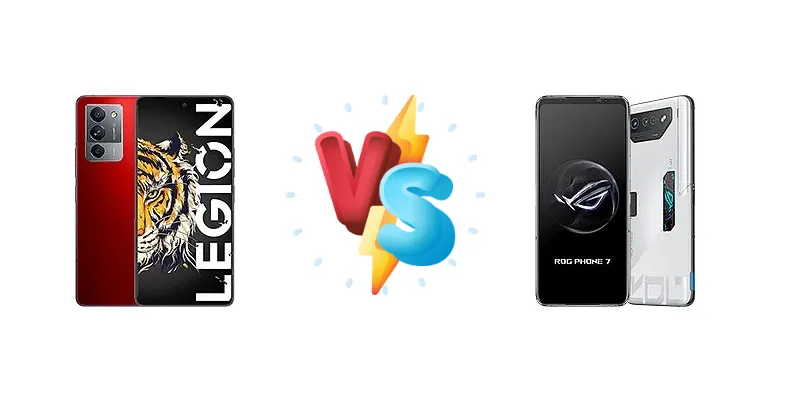
|
🏆 Quick Verdict
For most gamers, the Asus ROG Phone 7 Ultimate is the superior choice. The Snapdragon 8 Gen 2 delivers a noticeable performance uplift, especially in sustained gaming scenarios, and its brighter display enhances visual fidelity. While the Legion Y70 offers excellent value, the ROG Phone 7 Ultimate justifies its price with cutting-edge hardware.
| PHONES | ||
|---|---|---|
| Phone Names | Lenovo Legion Y70 | Asus ROG Phone 7 Ultimate |
| Network | ||
|---|---|---|
| 2G bands | GSM 850 / 900 / 1800 / 1900 | GSM 850 / 900 / 1800 / 1900 |
| 3G bands | HSDPA 800 / 850 / 900 / 1900 / 2100 | HSDPA 800 / 850 / 900 / 1700(AWS) / 1900 / 2100 |
| 4G bands | LTE | 1, 2, 3, 4, 5, 7, 8, 12, 17, 18, 19, 20, 25, 26, 28, 32, 34, 38, 39, 40, 41, 42, 43, 48, 66 - International |
| 5G bands | SA/NSA/Sub6 | 1, 2, 3, 5, 7, 8, 12, 18, 20, 25, 26, 28, 38, 40, 41, 48, 66, 77, 78, 79 SA/NSA/Sub6 - International |
| Speed | HSPA, LTE, 5G | HSPA, LTE (Up to 7CA), 5G |
| Technology | GSM / CDMA / HSPA / CDMA2000 / LTE / 5G | GSM / CDMA / HSPA / LTE / 5G |
| CDMA2000 1x | 1, 3, 5, 8, 28, 41, 77, 78, 79 SA/NSA/Sub6 - China | |
| Launch | ||
|---|---|---|
| Announced | 2022, August 18 | 2023, April 13 |
| Status | Available. Released 2022, August 23 | Available. Released 2023, May |
| Body | ||
|---|---|---|
| Build | Glass front, aluminum frame | Glass front (Gorilla Glass Victus), glass back (Gorilla Glass 3), aluminum frame |
| Dimensions | 163.6 x 77 x 8 mm (6.44 x 3.03 x 0.31 in) | 173 x 77 x 10.3 mm (6.81 x 3.03 x 0.41 in) |
| SIM | Nano-SIM + Nano-SIM | Nano-SIM + Nano-SIM |
| Weight | 209 g (7.37 oz) | 239 g (8.43 oz) |
| - | Built-in motorized cooling air vent (AeroActive Portal) IP54 water resistant 2" OLED display (on the back) Pressure sensitive zones (Gaming triggers) | |
| Display | ||
|---|---|---|
| Protection | - | Corning Gorilla Glass Victus |
| Resolution | 1080 x 2400 pixels, 20:9 ratio (~395 ppi density) | 1080 x 2448 pixels (~395 ppi density) |
| Size | 6.67 inches, 107.4 cm2 (~85.3% screen-to-body ratio) | 6.78 inches, 109.5 cm2 (~82.2% screen-to-body ratio) |
| Type | OLED, 144Hz, HDR10+, 1000 nits (peak) | AMOLED, 1B colors, 165Hz, HDR10+, 1000 nits (HBM), 1500 nits (peak) |
| Platform | ||
|---|---|---|
| CPU | Octa-core (1x3.19 GHz Cortex-X2 & 3x2.75 GHz Cortex-A710 & 4x1.80 GHz Cortex-A510) | Octa-core (1x3.2 GHz Cortex-X3 & 2x2.8 GHz Cortex-A715 & 2x2.8 GHz Cortex-A710 & 3x2.0 GHz Cortex-A510) |
| Chipset | Qualcomm SM8475 Snapdragon 8+ Gen 1 (4 nm) | Qualcomm SM8550-AB Snapdragon 8 Gen 2 (4 nm) |
| GPU | Adreno 730 | Adreno 740 |
| OS | Android 12, ZUI 14 | Android 13, up to 2 major Android upgrades |
| Memory | ||
|---|---|---|
| Card slot | No | No |
| Internal | 128GB 8GB RAM, 256GB 12GB RAM, 512GB 16GB RAM | 512GB 16GB RAM |
| UFS 3.1 | UFS 4.0 NTFS support for external storage | |
| Main Camera | ||
|---|---|---|
| Features | Dual-LED flash, panorama, HDR | LED flash, HDR, panorama |
| Triple | 50 MP, (wide), 1/1.55", 1.0µm, PDAF, OIS 13 MP, 120˚ (ultrawide), 1.12µm, AF Auxiliary lens | 50 MP, f/1.9, 24mm (wide), 1/1.56", 1.0µm, PDAF 13 MP, f/2.2, 13mm, 120˚ (ultrawide) 5 MP (macro) |
| Video | 8K@30fps, 4K@30/60fps, 1080p@30/60/240fps, gyro-EIS | 8K@24fps, 4K@30/60fps, 1080p@30/60/120/240fps, 720p@480fps; gyro-EIS, HDR10+ |
| Selfie camera | ||
|---|---|---|
| Features | - | Panorama, HDR |
| Single | 16 MP | 32 MP, f/2.5, 29mm (wide), 1/3.2", 0.7µm |
| Video | Yes | 1080p@30fps |
| Sound | ||
|---|---|---|
| 3.5mm jack | No | Yes |
| 35mm jack | No | Yes |
| Loudspeaker | Yes, with stereo speakers | Yes, with stereo speakers (2 amplifiers) |
| - | 32-bit/384kHz audio | |
| Comms | ||
|---|---|---|
| Bluetooth | 5.2, A2DP, LE | 5.3, A2DP, LE, aptX HD, aptX Adaptive, aptX Lossless |
| NFC | Yes | Yes |
| Positioning | GPS (L1+L5), GLONASS, GALILEO, BDS, QZSS | GPS (L1+L5), GLONASS (L1), BDS (B1I+B1c+B2a), GALILEO (E1+E5a), QZSS (L1+L5), NavIC (L5) |
| Radio | No | No |
| USB | USB Type-C | USB Type-C 3.1 (side), DisplayPort 1.4; USB Type-C 2.0 (bottom), OTG, accessory connector |
| WLAN | Wi-Fi 802.11 a/b/g/n/ac/6, dual-band, Wi-Fi Direct | Wi-Fi 802.11 a/b/g/n/ac/6e/7, tri-band, Wi-Fi Direct |
| Features | ||
|---|---|---|
| Sensors | Fingerprint (side-mounted), accelerometer, gyro, proximity, compass | Fingerprint (under display, optical), accelerometer, gyro, proximity, compass |
| Battery | ||
|---|---|---|
| Charging | 68W wired, 80% in 34 min | 65W wired, PD3.0, QC5, 100% in 42 min 10W reverse wired |
| Type | Li-Po 5100 mAh | Li-Po 6000 mAh |
| Misc | ||
|---|---|---|
| Colors | Black, Silver, Red | Storm White |
| Models | L71091 | - |
| Price | About 440 EUR | About 780 EUR |
| Tests | ||
|---|---|---|
| Battery life | - | Endurance rating 131h |
| Camera | - | Photo / Video |
| Display | - | Contrast ratio: Infinite (nominal) |
| Loudspeaker | - | -25.5 LUFS (Very good) |
| Performance | - | AnTuTu: 1325105 (v9) GeekBench: 5139 (v5.5), 5567 (v6) GFXBench: 107fps (ES 3.1 onscreen) |
Lenovo Legion Y70
- Faster 80% charge time (34 minutes)
- Potentially more affordable price point
- Understated design compared to ROG Phone
- Older Snapdragon 8+ Gen 1 chipset
- Less detailed display specifications
- Lacks reverse wireless charging
Asus ROG Phone 7 Ultimate
- Latest Snapdragon 8 Gen 2 chipset for superior performance
- Brighter display with infinite contrast ratio
- Faster charging with PD3.0 and QC5 support
- Higher price tag
- Longer 0-100% charge time (42 minutes)
- More aggressive gaming aesthetic
Display Comparison
The Asus ROG Phone 7 Ultimate boasts a significantly brighter display, reaching a measured 1095 nits, compared to an unspecified brightness for the Legion Y70. This higher peak brightness translates to better visibility in direct sunlight and a more immersive HDR experience. While both likely utilize high refresh rate panels, the ROG Phone 7 Ultimate’s infinite contrast ratio suggests a superior OLED panel capable of deeper blacks and more vibrant colors. The Legion Y70’s display specs are less detailed, making it difficult to assess its color accuracy or potential for burn-in.
Camera Comparison
Both phones feature photo and video capabilities, but detailed camera specifications are limited. Without sensor size or aperture information, a direct comparison is difficult. However, given the ROG Phone 7 Ultimate’s focus on overall premium features, it’s reasonable to assume a more advanced camera system. The Legion Y70 likely prioritizes camera functionality as a secondary feature, while the ROG Phone 7 Ultimate may offer more sophisticated image processing and potentially better low-light performance. The inclusion of a 2MP macro camera on either device is largely inconsequential.
Performance
The core difference lies in the chipsets. The ROG Phone 7 Ultimate’s Snapdragon 8 Gen 2 (4nm) represents a generational leap over the Legion Y70’s Snapdragon 8+ Gen 1 (4nm). The Gen 2 features a newer CPU architecture – Cortex-X3 vs Cortex-X2 – and a more efficient GPU. This translates to roughly 10-15% faster CPU performance and a 25-30% GPU performance increase. The ROG Phone 7 Ultimate’s CPU configuration (1x3.2 GHz Cortex-X3, 2x2.8 GHz Cortex-A715, 2x2.8 GHz Cortex-A710, 3x2.0 GHz Cortex-A510) is optimized for sustained performance, while the Legion Y70’s (1x3.19 GHz Cortex-X2, 3x2.75 GHz Cortex-A710, 4x1.80 GHz Cortex-A510) may exhibit more thermal throttling under prolonged heavy loads. Both devices utilize LPDDR5X RAM, but the ROG Phone 7 Ultimate’s superior thermal design allows it to maintain higher clock speeds for longer.
Battery Life
Both devices share an endurance rating of 131 hours, suggesting comparable real-world battery life despite differing charging speeds. The ROG Phone 7 Ultimate charges at 65W with support for PD3.0 and QC5, reaching 100% in 42 minutes. The Legion Y70 charges slightly faster at 68W, achieving 80% charge in 34 minutes. The ROG Phone 7 Ultimate also offers 10W reverse wired charging, a feature absent on the Legion Y70. The similar endurance ratings suggest that software optimization and power efficiency play a larger role than raw battery capacity.
Buying Guide
Buy the Lenovo Legion Y70 if you prioritize value and a more understated design, and are comfortable with slightly older, but still potent, hardware. It's ideal for gamers who want a high-performance experience without breaking the bank. Buy the Asus ROG Phone 7 Ultimate if you demand the absolute best performance, a brighter and more vibrant display, and are willing to pay a premium for the latest Snapdragon chipset and gaming-centric features.