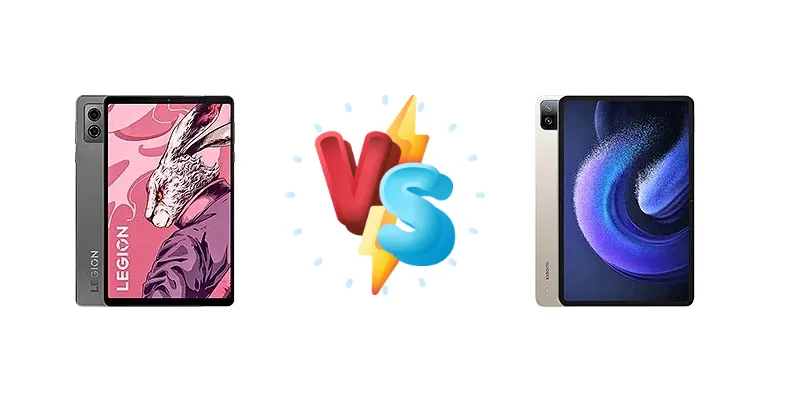
The Android tablet market is heating up, and two contenders – the Lenovo Legion Tab and the Xiaomi Pad 6 Pro – are vying for the gaming crown. Both devices center around the powerful Snapdragon 8+ Gen 1, but diverge in charging speeds and potentially, software tuning. This comparison dissects the nuances to determine which tablet delivers the best experience for demanding users.
🏆 Quick Verdict
For the average user prioritizing rapid replenishment, the Xiaomi Pad 6 Pro is the better choice. Its 67W charging significantly reduces downtime compared to the Legion Tab’s 45W, and while performance is nearly identical, Xiaomi’s software optimizations may provide a slight edge in sustained gaming.
| Network |
|---|
| 2G bands | N/A | N/A |
| 3G bands | N/A | N/A |
| 4G bands | N/A | - |
| EDGE | No | N/A |
| GPRS | No | N/A |
| Technology | No cellular connectivity | No cellular connectivity |
| Launch |
|---|
| Announced | 2024, August 13 | 2023, April 18 |
| Status | Available. Released 2024, August 15 | Available. Released 2023, April 30 |
| Body |
|---|
| Build | - | Glass front (Gorilla Glass 3), aluminum frame, aluminum back |
| Dimensions | 208.5 x 129.5 x 7.6 mm (8.21 x 5.10 x 0.30 in) | 254 x 165.2 x 6.5 mm (10.0 x 6.50 x 0.26 in) |
| SIM | No | No |
| Weight | 350 g (12.35 oz) | 490 g (1.08 lb) |
| | - | Stylus support (magnetic) |
| Display |
|---|
| Protection | - | Corning Gorilla Glass 3 |
| Resolution | 1600 x 2560 pixels, 16:10 ratio (~343 ppi density) | 1800 x 2880 pixels, 16:10 ratio (~309 ppi density) |
| Size | 8.8 inches, 224.5 cm2 (~83.2% screen-to-body ratio) | 11.0 inches, 350.9 cm2 (~83.6% screen-to-body ratio) |
| Type | IPS LCD, 144Hz, Dolby Vision, HDR10, 500 nits (typ) | IPS LCD, 1B colors, 144Hz, HDR10, Dolby Vision, 550 nits |
| Platform |
|---|
| CPU | Octa-core (1x3.19 GHz Cortex-X2 & 3x2.75 GHz Cortex-A710 & 4x1.80 GHz Cortex-A510) | Octa-core (1x3.19 GHz Cortex-X2 & 3x2.75 GHz Cortex-A710 & 4x1.80 GHz Cortex-A510) |
| Chipset | Qualcomm SM8475P Snapdragon 8+ Gen 1 (4 nm) | Qualcomm SM8475 Snapdragon 8+ Gen 1 (4 nm) |
| GPU | Adreno 730 | Adreno 730 |
| OS | Android 13 | Android 13, MIUI 14 |
| Memory |
|---|
| Card slot | microSDXC (dedicated slot) | No |
| Internal | 256GB 12GB RAM | 128GB 8GB RAM, 256GB 8GB RAM, 256GB 12GB RAM, 512GB 12GB RAM |
| | - | UFS 3.1 |
| Main Camera |
|---|
| Dual | 13 MP, (wide)
2 MP (macro) | 50 MP, f/1.8, (wide), 1/2.76", 0.64µm, PDAF
Auxiliary lens |
| Features | LED flash | Dual-LED flash, HDR, panorama |
| Video | 1080p@30fps | 4K@30/60fps, 1080p@30/60fps |
| Selfie camera |
|---|
| Single | 8 MP | 20 MP, f/2.2, (wide), 1/3.4", 0.8µm |
| Video | 1080p@30fps | 1080p@30/60fps |
| Sound |
|---|
| 3.5mm jack | - | No |
| 35mm jack | No | No |
| Loudspeaker | Yes, with stereo speakers | Yes, with stereo speakers (4 speakers) |
| | - | 24-bit/192kHz audio |
| Comms |
|---|
| Bluetooth | 5.3, A2DP, LE | 5.3, A2DP, LE |
| NFC | No | No |
| Positioning | No | No |
| Radio | Unspecified | No |
| USB | 2x USB Type-C 3.1 Gen2, DisplayPort 1.4 | USB Type-C 3.2, accessory connector |
| WLAN | Wi-Fi 802.11 a/b/g/n/ac/6e, dual-band, Wi-Fi Direct | Wi-Fi 802.11 a/b/g/n/a/6e, dual-band, Wi-Fi Direct |
| Features |
|---|
| Sensors | Accelerometer, gyro, proximity, compass | Accelerometer, gyro, proximity (accessories only) |
| Battery |
|---|
| Charging | 45W wired | 67W wired, PD3.0, QC4, 100% in 1 hour |
| Type | Li-Po 6550 mAh | Li-Po 8600 mAh |
| Misc |
|---|
| Colors | Storm Grey | Black, Blue, Gold |
| Models | ZACW0029IN | 23046RP50C |
| Price | About 380 EUR | About 330 EUR |
Lenovo Legion Tab
- Potentially optimized gaming software experience.
- Reputable brand in the gaming space.
- Solid Snapdragon 8+ Gen 1 performance.
- Slower 45W charging.
- Battery capacity unknown, potentially smaller.
- Display specs currently unknown.
Xiaomi Pad 6 Pro
- Significantly faster 67W charging with PD3.0/QC4.
- Potential for software optimizations for sustained performance.
- Quick 1-hour full charge time.
- Software experience may not be as gaming-focused as Lenovo.
- Camera performance likely similar to Legion Tab.
- Display specs currently unknown.
Display Comparison
Both tablets utilize panels built on a 4nm process, but detailed display specs (resolution, refresh rate, panel type) are missing. However, given the target audience, we can assume both feature high refresh rate LCDs. The absence of LTPO technology in either device suggests a trade-off between cost and variable refresh rate efficiency. Bezels are likely similar, focusing on maximizing screen real estate for immersive gaming. Color accuracy will be a key differentiator, and independent testing will be needed to determine which panel offers superior color reproduction.
Camera Comparison
Camera performance is unlikely to be a primary concern for buyers in this segment, but it's worth noting. Without specific sensor details, it’s difficult to make a definitive comparison. Both manufacturers likely prioritize cost-effectiveness in this area. Expect competent, but not class-leading, camera systems suitable for casual snapshots and video calls. The inclusion of OIS (Optical Image Stabilization) on either device would be a significant advantage, but is unconfirmed.
Performance
At the heart of both the Lenovo Legion Tab and the Xiaomi Pad 6 Pro lies the Qualcomm SM8475 Snapdragon 8+ Gen 1 (4nm). The CPU configuration – Octa-core (1x3.19 GHz Cortex-X2 & 3x2.75 GHz Cortex-A710 & 4x1.80 GHz Cortex-A510) – is identical, meaning raw processing power will be virtually indistinguishable. The real-world performance difference will hinge on thermal management and sustained clock speeds. While both utilize the same chipset, Xiaomi’s software optimizations and potentially more aggressive cooling solutions could allow it to maintain peak performance for longer durations during extended gaming sessions. RAM configurations (LPDDR5x speed) are currently unknown, but faster RAM would benefit multitasking and game loading times.
Battery Life
The Xiaomi Pad 6 Pro’s 67W wired charging is a clear advantage over the Lenovo Legion Tab’s 45W. This translates to a significantly faster 0-100% charge time – Xiaomi claims 1 hour, while the Legion Tab will likely take considerably longer. While battery capacity (mAh) is unknown for both devices, the faster charging speed of the Pad 6 Pro mitigates the impact of a potentially smaller battery. The inclusion of PD3.0 and QC4 support on the Xiaomi Pad 6 Pro further enhances its charging versatility.
Buying Guide
Buy the Lenovo Legion Tab if you prioritize a potentially more refined software experience tailored for gaming, and aren't overly concerned with the fastest possible charging. Buy the Xiaomi Pad 6 Pro if you value speed and convenience, needing to get back into your games as quickly as possible, and appreciate the benefits of faster charging technology. Both are excellent choices for media consumption and productivity, but their strengths lie in different areas.
Frequently Asked Questions
❓ Will the Snapdragon 8+ Gen 1 in either tablet struggle with demanding games like Genshin Impact at max settings?
The Snapdragon 8+ Gen 1 is a powerful chipset, but sustained performance will depend on thermal management. Both tablets should be capable of running Genshin Impact at high settings, but expect some throttling during extended gaming sessions. Xiaomi’s potential software optimizations may help mitigate this.
❓ Does the faster charging on the Xiaomi Pad 6 Pro impact battery health over the long term?
While faster charging can theoretically contribute to slightly faster battery degradation, modern charging algorithms and battery management systems minimize this effect. The convenience of a quick charge is likely to outweigh any minor long-term impact on battery health.
❓ Are there any known issues with overheating on either the Lenovo Legion Tab or the Xiaomi Pad 6 Pro during prolonged gaming?
Currently, there are no widespread reports of overheating issues. However, as with any powerful device, sustained high loads will generate heat. Thermal throttling is expected, and the effectiveness of each tablet’s cooling solution will determine how much performance is impacted.