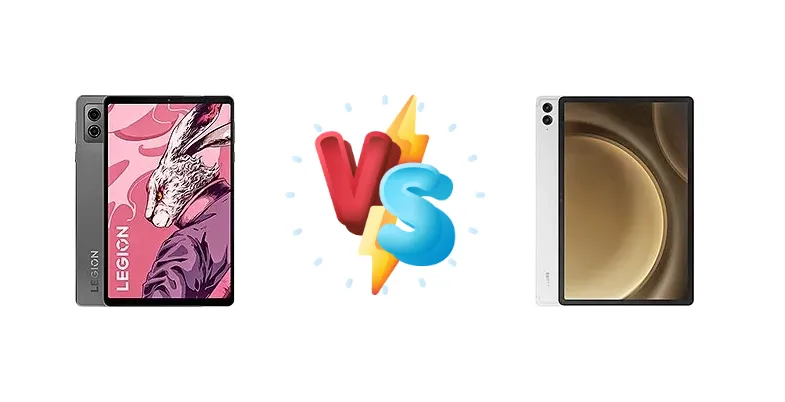
The Android tablet market is heating up, with options ranging from productivity powerhouses to dedicated gaming machines. The Lenovo Legion Tab and Samsung Galaxy Tab S9 FE+ represent two distinct approaches: the Legion Tab prioritizes raw performance with its Snapdragon 8+ Gen 1, while the S9 FE+ focuses on a more balanced experience with the Exynos 1380 and a larger display. This comparison will dissect their strengths and weaknesses to determine which tablet best suits your needs.
🏆 Quick Verdict
For users prioritizing uncompromising gaming performance and demanding tasks, the Lenovo Legion Tab emerges as the winner. Its Snapdragon 8+ Gen 1 chipset delivers significantly higher processing power. However, the Samsung Galaxy Tab S9 FE+ is a compelling choice for those seeking a more versatile tablet with longer battery life and a larger screen, at a potentially lower price point.
| Network |
|---|
| 2G bands | N/A | GSM 850 / 900 / 1800 / 1900 |
| 3G bands | N/A | HSDPA 850 / 900 / 1700(AWS) / 1900 / 2100 |
| 4G bands | N/A | 1, 2, 3, 4, 5, 7, 8, 12, 13, 17, 20, 26, 28, 32, 38, 40, 41, 66 |
| 5G bands | - | 1, 3, 5, 7, 8, 20, 28, 38, 40, 41, 66, 77, 78 SA/NSA/Sub6 |
| EDGE | No | - |
| GPRS | No | - |
| Speed | - | HSPA, LTE, 5G - cellular model only |
| Technology | No cellular connectivity | GSM / HSPA / LTE / 5G |
| Launch |
|---|
| Announced | 2024, August 13 | 2023, October 04 |
| Status | Available. Released 2024, August 15 | Available. Released 2023, October 16 |
| Body |
|---|
| Build | - | Glass front, aluminum back, aluminum frame |
| Dimensions | 208.5 x 129.5 x 7.6 mm (8.21 x 5.10 x 0.30 in) | 285.4 x 185.4 x 6.5 mm (11.24 x 7.30 x 0.26 in) |
| SIM | No | Nano-SIM + eSIM (cellular model only) |
| Weight | 350 g (12.35 oz) | 627 g or 628 g (1.38 lb) |
| Display |
|---|
| Resolution | 1600 x 2560 pixels, 16:10 ratio (~343 ppi density) | 1600 x 2560 pixels, 16:10 ratio (~243 ppi density) |
| Size | 8.8 inches, 224.5 cm2 (~83.2% screen-to-body ratio) | 12.4 inches, 445.8 cm2 (~84.3% screen-to-body ratio) |
| Type | IPS LCD, 144Hz, Dolby Vision, HDR10, 500 nits (typ) | IPS LCD, 90Hz |
| Platform |
|---|
| CPU | Octa-core (1x3.19 GHz Cortex-X2 & 3x2.75 GHz Cortex-A710 & 4x1.80 GHz Cortex-A510) | Octa-core (4x2.4 GHz Cortex-A78 & 4x2.0 GHz Cortex-A55) |
| Chipset | Qualcomm SM8475P Snapdragon 8+ Gen 1 (4 nm) | Exynos 1380 (5 nm) |
| GPU | Adreno 730 | Mali-G68 MP5 |
| OS | Android 13 | Android 13, up to 4 major Android upgrades, One UI 6 |
| Memory |
|---|
| Card slot | microSDXC (dedicated slot) | microSDXC (dedicated slot) |
| Internal | 256GB 12GB RAM | 128GB 6GB RAM, 128GB 8GB RAM, 256GB 8GB RAM, 256GB 12GB RAM |
| Main Camera |
|---|
| Dual | 13 MP, (wide)
2 MP (macro) | 8 MP, (wide)
8 MP, (ultrawide) |
| Features | LED flash | - |
| Video | 1080p@30fps | 4K@30fps, 1080p@30fps |
| Selfie camera |
|---|
| Single | 8 MP | 12 MP, (ultrawide) |
| Video | 1080p@30fps | Yes |
| Sound |
|---|
| 35mm jack | No | No |
| Loudspeaker | Yes, with stereo speakers | Yes, with stereo speakers |
| Comms |
|---|
| Bluetooth | 5.3, A2DP, LE | 5.3, A2DP, LE |
| NFC | No | No |
| Positioning | No | GPS, GALILEO, GLONASS, BDS, QZSS - cellular model only |
| Radio | Unspecified | No |
| USB | 2x USB Type-C 3.1 Gen2, DisplayPort 1.4 | USB Type-C 2.0, magnetic connector |
| WLAN | Wi-Fi 802.11 a/b/g/n/ac/6e, dual-band, Wi-Fi Direct | Wi-Fi 802.11 a/b/g/n/ac/6, dual-band, Wi-Fi Direct |
| Features |
|---|
| Sensors | Accelerometer, gyro, proximity, compass | Fingerprint (side-mounted), accelerometer, gyro, compass, proximity (accessories only) |
| Battery |
|---|
| Charging | 45W wired | 45W wired, QC2.0 |
| Type | Li-Po 6550 mAh | Li-Po 10090 mAh |
| Misc |
|---|
| Colors | Storm Grey | Mint, Silver, Gray, Lavender |
| Models | ZACW0029IN | SM-X610, SM-X616B |
| Price | About 380 EUR | About 770 EUR |
| SAR | - | 0.77 W/kg (body) |
| SAR EU | - | 0.50 W/kg (body) |
Lenovo Legion Tab
- Superior gaming performance due to Snapdragon 8+ Gen 1
- More efficient thermal management for sustained performance
- Potentially higher pixel density due to smaller screen size
- Likely shorter battery life compared to the S9 FE+
- Smaller screen size may not be ideal for all users
Samsung Galaxy Tab S9 FE+
- Larger display for immersive viewing and multitasking
- Potentially longer battery life due to Exynos 1380's efficiency
- QC2.0 support for potentially faster charging
- Significantly lower processing power compared to the Legion Tab
- Less capable GPU for demanding games
Display Comparison
While both tablets feature LCD panels, details regarding resolution, refresh rate, and peak brightness are missing. However, the S9 FE+'s larger size (likely 12.4 inches vs. the Legion Tab's 8.8 inches) will provide a more immersive viewing experience. The Exynos 1380's graphics capabilities, while less powerful than the Snapdragon, will still deliver a smooth experience for most content. The Legion Tab's smaller size may offer a higher pixel density, but without specific specs, it's difficult to definitively say which display is superior. Bezels are also unknown, but a smaller tablet like the Legion Tab may have tighter bezels.
Camera Comparison
Camera details are sparse, but given the focus of these tablets, camera quality isn't a primary concern. Both are likely to feature basic camera setups. The presence of a 2MP macro camera on either device is largely inconsequential. The larger sensor size (if any) on the main camera will be the determining factor, but without specific information, it's impossible to declare a winner. Image processing will likely differ, with Samsung typically favoring more saturated colors.
Performance
The core difference lies in the chipsets. The Lenovo Legion Tab’s Qualcomm SM8475P Snapdragon 8+ Gen 1 (4nm) is a flagship-level processor, boasting a Cortex-X2 prime core clocked at 3.19 GHz. This architecture, combined with the 4nm process, delivers significantly higher single-core and multi-core performance compared to the Samsung Galaxy Tab S9 FE+'s Exynos 1380 (5nm). The Exynos 1380 utilizes older Cortex-A78 cores at 2.4 GHz, which are less efficient and powerful. The Snapdragon 8+ Gen 1’s Adreno 730 GPU will provide a substantial advantage in gaming, while the Exynos 1380’s Mali-G68 MP5 is adequate for casual gaming but will struggle with demanding titles at high settings. The 4nm node of the Snapdragon also translates to better thermal efficiency, reducing the likelihood of throttling during extended gaming sessions.
Battery Life
Battery capacity is unknown for both devices. However, the Exynos 1380’s 5nm process is more power-efficient than the Snapdragon 8+ Gen 1’s 4nm process. This, combined with the S9 FE+'s larger size potentially accommodating a larger battery, suggests it will likely offer longer battery life. Both tablets support 45W wired charging, and the S9 FE+ adds QC2.0 support, potentially allowing for slightly faster charging with compatible chargers. The Snapdragon's higher power draw will likely result in a shorter time between charges, despite the same charging wattage.
Buying Guide
Buy the Lenovo Legion Tab if you need a tablet primarily for graphically intensive gaming, video editing, or other demanding applications where sustained performance is critical. You'll benefit from the superior processing power of the Snapdragon 8+ Gen 1. Buy the Samsung Galaxy Tab S9 FE+ if you prefer a larger screen for media consumption, note-taking, or multitasking, and value all-day battery life over peak performance. It’s the better option for general productivity and entertainment.
Frequently Asked Questions
❓ Does the Exynos 1380 in the Galaxy Tab S9 FE+ overheat during prolonged gaming sessions?
While the Exynos 1380 is a capable chip, it's not designed for the same level of sustained performance as the Snapdragon 8+ Gen 1. It's likely to experience some thermal throttling during extended gaming, leading to reduced frame rates. However, it should remain within safe operating temperatures and won't likely shut down.
❓ Is the 45W charging on both tablets equally fast in real-world usage?
The Samsung Galaxy Tab S9 FE+’s inclusion of QC2.0 may allow for slightly faster charging speeds with a compatible charger, potentially reaching 45W more consistently. The Legion Tab’s 45W charging may be limited by its power delivery implementation. However, the difference is likely to be marginal.
❓ Can the Lenovo Legion Tab handle demanding games like Genshin Impact at maximum settings?
Yes, the Snapdragon 8+ Gen 1 in the Legion Tab is more than capable of running Genshin Impact at maximum settings with consistently high frame rates. It will provide a significantly smoother and more enjoyable gaming experience compared to the S9 FE+.
❓ What type of storage does each tablet use, and is it expandable?
Storage type and expandability are unknown. However, Samsung typically uses UFS storage, which is faster than eMMC. Expandability via microSD card is common in Samsung tablets, but not always present in gaming-focused devices like the Legion Tab. Check the specific model specifications before purchasing.