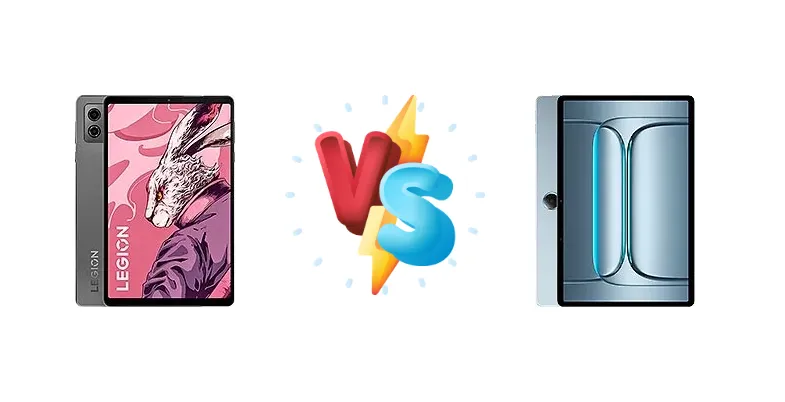
The Android tablet market is heating up, with options ranging from budget-friendly media consumption devices to dedicated gaming powerhouses. The Lenovo Legion Tab and OnePlus Pad Lite represent opposite ends of this spectrum. The Legion Tab aims to deliver a near-flagship experience for mobile gamers, while the Pad Lite prioritizes value and everyday usability. This comparison dissects their key differences to help you choose the right tablet for your needs.
🏆 Quick Verdict
For users prioritizing gaming and demanding performance, the Lenovo Legion Tab is the clear winner thanks to its Snapdragon 8+ Gen 1 chipset. However, the OnePlus Pad Lite offers a compelling value proposition for casual users and those seeking a more affordable tablet for streaming, browsing, and light tasks.
| Network |
|---|
| 2G bands | N/A | GSM 850 / 900 / 1800 / 1900 - cellular model only |
| 3G bands | N/A | HSDPA 850 / 900 / 2100 - cellular model only |
| 4G bands | N/A | LTE - cellular model only |
| EDGE | No | - |
| GPRS | No | - |
| Speed | - | HSPA, LTE - cellular model only |
| Technology | No cellular connectivity | GSM / HSPA / LTE |
| Launch |
|---|
| Announced | 2024, August 13 | 2025, July 08 |
| Status | Available. Released 2024, August 15 | Available. Released 2025, August 14 |
| Body |
|---|
| Dimensions | 208.5 x 129.5 x 7.6 mm (8.21 x 5.10 x 0.30 in) | 254.9 x 166.5 x 7.4 mm (10.04 x 6.56 x 0.29 in) |
| SIM | No | Yes - cellular model only |
| Weight | 350 g (12.35 oz) | 530 g (1.17 lb) |
| Display |
|---|
| Resolution | 1600 x 2560 pixels, 16:10 ratio (~343 ppi density) | 1200 x 1920 pixels, 16:10 ratio (~207 ppi density) |
| Size | 8.8 inches, 224.5 cm2 (~83.2% screen-to-body ratio) | 11.0 inches, 347.5 cm2 (~81.9% screen-to-body ratio) |
| Type | IPS LCD, 144Hz, Dolby Vision, HDR10, 500 nits (typ) | IPS LCD, 1B colors, 90Hz, 500 nits |
| Platform |
|---|
| CPU | Octa-core (1x3.19 GHz Cortex-X2 & 3x2.75 GHz Cortex-A710 & 4x1.80 GHz Cortex-A510) | Octa-core (2x2.2 GHz Cortex-A76 & 6x2.0 GHz Cortex-A55) |
| Chipset | Qualcomm SM8475P Snapdragon 8+ Gen 1 (4 nm) | Mediatek Helio G100 (6 nm) |
| GPU | Adreno 730 | Mali-G57 MC2 |
| OS | Android 13 | Android 15, OxygenOS 15 |
| Memory |
|---|
| Card slot | microSDXC (dedicated slot) | Unspecified |
| Internal | 256GB 12GB RAM | 128GB 6GB RAM, 128GB 8GB RAM |
| Main Camera |
|---|
| Dual | 13 MP, (wide)
2 MP (macro) | - |
| Features | LED flash | - |
| Single | - | 5 MP |
| Video | 1080p@30fps | 1080p@30fps |
| Selfie camera |
|---|
| Single | 8 MP | 5 MP |
| Video | 1080p@30fps | 1080p@30fps |
| Sound |
|---|
| 35mm jack | No | No |
| Loudspeaker | Yes, with stereo speakers | Yes, with stereo speakers (4 speakers, Hi-Res audio) |
| Comms |
|---|
| Bluetooth | 5.3, A2DP, LE | 5.2, A2DP, LE, aptX HD |
| NFC | No | No |
| Positioning | No | GPS, (cellular model only) - unconfirmed |
| Radio | Unspecified | No |
| USB | 2x USB Type-C 3.1 Gen2, DisplayPort 1.4 | USB Type-C 2.0 |
| WLAN | Wi-Fi 802.11 a/b/g/n/ac/6e, dual-band, Wi-Fi Direct | Wi-Fi 802.11 a/b/g/n/ac, dual-band |
| Features |
|---|
| Sensors | Accelerometer, gyro, proximity, compass | Unspecified |
| Battery |
|---|
| Charging | 45W wired | 33W wired |
| Type | Li-Po 6550 mAh | Li-Po 9340 mAh |
| Misc |
|---|
| Colors | Storm Grey | Aero Blue |
| Models | ZACW0029IN | OPD2480 |
| Price | About 380 EUR | About 200 EUR |
Lenovo Legion Tab
- Significantly more powerful Snapdragon 8+ Gen 1 processor
- Faster 45W wired charging
- Likely higher refresh rate display for smoother gaming
- Potentially higher price point
- May experience more heat during prolonged gaming
OnePlus Pad Lite
- More affordable price
- Potentially longer battery life due to efficient chipset
- Sufficient performance for everyday tasks
- Slower MediaTek Helio G100 processor
- Slower 33W wired charging
- Less capable for demanding games
Display Comparison
While both tablets likely feature LCD panels (data unavailable), the core performance difference begins with the processing power driving them. Display specs beyond panel type are unavailable, so we must infer. Given the Legion Tab's gaming focus, it likely features a higher refresh rate (potentially 120Hz) for smoother visuals, while the Pad Lite likely sticks to a standard 60Hz panel to conserve battery. Bezels are also likely thinner on the Legion Tab, contributing to a more immersive experience. Color accuracy is also likely superior on the Legion Tab, geared towards more accurate gaming visuals.
Camera Comparison
Camera specifications are not provided for either device, making a direct comparison difficult. However, given the Legion Tab’s focus on gaming, the camera system is likely a secondary consideration. The OnePlus Pad Lite may prioritize a more balanced camera setup for general-purpose photography. Without specific sensor details, it’s safe to assume neither tablet will compete with flagship smartphone cameras.
Performance
The Lenovo Legion Tab’s Qualcomm Snapdragon 8+ Gen 1 (4nm) is a significant leap ahead of the OnePlus Pad Lite’s MediaTek Helio G100 (6nm). The Snapdragon 8+ Gen 1 boasts a more advanced CPU architecture – an octa-core configuration with a Cortex-X2 prime core clocked at 3.19 GHz – compared to the Pad Lite’s Cortex-A76 cores at 2.2 GHz. This translates to substantially faster single-core and multi-core performance, crucial for demanding games and applications. The 4nm process node of the Snapdragon also provides better thermal efficiency, reducing throttling during extended gaming sessions. The Pad Lite’s Helio G100 is a capable chip for everyday tasks, but will struggle with graphically intensive titles.
Battery Life
Battery capacity is not specified for either device. However, the Lenovo Legion Tab’s 45W wired charging is significantly faster than the OnePlus Pad Lite’s 33W charging. This means the Legion Tab can replenish its battery more quickly, minimizing downtime between gaming sessions. While the Pad Lite may offer slightly longer battery life due to its less power-hungry chipset, the faster charging of the Legion Tab provides a more convenient user experience.
Buying Guide
Buy the Lenovo Legion Tab if you need a tablet capable of running demanding games at high settings, appreciate faster processing speeds for multitasking, and value the potential for future-proofing. Buy the OnePlus Pad Lite if you prefer a more affordable tablet for everyday tasks like streaming video, browsing the web, and light gaming, and prioritize battery life over raw performance.
Frequently Asked Questions
❓ Will the MediaTek Helio G100 in the OnePlus Pad Lite be able to run games like Genshin Impact or Call of Duty Mobile?
The Helio G100 can run these games, but you'll likely need to lower the graphics settings to medium or low to achieve a playable frame rate. Expect some stuttering during intense scenes. It's not designed for consistently high-end gaming.
❓ How well does the Lenovo Legion Tab handle sustained gaming sessions? Will it throttle?
The Snapdragon 8+ Gen 1 is a powerful chip, but it can generate heat under sustained load. The Legion Tab likely incorporates cooling solutions to mitigate throttling, but some performance reduction is still possible during very long gaming sessions. The 4nm process helps, but it's not a magic bullet.
❓ Is the difference in charging speed between 33W and 45W really noticeable in real-world use?
Yes, the 12W difference is significant. 45W charging will get you from 0-100% much faster, potentially shaving off 30-60 minutes compared to 33W, depending on battery capacity. This is particularly useful for gamers who want to quickly get back to playing.