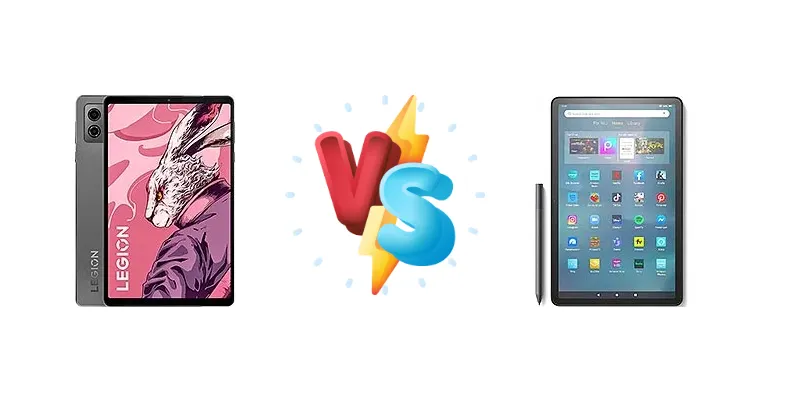
The tablet market offers a wide spectrum of choices, from high-performance gaming machines to affordable media consumption devices. The Lenovo Legion Tab aims for the former, packing a flagship Snapdragon 8+ Gen 1 processor, while the Amazon Fire Max 11 targets the latter with a more economical Mediatek chipset. This comparison dissects their key differences to help you determine which tablet best suits your needs.
🏆 Quick Verdict
For users prioritizing gaming and demanding applications, the Lenovo Legion Tab is the clear winner thanks to its significantly more powerful Snapdragon 8+ Gen 1. However, the Amazon Fire Max 11 provides a solid, functional experience for everyday tasks at a much lower price point, making it ideal for casual users.
| Network |
|---|
| 2G bands | N/A | N/A |
| 3G bands | N/A | - |
| 4G bands | N/A | - |
| EDGE | No | No |
| GPRS | No | No |
| Technology | No cellular connectivity | No cellular connectivity |
| Launch |
|---|
| Announced | 2024, August 13 | 2023, May 23 |
| Status | Available. Released 2024, August 15 | Available. Released 2023, May 23 |
| Body |
|---|
| Dimensions | 208.5 x 129.5 x 7.6 mm (8.21 x 5.10 x 0.30 in) | 259.1 x 163.7 x 7.5 mm (10.20 x 6.44 x 0.30 in) |
| SIM | No | No |
| Weight | 350 g (12.35 oz) | 490 g (1.08 lb) |
| Display |
|---|
| Resolution | 1600 x 2560 pixels, 16:10 ratio (~343 ppi density) | 2000 x 1200 pixels, 5:3 ratio (~212 ppi density) |
| Size | 8.8 inches, 224.5 cm2 (~83.2% screen-to-body ratio) | 11.0 inches, 344.4 cm2 (~81.2% screen-to-body ratio) |
| Type | IPS LCD, 144Hz, Dolby Vision, HDR10, 500 nits (typ) | IPS LCD |
| Platform |
|---|
| CPU | Octa-core (1x3.19 GHz Cortex-X2 & 3x2.75 GHz Cortex-A710 & 4x1.80 GHz Cortex-A510) | Octa-core (2x2.2 GHz Cortex-A78 & 6x2.0 GHz Cortex-A55) |
| Chipset | Qualcomm SM8475P Snapdragon 8+ Gen 1 (4 nm) | Mediatek MT8188J |
| GPU | Adreno 730 | Mali-G57 MC2 |
| OS | Android 13 | Android 11, Fire OS 8 |
| Memory |
|---|
| Card slot | microSDXC (dedicated slot) | microSDXC (dedicated slot) |
| Internal | 256GB 12GB RAM | 64GB 4GB RAM, 128GB 4GB RAM |
| Main Camera |
|---|
| Dual | 13 MP, (wide)
2 MP (macro) | - |
| Features | LED flash | - |
| Single | - | 8 MP, AF |
| Video | 1080p@30fps | 1080p |
| Selfie camera |
|---|
| Single | 8 MP | 8 MP |
| Video | 1080p@30fps | 1080p |
| Sound |
|---|
| 35mm jack | No | No |
| Loudspeaker | Yes, with stereo speakers | Yes, with stereo speakers |
| Comms |
|---|
| Bluetooth | 5.3, A2DP, LE | 5.3, A2DP, LE |
| NFC | No | No |
| Positioning | No | No |
| Radio | Unspecified | No |
| USB | 2x USB Type-C 3.1 Gen2, DisplayPort 1.4 | USB Type-C 2.0, OTG, magnetic accessory connector |
| WLAN | Wi-Fi 802.11 a/b/g/n/ac/6e, dual-band, Wi-Fi Direct | Wi-Fi 802.11 a/b/g/n/ac/6, dual-band |
| Features |
|---|
| Sensors | Accelerometer, gyro, proximity, compass | Fingerprint (side-mounted), accelerometer, proximity (accessories only) |
| Battery |
|---|
| Charging | 45W wired | 15W wired |
| Type | Li-Po 6550 mAh | Li-Ion |
| Misc |
|---|
| Colors | Storm Grey | Gray |
| Models | ZACW0029IN | KFSNWI |
| Price | About 380 EUR | About 270 EUR |
Lenovo Legion Tab
- Exceptional performance with Snapdragon 8+ Gen 1
- Faster 45W charging for minimal downtime
- Likely superior display quality for gaming and content creation
- Higher price point
- Potentially shorter battery life due to power-hungry processor
Amazon Fire Max 11
- Significantly more affordable
- Amazon ecosystem integration
- Suitable for everyday tasks like browsing and streaming
- Limited performance for demanding games and applications
- Slower 15W charging
Display Comparison
While specific display specs (resolution, panel type) are missing for both devices, the intended use cases suggest differences. The Legion Tab, geared towards gaming, likely prioritizes a high refresh rate panel to complement its powerful processor. The Fire Max 11, focused on value, likely utilizes a standard 60Hz panel. The Legion Tab’s higher performance demands a more responsive display. Bezels are likely slimmer on the Legion Tab, reflecting its premium positioning. Color accuracy is also likely superior on the Legion Tab, important for content creation.
Camera Comparison
Given the context, camera quality isn't a primary focus for either device. However, the Legion Tab, as a more premium offering, likely features a more capable camera system with a larger sensor and potentially optical image stabilization (OIS). The Fire Max 11 likely employs a simpler camera setup optimized for video calls and casual snapshots. Without specific sensor details, it's difficult to make a precise comparison, but the Legion Tab’s higher processing power will aid in image processing and low-light performance.
Performance
The core difference lies in the chipsets. The Lenovo Legion Tab’s Qualcomm SM8475P Snapdragon 8+ Gen 1 (4nm) is a flagship processor featuring an octa-core configuration with a prime Cortex-X2 core clocked at 3.19 GHz. This architecture delivers significantly higher CPU and GPU performance compared to the Amazon Fire Max 11’s Mediatek MT8188J, which utilizes a more modest octa-core setup with Cortex-A78 and A55 cores peaking at 2.2 GHz. The 4nm fabrication process of the Snapdragon 8+ Gen 1 also translates to improved thermal efficiency, reducing throttling during sustained workloads. The Legion Tab will handle graphically intensive games and applications with ease, while the Fire Max 11 will struggle with more demanding tasks. The Legion Tab likely utilizes faster LPDDR5x RAM, further enhancing performance.
Battery Life
Battery capacity is not specified, but the charging speeds reveal a significant difference. The Lenovo Legion Tab supports 45W wired charging, enabling significantly faster charging times compared to the Amazon Fire Max 11’s 15W charging. This means the Legion Tab can quickly replenish its battery, minimizing downtime. While a larger battery capacity on the Fire Max 11 could offset the slower charging, the Legion Tab’s faster charging is a substantial convenience for users who frequently use their tablet throughout the day.
Buying Guide
Buy the Lenovo Legion Tab if you need a tablet capable of running demanding games at high settings, editing videos, or multitasking with resource-intensive applications. Its superior processing power and faster charging are crucial for power users. Buy the Amazon Fire Max 11 if you prefer a tablet for web browsing, streaming video, reading, and light productivity tasks. Its affordability and Amazon ecosystem integration make it a practical choice for casual users and families.
Frequently Asked Questions
❓ Will the Mediatek MT8188J in the Fire Max 11 struggle with graphically intensive games like Genshin Impact?
Yes, the Mediatek MT8188J is a mid-range processor and will likely struggle to run Genshin Impact at high settings. Expect significant frame rate drops and potentially long loading times. The Fire Max 11 is better suited for less demanding games.
❓ How much faster is the 45W charging on the Lenovo Legion Tab compared to the 15W charging on the Fire Max 11?
45W charging is three times faster than 15W charging. This translates to a significantly reduced charging time for the Legion Tab, allowing you to quickly get back to using your device. While exact 0-100% times depend on battery capacity, the Legion Tab will be considerably quicker.
❓ Is the Amazon Fire Max 11 a good choice for someone primarily using streaming services like Netflix and Prime Video?
Yes, the Amazon Fire Max 11 is an excellent choice for media consumption. Its screen is adequate for streaming, and its integration with Amazon Prime Video is seamless. The Mediatek processor is sufficient for handling video playback without issues.
❓ Does the Lenovo Legion Tab support external displays for productivity tasks?
While not explicitly stated, tablets with Snapdragon 8+ Gen 1 processors often support external display output via USB-C. This would allow you to connect the Legion Tab to a monitor for a more desktop-like experience, enhancing productivity.