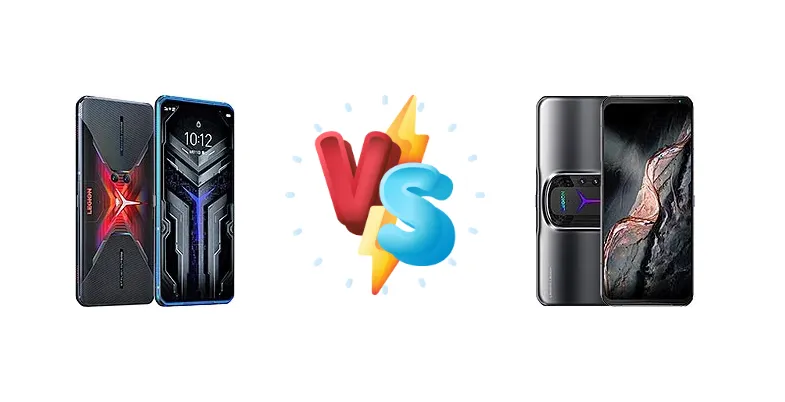
The Lenovo Legion Pro established itself as a strong contender in the gaming phone space, but the newer Legion Y90 arrives with a significant chipset upgrade. This comparison dissects the differences between the Snapdragon 865-powered Pro and the Snapdragon 8 Gen 1-equipped Y90, focusing on real-world performance implications for gamers and power users.
🏆 Quick Verdict
For most users, the Lenovo Legion Y90 is the superior choice, offering a substantial performance leap thanks to the Snapdragon 8 Gen 1. While the Legion Pro remains capable, the Y90’s more efficient 4nm process and faster CPU cores deliver a smoother, more sustained gaming experience. However, the Legion Pro’s variable charging speeds based on RAM configuration are a notable quirk.
| Network |
|---|
| 2G bands | GSM 850 / 900 / 1800 / 1900 | GSM 850 / 900 / 1800 / 1900 |
| 3G bands | HSDPA 850 / 900 / 1900 / 2100 | HSDPA 800 / 850 / 900 / 1900 / 2100 |
| 4G bands | LTE | LTE |
| 5G bands | SA/NSA | SA/NSA/Sub6 |
| Speed | HSPA 42.2/5.76 Mbps, LTE (4CA) Cat15 800/210 Mbps, 5G 2.5 Gbps DL | HSPA, LTE, 5G |
| Technology | GSM / CDMA / HSPA / LTE / 5G | GSM / CDMA / HSPA / CDMA2000 / LTE / 5G |
| | CDMA 800 & TD-SCDMA | CDMA2000 1x |
| Launch |
|---|
| Announced | 2020, July 22. Released 2020, July 30 | 2022, March 01 |
| Status | Discontinued | Available. Released 2022, March 10 |
| Body |
|---|
| Build | Glass front, glass back, aluminum frame | - |
| Dimensions | 169.2 x 78.5 x 9.9 mm (6.66 x 3.09 x 0.39 in) | 177 x 78.4 x 10.1 mm (6.97 x 3.09 x 0.40 in) |
| SIM | Nano-SIM + Nano-SIM | Nano-SIM + Nano-SIM |
| Weight | 239 g (8.43 oz) | 252 g (8.89 oz) |
| | Water-repellent coating | Built-in two cooling fans
RGB light panel (on the back)
4 ultrasonic buttons (Gaming triggers) |
| Display |
|---|
| Resolution | 1080 x 2340 pixels, 19.5:9 ratio (~388 ppi density) | 1080 x 2460 pixels (~388 ppi density) |
| Size | 6.65 inches, 108.6 cm2 (~81.7% screen-to-body ratio) | 6.92 inches, 113.7 cm2 (~81.9% screen-to-body ratio) |
| Type | AMOLED, 144Hz, HDR10+ | AMOLED, 144Hz, HDR10+, 1300 nits (peak) |
| Platform |
|---|
| CPU | Octa-core (1x3.09 GHz Cortex-A77 & 3x2.42 GHz Cortex-A77 & 4x1.80 GHz Cortex-A55) | Octa-core (1x3.00 GHz Cortex-X2 & 3x2.50 GHz Cortex-A710 & 4x1.80 GHz Cortex-A510) |
| Chipset | Qualcomm SM8250 Snapdragon 865 5G+ (7 nm+) | Qualcomm SM8450 Snapdragon 8 Gen 1 (4 nm) |
| GPU | Adreno 650 | Adreno 730 |
| OS | Android 10, Legion OS/ ZUI12 | Android 12, ZUI 13 |
| Memory |
|---|
| Card slot | No | No |
| Internal | 128GB 8GB RAM, 128GB 12GB RAM, 256GB 12GB RAM, 512GB 16GB RAM | 256GB 12GB RAM, 256GB 16GB RAM, 640GB 18GB RAM |
| | UFS 3.1 | UFS 3.1
640GB (512GB UFS + 128GB SSD) |
| Main Camera |
|---|
| Dual | 64 MP, f/1.9, 25mm (wide), 1/1.72", 0.8µm, PDAF
16 MP, f/2.2, 120˚, 16mm (ultrawide) | 64 MP, f/1.9, 25mm (wide), 1/1.32", 1.0µm, PDAF
13 MP, 120˚ (ultrawide) |
| Features | Dual-LED flash, panorama, HDR | Dual-LED flash, panorama, HDR |
| Video | 4K@30fps gyro-EIS | 8K@24fps, 4K@30/60fps, 1080p@30/60/240fps, gyro-EIS, HDR10+ rec. |
| Selfie camera |
|---|
| Features | LED flash, HDR | HDR |
| Single | Motorized pop-up 20 MP, f/2.2, 25mm (wide), 1/3.1", 0.9µm | 16 MP |
| Video | 4K@30fps | 4K@30/60fps, 1080p@30/60/120fps |
| Sound |
|---|
| 3.5mm jack | No | No |
| 35mm jack | No | No |
| Loudspeaker | Yes, with stereo speakers | Yes, with stereo speakers |
| Comms |
|---|
| Bluetooth | 5.0, A2DP, LE, aptX HD, aptX Adaptive | 5.2, A2DP, LE |
| NFC | Yes | Yes |
| Positioning | GPS (L1+L5), GLONASS, GALILEO, BDS, QZSS | GPS (L1+L5), GLONASS, GALILEO, BDS, QZSS |
| Radio | No | No |
| USB | Two USB Type-C, OTG | USB Type-C 3.1 Gen2, USB Type-C 2.0, OTG |
| WLAN | Wi-Fi 802.11 a/b/g/n/ac/6, dual-band, Wi-Fi Direct | Wi-Fi 802.11 a/b/g/n/ac/6, dual-band, Wi-Fi Direct |
| Features |
|---|
| Sensors | Fingerprint (under display, optical), accelerometer, gyro, proximity, compass | Fingerprint (under display, optical), accelerometer, gyro, proximity, compass |
| Battery |
|---|
| Charging | 45W wired, (128GB 8GB RAM model)
65W wired, (128GB 12GB RAM, 256GB 12GB RAM models)
90W wired, 50% in 10 min, 100% in 30 min (512GB 16GB RAM model) | 68W wired, 100% in 35 min |
| Type | Li-Po 5000 mAh | Li-Po 5600 mAh |
| Misc |
|---|
| Colors | Vengeance Red, Blazing Blue, White | Gray |
| Models | L79031 | L71061 |
| Price | - | About 570 EUR |
Lenovo Legion Pro
- Potentially lower price point due to being an older model.
- Variable charging speeds offer some flexibility (depending on configuration).
- Still a capable performer for less demanding games.
- Older Snapdragon 865 chipset is less efficient and powerful.
- Inconsistent charging speeds based on RAM configuration.
- More prone to thermal throttling under sustained load.
Lenovo Legion Y90
- Significantly more powerful Snapdragon 8 Gen 1 chipset.
- More efficient 4nm process reduces thermal throttling.
- Consistent 68W fast charging.
- Improved CPU architecture for better responsiveness.
- Higher price point.
- Snapdragon 8 Gen 1 is known to run hot under extreme load (though the Legion's cooling should mitigate this).
- May not represent a massive upgrade for casual users.
Display Comparison
Both devices are assumed to have high refresh rate displays, typical of the Legion series, but the provided data focuses on internal components. The core difference lies in the processing power driving the visuals. While display specs aren't provided, the Y90's more powerful GPU will translate to higher, more stable frame rates in graphically intensive games.
Camera Comparison
The provided data doesn't detail camera specifications. However, given the gaming focus of both devices, camera performance is likely secondary. We can assume both phones feature capable camera systems for their price points, but neither is likely to compete with dedicated camera flagships. Without specific sensor details, a direct comparison is impossible.
Performance
The heart of the difference is the chipset: the Legion Pro utilizes the Qualcomm SM8250 Snapdragon 865 5G+, built on a 7nm+ process, while the Y90 boasts the SM8450 Snapdragon 8 Gen 1, fabricated on a more efficient 4nm node. This process shrink is crucial; the 4nm node inherently offers better thermal efficiency, reducing the likelihood of throttling during extended gaming sessions. The Y90’s CPU configuration – a Cortex-X2 prime core alongside three Cortex-A710 performance cores and four Cortex-A510 efficiency cores – represents a significant architectural upgrade over the Legion Pro’s Cortex-A77 and A55 arrangement. The Y90’s CPU cores operate at higher clock speeds (3.00 GHz X2 vs 3.09 GHz A77), further enhancing performance.
Battery Life
The Legion Y90’s 68W wired charging, achieving a full charge in 35 minutes, offers a more consistent experience than the Legion Pro’s variable charging speeds. The Pro’s charging ranges from 45W (8GB RAM model) to 65W (12GB RAM models) and peaks at 90W (16GB RAM model), with the 90W option claiming 100% charge in 30 minutes. While the 90W option is faster, it’s only available on the highest-spec model. The Y90’s consistent 68W charging provides predictable and reliable power-ups, a benefit for users who frequently top up their battery.
Buying Guide
Buy the Lenovo Legion Pro if you prioritize value and can find it at a significantly discounted price. It’s still a capable gaming phone, especially for less demanding titles, and its variable charging speeds (45W-90W) offer some flexibility. Buy the Lenovo Legion Y90 if you demand the best possible gaming performance and are willing to pay a premium. The Snapdragon 8 Gen 1 provides a noticeable upgrade in frame rates and responsiveness, and the consistent 68W charging is a welcome improvement.
Frequently Asked Questions
❓ Will the Snapdragon 8 Gen 1 in the Legion Y90 overheat during prolonged gaming sessions?
The Snapdragon 8 Gen 1 is known to generate heat under sustained load. However, Lenovo Legion phones are typically equipped with robust cooling systems, including vapor chambers and multiple layers of graphite. While some throttling is possible, the Y90’s cooling should mitigate overheating and maintain stable performance for extended gaming periods.
❓ Does the variable charging speed on the Legion Pro significantly impact the user experience?
Yes, the variable charging speed (45W, 65W, or 90W) depending on the RAM configuration is a notable drawback. Users with the 8GB RAM model will experience the slowest charging speeds, while the 16GB model gets the fastest. This inconsistency can be frustrating for those who expect a consistent charging experience.
❓ Is the performance difference between the Snapdragon 865 and 8 Gen 1 noticeable in everyday tasks?
While both chipsets are capable, the Snapdragon 8 Gen 1 offers a noticeable improvement in responsiveness and smoothness for demanding tasks like video editing and multitasking. However, for basic everyday tasks like browsing and social media, the difference may be less apparent.