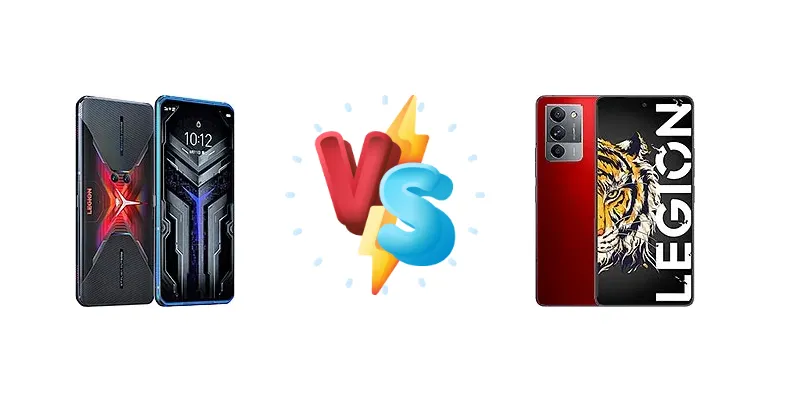
The Lenovo Legion Pro established itself as a strong contender in the gaming phone space, but the newer Lenovo Legion Y70 arrives with a significant chipset upgrade. This comparison dissects the differences between the Snapdragon 865-powered Pro and the Snapdragon 8+ Gen 1-equipped Y70, focusing on performance gains, charging efficiency, and which phone best suits your gaming needs and budget.
🏆 Quick Verdict
For most gamers, the Lenovo Legion Y70 is the superior choice. The Snapdragon 8+ Gen 1 offers a substantial performance leap over the 865, translating to smoother gameplay and improved efficiency. While the Legion Pro’s charging speeds can reach 90W on the 512GB model, the Y70’s consistent 68W charging and more modern chipset make it the better all-around performer.
| Network |
|---|
| 2G bands | GSM 850 / 900 / 1800 / 1900 | GSM 850 / 900 / 1800 / 1900 |
| 3G bands | HSDPA 850 / 900 / 1900 / 2100 | HSDPA 800 / 850 / 900 / 1900 / 2100 |
| 4G bands | LTE | LTE |
| 5G bands | SA/NSA | SA/NSA/Sub6 |
| Speed | HSPA 42.2/5.76 Mbps, LTE (4CA) Cat15 800/210 Mbps, 5G 2.5 Gbps DL | HSPA, LTE, 5G |
| Technology | GSM / CDMA / HSPA / LTE / 5G | GSM / CDMA / HSPA / CDMA2000 / LTE / 5G |
| | CDMA 800 & TD-SCDMA | CDMA2000 1x |
| Launch |
|---|
| Announced | 2020, July 22. Released 2020, July 30 | 2022, August 18 |
| Status | Discontinued | Available. Released 2022, August 23 |
| Body |
|---|
| Build | Glass front, glass back, aluminum frame | Glass front, aluminum frame |
| Dimensions | 169.2 x 78.5 x 9.9 mm (6.66 x 3.09 x 0.39 in) | 163.6 x 77 x 8 mm (6.44 x 3.03 x 0.31 in) |
| SIM | Nano-SIM + Nano-SIM | Nano-SIM + Nano-SIM |
| Weight | 239 g (8.43 oz) | 209 g (7.37 oz) |
| | Water-repellent coating | - |
| Display |
|---|
| Resolution | 1080 x 2340 pixels, 19.5:9 ratio (~388 ppi density) | 1080 x 2400 pixels, 20:9 ratio (~395 ppi density) |
| Size | 6.65 inches, 108.6 cm2 (~81.7% screen-to-body ratio) | 6.67 inches, 107.4 cm2 (~85.3% screen-to-body ratio) |
| Type | AMOLED, 144Hz, HDR10+ | OLED, 144Hz, HDR10+, 1000 nits (peak) |
| Platform |
|---|
| CPU | Octa-core (1x3.09 GHz Cortex-A77 & 3x2.42 GHz Cortex-A77 & 4x1.80 GHz Cortex-A55) | Octa-core (1x3.19 GHz Cortex-X2 & 3x2.75 GHz Cortex-A710 & 4x1.80 GHz Cortex-A510) |
| Chipset | Qualcomm SM8250 Snapdragon 865 5G+ (7 nm+) | Qualcomm SM8475 Snapdragon 8+ Gen 1 (4 nm) |
| GPU | Adreno 650 | Adreno 730 |
| OS | Android 10, Legion OS/ ZUI12 | Android 12, ZUI 14 |
| Memory |
|---|
| Card slot | No | No |
| Internal | 128GB 8GB RAM, 128GB 12GB RAM, 256GB 12GB RAM, 512GB 16GB RAM | 128GB 8GB RAM, 256GB 12GB RAM, 512GB 16GB RAM |
| | UFS 3.1 | UFS 3.1 |
| Main Camera |
|---|
| Dual | 64 MP, f/1.9, 25mm (wide), 1/1.72", 0.8µm, PDAF
16 MP, f/2.2, 120˚, 16mm (ultrawide) | - |
| Features | Dual-LED flash, panorama, HDR | Dual-LED flash, panorama, HDR |
| Triple | - | 50 MP, (wide), 1/1.55", 1.0µm, PDAF, OIS
13 MP, 120˚ (ultrawide), 1.12µm, AF
Auxiliary lens |
| Video | 4K@30fps gyro-EIS | 8K@30fps, 4K@30/60fps, 1080p@30/60/240fps, gyro-EIS |
| Selfie camera |
|---|
| Features | LED flash, HDR | - |
| Single | Motorized pop-up 20 MP, f/2.2, 25mm (wide), 1/3.1", 0.9µm | 16 MP |
| Video | 4K@30fps | Yes |
| Sound |
|---|
| 3.5mm jack | No | No |
| 35mm jack | No | No |
| Loudspeaker | Yes, with stereo speakers | Yes, with stereo speakers |
| Comms |
|---|
| Bluetooth | 5.0, A2DP, LE, aptX HD, aptX Adaptive | 5.2, A2DP, LE |
| NFC | Yes | Yes |
| Positioning | GPS (L1+L5), GLONASS, GALILEO, BDS, QZSS | GPS (L1+L5), GLONASS, GALILEO, BDS, QZSS |
| Radio | No | No |
| USB | Two USB Type-C, OTG | USB Type-C |
| WLAN | Wi-Fi 802.11 a/b/g/n/ac/6, dual-band, Wi-Fi Direct | Wi-Fi 802.11 a/b/g/n/ac/6, dual-band, Wi-Fi Direct |
| Features |
|---|
| Sensors | Fingerprint (under display, optical), accelerometer, gyro, proximity, compass | Fingerprint (side-mounted), accelerometer, gyro, proximity, compass |
| Battery |
|---|
| Charging | 45W wired, (128GB 8GB RAM model)
65W wired, (128GB 12GB RAM, 256GB 12GB RAM models)
90W wired, 50% in 10 min, 100% in 30 min (512GB 16GB RAM model) | 68W wired, 80% in 34 min |
| Type | Li-Po 5000 mAh | Li-Po 5100 mAh |
| Misc |
|---|
| Colors | Vengeance Red, Blazing Blue, White | Black, Silver, Red |
| Models | L79031 | L71091 |
| Price | - | About 440 EUR |
Lenovo Legion Pro
- Potentially lower price point due to age.
- Up to 90W fast charging (512GB/16GB model).
- Still a capable performer for less demanding games.
- Older Snapdragon 865 chipset is less powerful and efficient.
- Variable charging speeds depending on configuration.
- Likely to exhibit more thermal throttling under sustained load.
Lenovo Legion Y70
- Significantly faster Snapdragon 8+ Gen 1 chipset.
- Improved thermal efficiency for sustained performance.
- Consistent 68W fast charging.
- More modern features and software support.
- Potentially higher price point.
- 68W charging is slower than the Legion Pro's maximum 90W.
Display Comparison
Both devices are assumed to feature high refresh rate displays typical of gaming phones, though specific details like peak brightness and panel type aren't provided. However, the age difference suggests the Y70 likely benefits from advancements in display technology, potentially offering improved color accuracy and viewing angles. The Legion Pro, being an older model, may exhibit slightly more noticeable bezels.
Camera Comparison
Without detailed camera specifications, a direct comparison is limited. However, given the Y70 is a newer device, it likely incorporates improved image processing algorithms and potentially larger sensor sizes. The focus should be on the main sensor performance, as the inclusion of 2MP macro lenses on either device offers minimal practical benefit. The Snapdragon 8+ Gen 1’s ISP (Image Signal Processor) is also more advanced, potentially leading to better low-light performance and dynamic range.
Performance
The core difference lies in the chipsets. The Lenovo Legion Y70’s Snapdragon 8+ Gen 1 (4nm) represents a significant architectural improvement over the Legion Pro’s Snapdragon 865 (7nm+). The 8+ Gen 1 features the newer Cortex-X2 prime core clocked at 3.19 GHz, alongside Cortex-A710 performance cores, offering a substantial uplift in both single-core and multi-core performance. This translates to faster app loading times, smoother multitasking, and notably improved frame rates in demanding games. The 4nm process also contributes to better thermal efficiency, reducing the likelihood of throttling during extended gaming sessions. The Legion Pro’s Cortex-A77 cores, while capable, are demonstrably less efficient and powerful.
Battery Life
The Legion Pro’s charging speeds vary significantly based on RAM and storage configuration, ranging from 45W to 90W. The 90W charging on the 512GB/16GB model promises a 0-100% charge in 30 minutes, a considerable advantage. However, the Y70’s consistent 68W charging, while slower, still achieves 80% charge in 34 minutes. The Snapdragon 8+ Gen 1’s improved power efficiency means the Y70 may offer comparable or even better real-world battery life despite potentially having a smaller battery capacity (not specified in the data).
Buying Guide
Buy the Lenovo Legion Pro if you prioritize finding the lowest possible price for a capable gaming phone and don't require the absolute latest performance. It remains a viable option for less demanding titles and casual gaming. Buy the Lenovo Legion Y70 if you demand a smoother, more responsive gaming experience, benefit from improved thermal management, and appreciate faster overall performance thanks to the Snapdragon 8+ Gen 1.
Frequently Asked Questions
❓ Will the Snapdragon 8+ Gen 1 in the Y70 handle demanding games like Genshin Impact at max settings?
Yes, the Snapdragon 8+ Gen 1 is more than capable of running Genshin Impact at maximum settings with consistently high frame rates. Its improved GPU and thermal management will prevent significant throttling, providing a smoother and more enjoyable gaming experience compared to the Legion Pro.
❓ Does the Legion Pro's 90W charging make a significant difference in real-world usage compared to the Y70's 68W?
While 90W is faster on paper, the difference in charging time from 0-100% isn't massive. The Y70's 68W charging is still very quick, and the Snapdragon 8+ Gen 1's efficiency means you may not need to charge as frequently, mitigating the slower charging speed.
❓ Is the difference in CPU performance between the Snapdragon 865 and 8+ Gen 1 noticeable for everyday tasks?
Absolutely. The Snapdragon 8+ Gen 1's newer Cortex-X2 core and improved architecture result in snappier app launches, smoother multitasking, and a more responsive overall user experience. While the 865 is still functional, the 8+ Gen 1 provides a noticeable upgrade in daily usage.