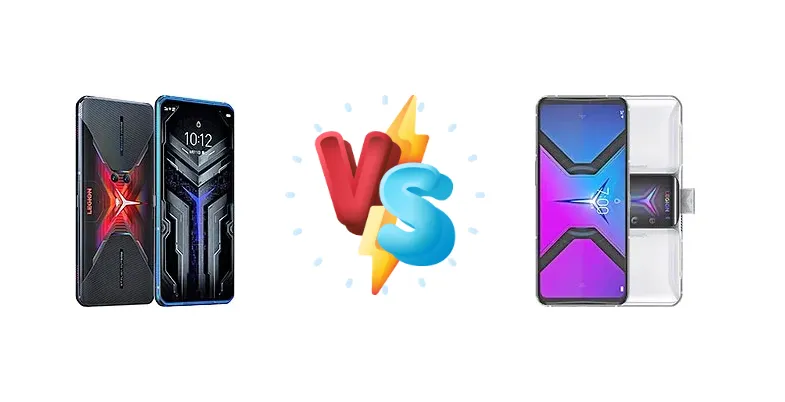
Lenovo entered the gaming phone arena with a clear vision, and the Legion Pro and Duel 2 represent distinct approaches. The Legion Pro, powered by the Snapdragon 865, aimed for a balance of power and affordability. The Duel 2, with the newer Snapdragon 888, pushed the boundaries of performance and charging technology. This comparison dissects the key differences to help you choose the right gaming companion.
🏆 Quick Verdict
For most gamers, the Lenovo Legion Duel 2 is the superior choice. The Snapdragon 888 offers a noticeable performance uplift over the 865 in the Legion Pro, and the faster 90W charging (with dual USB-C) significantly reduces downtime. While the Legion Pro remains a capable device, the Duel 2’s advancements justify the price difference.
| Network |
|---|
| 2G bands | GSM 850 / 900 / 1800 / 1900 | GSM 850 / 900 / 1800 / 1900 |
| 3G bands | HSDPA 850 / 900 / 1900 / 2100 | HSDPA 850 / 900 / 1700(AWS) / 1900 / 2100 |
| 4G bands | LTE | 1, 2, 3, 4, 5, 7, 8, 12, 13, 17, 20, 26, 28, 32, 34, 38, 39, 40, 41, 42, 43 |
| 5G bands | SA/NSA | 1, 2, 3, 7, 8, 20, 25, 28, 38, 40, 41, 66, 71, 77, 78, 79 SA/NSA/Sub6/mmWave |
| Speed | HSPA 42.2/5.76 Mbps, LTE (4CA) Cat15 800/210 Mbps, 5G 2.5 Gbps DL | HSPA, LTE, 5G |
| Technology | GSM / CDMA / HSPA / LTE / 5G | GSM / CDMA / HSPA / EVDO / LTE / 5G |
| | CDMA 800 & TD-SCDMA | CDMA2000 1xEV-DO |
| Launch |
|---|
| Announced | 2020, July 22. Released 2020, July 30 | 2021, April 08 |
| Status | Discontinued | Available. Released 2021, May 10 |
| Body |
|---|
| Build | Glass front, glass back, aluminum frame | Glass front (Gorilla Glass 5), glass back, aluminum frame |
| Dimensions | 169.2 x 78.5 x 9.9 mm (6.66 x 3.09 x 0.39 in) | 176 x 78.5 x 9.9 mm (6.93 x 3.09 x 0.39 in) |
| SIM | Nano-SIM + Nano-SIM | Nano-SIM + Nano-SIM |
| Weight | 239 g (8.43 oz) | 259 g (9.14 oz) |
| | Water-repellent coating | Built-in two cooling fans
RGB light panel (on the back)
6 pressure sensitive zones (Gaming triggers):
4 ultrasonic buttons (top), 2 capacitive sliding buttons (back) |
| Display |
|---|
| Protection | - | Corning Gorilla Glass 5 |
| Resolution | 1080 x 2340 pixels, 19.5:9 ratio (~388 ppi density) | 1080 x 2460 pixels (~388 ppi density) |
| Size | 6.65 inches, 108.6 cm2 (~81.7% screen-to-body ratio) | 6.92 inches, 113.7 cm2 (~82.3% screen-to-body ratio) |
| Type | AMOLED, 144Hz, HDR10+ | AMOLED, 144Hz, HDR10+, 1300 nits (peak) |
| Platform |
|---|
| CPU | Octa-core (1x3.09 GHz Cortex-A77 & 3x2.42 GHz Cortex-A77 & 4x1.80 GHz Cortex-A55) | Octa-core (1x2.84 GHz Cortex-X1 & 3x2.42 GHz Cortex-A78 & 4x1.80 GHz Cortex-A55) |
| Chipset | Qualcomm SM8250 Snapdragon 865 5G+ (7 nm+) | Qualcomm SM8350 Snapdragon 888 5G (5 nm) |
| GPU | Adreno 650 | Adreno 660 |
| OS | Android 10, Legion OS/ ZUI12 | Android 11, ZUI 12.5 |
| Memory |
|---|
| Card slot | No | No |
| Internal | 128GB 8GB RAM, 128GB 12GB RAM, 256GB 12GB RAM, 512GB 16GB RAM | 256GB 12GB RAM, 512GB 16GB RAM |
| | UFS 3.1 | UFS 3.1 |
| Main Camera |
|---|
| Dual | 64 MP, f/1.9, 25mm (wide), 1/1.72", 0.8µm, PDAF
16 MP, f/2.2, 120˚, 16mm (ultrawide) | 64 MP, f/1.9, 25mm (wide), 1/1.32", 1.0µm, PDAF
16 MP, f/2.2, 123˚, 16mm (ultrawide), 1.0µm |
| Features | Dual-LED flash, panorama, HDR | Dual-LED flash, panorama, HDR |
| Video | 4K@30fps gyro-EIS | 8K@24fps, 4K@30/60fps, 1080p@30/60/240fps, gyro-EIS, HDR10+ rec. |
| Selfie camera |
|---|
| Features | LED flash, HDR | HDR |
| Single | Motorized pop-up 20 MP, f/2.2, 25mm (wide), 1/3.1", 0.9µm | Motorized pop-up 44 MP, f/2.0, 24mm (wide), 1/2.65", 1.0µm, AF |
| Video | 4K@30fps | 4K@30/60fps, 1080p@30/60/120fps |
| Sound |
|---|
| 3.5mm jack | No | No |
| 35mm jack | No | No |
| Loudspeaker | Yes, with stereo speakers | Yes, with stereo speakers |
| Comms |
|---|
| Bluetooth | 5.0, A2DP, LE, aptX HD, aptX Adaptive | 5.2, A2DP, LE |
| NFC | Yes | Yes |
| Positioning | GPS (L1+L5), GLONASS, GALILEO, BDS, QZSS | GPS (L1+L5), GLONASS, GALILEO, BDS, QZSS |
| Radio | No | No |
| USB | Two USB Type-C, OTG | Two USB Type-C (2.0 & 3.1), OTG |
| WLAN | Wi-Fi 802.11 a/b/g/n/ac/6, dual-band, Wi-Fi Direct | Wi-Fi 802.11 a/b/g/n/ac/6, dual-band, Wi-Fi Direct |
| Features |
|---|
| Sensors | Fingerprint (under display, optical), accelerometer, gyro, proximity, compass | Fingerprint (under display, optical), accelerometer, gyro, proximity, compass |
| Battery |
|---|
| Charging | 45W wired, (128GB 8GB RAM model)
65W wired, (128GB 12GB RAM, 256GB 12GB RAM models)
90W wired, 50% in 10 min, 100% in 30 min (512GB 16GB RAM model) | 90W wired (dual USB-C ports), 50% in 12 min, 100% in 30 min
65W wired (single USB-C port) |
| Type | Li-Po 5000 mAh | Li-Po 5500 mAh |
| Misc |
|---|
| Colors | Vengeance Red, Blazing Blue, White | Titanium White, Ultimate Black |
| Models | L79031 | - |
| Price | - | About 800 EUR |
Lenovo Legion Pro
- More affordable price point
- Still a capable gaming performer
- Potentially better value for budget-conscious gamers
- Older Snapdragon 865 chipset
- Slower charging speeds (depending on configuration)
- Less efficient thermal management
Lenovo Legion Duel 2
- Significantly faster Snapdragon 888 chipset
- Ultra-fast 90W charging with dual USB-C
- Improved thermal efficiency
- Higher price tag
- May run hotter under extreme sustained load
- Premium price may not be justified for casual gamers
Display Comparison
While both devices are geared towards immersive gaming, details on display specs are missing. However, given the target market, we can assume both feature high refresh rate AMOLED panels. The Duel 2’s newer chipset may allow for more efficient display management, potentially leading to slightly better battery life during prolonged gaming sessions. The absence of LTPO information suggests neither device dynamically adjusts refresh rates for optimal power saving.
Camera Comparison
Camera details are sparse, but given the gaming focus, image quality is likely secondary. Both phones likely feature capable main sensors, but the Duel 2’s newer ISP (Image Signal Processor) within the Snapdragon 888 should offer improved image processing capabilities, resulting in better dynamic range and low-light performance. Without specific sensor size or aperture information, a definitive comparison is difficult.
Performance
The core difference lies in the chipsets. The Legion Duel 2’s Snapdragon 888 (5nm) represents a significant architectural leap over the Legion Pro’s Snapdragon 865 (7nm+). The 888 features the Cortex-X1 prime core clocked at 2.84 GHz, offering a substantial performance boost over the 865’s Cortex-A77. This translates to faster frame rates and smoother gameplay in demanding titles. The 5nm process also contributes to improved thermal efficiency, potentially mitigating throttling during extended gaming. The Legion Pro’s octa-core CPU (1x3.09 GHz Cortex-A77, 3x2.42 GHz Cortex-A77, 4x1.80 GHz Cortex-A55) is still capable, but demonstrably less powerful than the Duel 2’s configuration (1x2.84 GHz Cortex-X1, 3x2.42 GHz Cortex-A78, 4x1.80 GHz Cortex-A55).
Battery Life
The Legion Duel 2’s 90W charging is a game-changer. It promises a 50% charge in just 12 minutes and a full charge in 30 minutes, minimizing downtime between gaming sessions. The Legion Pro offers varying charging speeds (45W, 65W, or 90W depending on RAM/storage configuration), but even the 90W version takes slightly longer to fully charge. While battery capacity isn’t specified, the Duel 2’s more efficient chipset and potentially optimized power management could offset any capacity differences.
Buying Guide
Buy the Lenovo Legion Pro if you prioritize value and are comfortable with slightly older hardware. It’s an excellent option for gamers who want a solid experience without breaking the bank. Buy the Lenovo Legion Duel 2 if you demand the highest possible performance, fastest charging speeds, and are willing to invest in a more premium gaming experience. It’s ideal for competitive gamers and those who frequently play graphically demanding titles.
Frequently Asked Questions
❓ Does the Snapdragon 888 in the Duel 2 overheat during prolonged gaming sessions?
While the Snapdragon 888 is more powerful, it's also known to run warmer than the 865. However, the Legion Duel 2 incorporates advanced cooling solutions, including vapor chamber cooling, to mitigate thermal throttling. Expect some heat, but the Duel 2 is designed to maintain performance for extended periods.
❓ What are the benefits of the dual USB-C ports on the Legion Duel 2?
The dual USB-C ports on the Duel 2 allow for 90W fast charging, and also enable pass-through charging – you can charge the phone while simultaneously using accessories like headphones or a gamepad. This is a significant convenience for gamers.
❓ Is the performance difference between the Snapdragon 865 and 888 noticeable in everyday tasks?
For basic tasks like browsing and social media, the difference will be minimal. However, when launching demanding apps, playing graphically intensive games, or multitasking heavily, the Snapdragon 888 in the Duel 2 will provide a noticeably smoother and more responsive experience.
❓ Which phone is better for emulating older consoles?
The Legion Duel 2’s more powerful Snapdragon 888 and improved thermal management make it the better choice for console emulation. Emulating older consoles often requires significant processing power, and the Duel 2 is better equipped to handle the workload without performance drops.