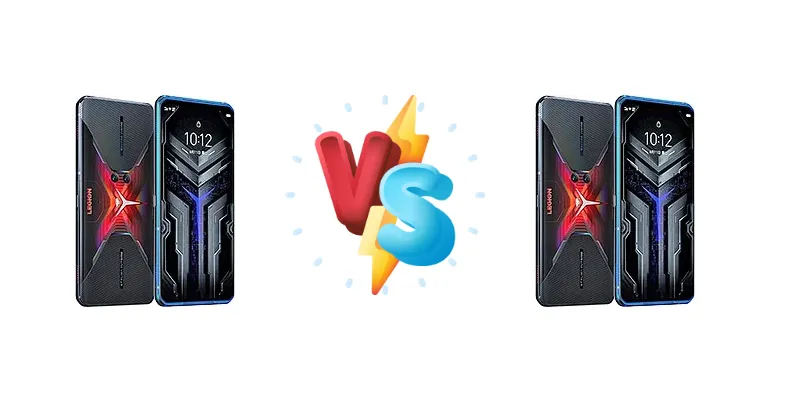
Lenovo entered the gaming phone arena with two distinct devices: the Legion Pro and the Legion Duel. Both leverage the Qualcomm Snapdragon 865 5G+ chipset, promising top-tier performance. However, subtle differences in charging capabilities and potentially thermal solutions differentiate these devices, making a direct comparison crucial for discerning gamers.
🏆 Quick Verdict
For most users, the Lenovo Legion Duel offers a slightly better value proposition. While both phones share the same core performance, the Duel consistently offers 65W or 90W charging across all configurations, while the Pro's charging speed varies significantly based on RAM and storage. This translates to faster top-ups for extended gaming sessions.
| Network |
|---|
| 2G bands | GSM 850 / 900 / 1800 / 1900 | GSM 850 / 900 / 1800 / 1900 |
| 3G bands | HSDPA 850 / 900 / 1900 / 2100 | HSDPA 850 / 900 / 1700(AWS) / 1900 / 2100 |
| 4G bands | LTE | 1, 2, 3, 4, 5, 7, 8, 12, 17, 18, 19, 20, 26, 28, 34, 38, 39, 40, 41, 42 - International |
| 5G bands | SA/NSA | 1, 3, 28, 38, 41, 77, 78, 79 SA/NSA |
| Speed | HSPA 42.2/5.76 Mbps, LTE (4CA) Cat15 800/210 Mbps, 5G 2.5 Gbps DL | HSPA 42.2/5.76 Mbps, LTE (4CA) Cat15 800/210 Mbps, 5G 2.5 Gbps DL |
| Technology | GSM / CDMA / HSPA / LTE / 5G | GSM / HSPA / LTE / 5G |
| | CDMA 800 & TD-SCDMA | - |
| Launch |
|---|
| Announced | 2020, July 22. Released 2020, July 30 | 2020, July 22. Released 2020, October 15 |
| Status | Discontinued | Discontinued |
| Body |
|---|
| Build | Glass front, glass back, aluminum frame | Glass front, glass back, aluminum frame |
| Dimensions | 169.2 x 78.5 x 9.9 mm (6.66 x 3.09 x 0.39 in) | 169.2 x 78.5 x 9.9 mm (6.66 x 3.09 x 0.39 in) |
| SIM | Nano-SIM + Nano-SIM | Nano-SIM + Nano-SIM |
| Weight | 239 g (8.43 oz) | 239 g (8.43 oz) |
| | Water-repellent coating | Water-repellent coating |
| Display |
|---|
| Resolution | 1080 x 2340 pixels, 19.5:9 ratio (~388 ppi density) | 1080 x 2340 pixels, 19.5:9 ratio (~388 ppi density) |
| Size | 6.65 inches, 108.6 cm2 (~81.7% screen-to-body ratio) | 6.65 inches, 108.6 cm2 (~81.7% screen-to-body ratio) |
| Type | AMOLED, 144Hz, HDR10+ | AMOLED, 144Hz, HDR10+ |
| Platform |
|---|
| CPU | Octa-core (1x3.09 GHz Cortex-A77 & 3x2.42 GHz Cortex-A77 & 4x1.80 GHz Cortex-A55) | Octa-core (1x3.09 GHz Cortex-A77 & 3x2.42 GHz Cortex-A77 & 4x1.80 GHz Cortex-A55) |
| Chipset | Qualcomm SM8250 Snapdragon 865 5G+ (7 nm+) | Qualcomm SM8250 Snapdragon 865 5G+ (7 nm+) |
| GPU | Adreno 650 | Adreno 650 |
| OS | Android 10, Legion OS/ ZUI12 | Android 10, Legion OS/ ZUI12 |
| Memory |
|---|
| Card slot | No | No |
| Internal | 128GB 8GB RAM, 128GB 12GB RAM, 256GB 12GB RAM, 512GB 16GB RAM | 256GB 12GB RAM, 512GB 16GB RAM |
| | UFS 3.1 | UFS 3.1 |
| Main Camera |
|---|
| Dual | 64 MP, f/1.9, 25mm (wide), 1/1.72", 0.8µm, PDAF
16 MP, f/2.2, 120˚, 16mm (ultrawide) | 64 MP, f/1.9, 25mm (wide), 1/1.72", 0.8µm, PDAF
16 MP, f/2.2, 120˚, 16mm (ultrawide) |
| Features | Dual-LED flash, panorama, HDR | Dual-LED flash, panorama, HDR |
| Video | 4K@30fps gyro-EIS | 4K@30fps gyro-EIS |
| Selfie camera |
|---|
| Features | LED flash, HDR | LED flash, HDR |
| Single | Motorized pop-up 20 MP, f/2.2, 25mm (wide), 1/3.1", 0.9µm | Motorized pop-up 20 MP, f/2.2, 25mm (wide), 1/3.1", 0.9µm |
| Video | 4K@30fps | 4K@30fps |
| Sound |
|---|
| 3.5mm jack | No | No |
| 35mm jack | No | No |
| Loudspeaker | Yes, with stereo speakers | Yes, with stereo speakers |
| Comms |
|---|
| Bluetooth | 5.0, A2DP, LE, aptX HD, aptX Adaptive | 5.0, A2DP, LE, aptX HD, aptX Adaptive |
| NFC | Yes | Yes |
| Positioning | GPS (L1+L5), GLONASS, GALILEO, BDS, QZSS | GPS (L1+L5), GLONASS, GALILEO, BDS, QZSS |
| Radio | No | No |
| USB | Two USB Type-C, OTG | USB Type-C 3.1 (side), USB Type-C 2.0 (bottom), OTG |
| WLAN | Wi-Fi 802.11 a/b/g/n/ac/6, dual-band, Wi-Fi Direct | Wi-Fi 802.11 a/b/g/n/ac/6, dual-band, Wi-Fi Direct |
| Features |
|---|
| Sensors | Fingerprint (under display, optical), accelerometer, gyro, proximity, compass | Fingerprint (under display, optical), accelerometer, gyro, proximity, compass |
| Battery |
|---|
| Charging | 45W wired, (128GB 8GB RAM model)
65W wired, (128GB 12GB RAM, 256GB 12GB RAM models)
90W wired, 50% in 10 min, 100% in 30 min (512GB 16GB RAM model) | 65W wired, (128GB 12GB RAM, 256GB 12GB RAM models)
90W wired, 50% in 10 min, 100% in 30 min (512GB 16GB RAM model) |
| Type | Li-Po 5000 mAh | Li-Po 5000 mAh |
| Misc |
|---|
| Colors | Vengeance Red, Blazing Blue, White | Vengeance Red, Blazing Blue |
| Models | L79031 | - |
| Price | - | About 510 EUR |
Lenovo Legion Pro
- Potentially lower entry price (depending on configuration)
- Identical Snapdragon 865+ performance to the Duel
- Offers a 90W charging option on the highest-end configuration
- Inconsistent charging speeds based on RAM/storage configuration
- Lower charging speeds on base model (45W)
Lenovo Legion Duel
- Consistent 65W or 90W charging across all configurations
- Faster charging times overall compared to the base Legion Pro
- Predictable charging experience
- May be slightly more expensive than the base Legion Pro configuration
- Shares the same Snapdragon 865+ chipset, offering no performance advantage
Display Comparison
Both the Legion Pro and Duel utilize displays optimized for gaming, though specific details like refresh rates and panel technology aren't provided in the source data. The focus here is on the charging differences. While display quality is likely comparable, the charging speed impacts how quickly you can return to gaming after a break. The absence of information on PWM dimming rates prevents a definitive statement on eye strain reduction.
Camera Comparison
The provided data doesn't offer any details regarding camera specifications beyond the storage options. Therefore, a meaningful comparison is impossible. It's reasonable to assume both phones feature capable camera systems for their price point, but without sensor size, aperture, or image processing details, we can only speculate. The presence of a 2MP macro camera (likely on both) is unlikely to be a significant differentiating factor for most users.
Performance
At the heart of both devices lies the Qualcomm SM8250 Snapdragon 865 5G+ chipset, featuring an octa-core CPU configuration (1x3.09 GHz Cortex-A77, 3x2.42 GHz Cortex-A77, and 4x1.80 GHz Cortex-A55). This ensures identical raw processing power. The performance will be nearly indistinguishable in demanding games and applications. However, the thermal management solutions – which aren't detailed here – could lead to slight differences in sustained performance under heavy load. The shared chipset means RAM speed (likely LPDDR5) will also be similar.
Battery Life
The key differentiator lies in the charging capabilities. The Legion Pro offers 45W charging on the 8GB RAM/128GB model, increasing to 65W for the 12GB RAM/128GB & 256GB models, and finally 90W for the 16GB RAM/512GB model. The Legion Duel consistently provides 65W or 90W charging across its configurations. The 90W charging on both models promises a 50% charge in 10 minutes and 100% in 30 minutes, offering a significant advantage for gamers who need a quick power boost.
Buying Guide
Buy the Lenovo Legion Pro if you prioritize potentially lower entry costs (depending on current deals) and don't mind the variability in charging speeds based on the configuration you choose. Buy the Lenovo Legion Duel if you value consistent, faster charging – particularly the 90W option on higher-end models – and want a more predictable experience for maximizing uptime during intense gaming.
Frequently Asked Questions
❓ Does the varying charging speed on the Legion Pro significantly impact gaming sessions?
Yes, if you purchase the 8GB/128GB Legion Pro with 45W charging, you'll experience considerably slower charging times compared to the Duel's 65W/90W options. This means longer downtime between gaming sessions.
❓ Will I notice a difference in performance between the Legion Pro and Duel while playing demanding games?
No, both phones utilize the same Snapdragon 865 5G+ chipset and likely similar RAM configurations. Performance will be virtually identical in most gaming scenarios. Differences will likely be limited to thermal throttling, which isn't detailed in the provided data.
❓ Is the 90W charging on both phones truly capable of reaching 100% in 30 minutes?
Based on Lenovo's claims, both the Legion Pro (512GB model) and the Legion Duel (with 90W charging) are advertised to reach 100% charge in 30 minutes. However, real-world charging times can vary based on battery temperature and usage patterns.