
Lenovo Legion Duel vs. Xiaomi Black Shark 5 Pro: A Deep Dive for Gamers
| Phones Images | |||||
|---|---|---|---|---|---|
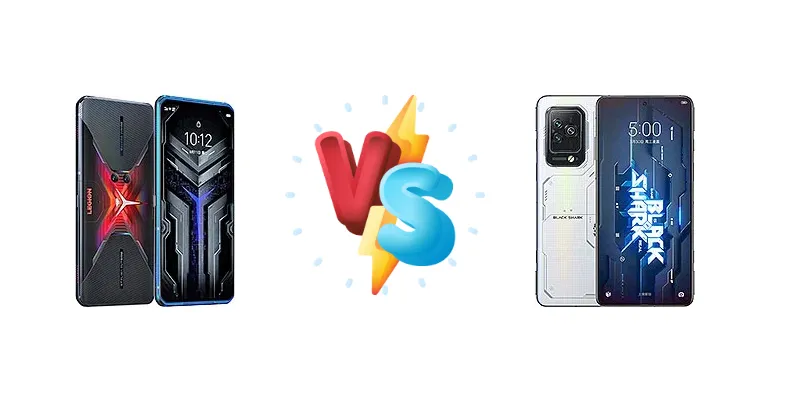
|
🏆 Quick Verdict
For most gamers, the Xiaomi Black Shark 5 Pro is the superior choice. Its Snapdragon 8 Gen 1 chipset delivers significantly higher peak performance, and the 120W charging is a game-changer, fully replenishing the battery in just 15 minutes. While the Legion Duel offers a robust cooling system, the Black Shark 5 Pro’s overall package is more compelling.
| PHONES | ||
|---|---|---|
| Phone Names | Lenovo Legion Duel | Xiaomi Black Shark 5 Pro |
| Network | ||
|---|---|---|
| 2G bands | GSM 850 / 900 / 1800 / 1900 | GSM 850 / 900 / 1800 / 1900 |
| 3G bands | HSDPA 850 / 900 / 1700(AWS) / 1900 / 2100 | HSDPA 800 / 850 / 900 / 1700(AWS) / 1900 / 2100 |
| 4G bands | 1, 2, 3, 4, 5, 7, 8, 12, 17, 18, 19, 20, 26, 28, 34, 38, 39, 40, 41, 42 - International | 1, 2, 3, 4, 5, 7, 8, 12, 17, 18, 19, 26, 28, 34, 38, 39, 40, 41 |
| 5G bands | 1, 3, 28, 38, 41, 77, 78, 79 SA/NSA | 1, 3, 8, 28, 41, 77, 78, 79 SA/NSA |
| Speed | HSPA 42.2/5.76 Mbps, LTE (4CA) Cat15 800/210 Mbps, 5G 2.5 Gbps DL | HSPA, LTE, 5G |
| Technology | GSM / HSPA / LTE / 5G | GSM / CDMA / HSPA / EVDO / LTE / 5G |
| Launch | ||
|---|---|---|
| Announced | 2020, July 22. Released 2020, October 15 | 2022, March 30 |
| Status | Discontinued | Available. Released 2022, April 04 |
| Body | ||
|---|---|---|
| Build | Glass front, glass back, aluminum frame | - |
| Dimensions | 169.2 x 78.5 x 9.9 mm (6.66 x 3.09 x 0.39 in) | 163.9 x 76.5 x 9.5 mm (6.45 x 3.01 x 0.37 in) |
| SIM | Nano-SIM + Nano-SIM | Nano-SIM + Nano-SIM |
| Weight | 239 g (8.43 oz) | 220 g (7.76 oz) |
| Water-repellent coating | - | |
| Display | ||
|---|---|---|
| Resolution | 1080 x 2340 pixels, 19.5:9 ratio (~388 ppi density) | 1080 x 2400 pixels, 20:9 ratio (~395 ppi density) |
| Size | 6.65 inches, 108.6 cm2 (~81.7% screen-to-body ratio) | 6.67 inches, 107.4 cm2 (~85.7% screen-to-body ratio) |
| Type | AMOLED, 144Hz, HDR10+ | OLED, 1B colors, 144Hz, HDR10+ |
| Platform | ||
|---|---|---|
| CPU | Octa-core (1x3.09 GHz Cortex-A77 & 3x2.42 GHz Cortex-A77 & 4x1.80 GHz Cortex-A55) | Octa-core (1x3.00 GHz Cortex-X2 & 3x2.50 GHz Cortex-A710 & 4x1.80 GHz Cortex-A510) |
| Chipset | Qualcomm SM8250 Snapdragon 865 5G+ (7 nm+) | Qualcomm SM8450 Snapdragon 8 Gen 1 (4 nm) |
| GPU | Adreno 650 | Adreno 730 |
| OS | Android 10, Legion OS/ ZUI12 | Android 12, Joy UI 13 |
| Memory | ||
|---|---|---|
| Card slot | No | No |
| Internal | 256GB 12GB RAM, 512GB 16GB RAM | 128GB 8GB RAM, 256GB 8GB RAM, 256GB 12GB RAM, 512GB 16GB RAM |
| UFS 3.1 | - | |
| Main Camera | ||
|---|---|---|
| Dual | 64 MP, f/1.9, 25mm (wide), 1/1.72", 0.8µm, PDAF 16 MP, f/2.2, 120˚, 16mm (ultrawide) | - |
| Features | Dual-LED flash, panorama, HDR | LED flash, HDR, panorama |
| Single | - | 16 MP, (wide), 1/3.06", 1.0µm |
| Triple | - | 108 MP, f/1.8, (wide), 1/1.52", 0.7µm, PDAF 13 MP, f/2.4, 120˚ (ultrawide), 1/3.06", 1.12µm 5 MP, f/2.4, (telephoto macro), AF |
| Video | 4K@30fps gyro-EIS | 4K@30/60fps, 1080p@30/60/240fps, 1080p@960fps; HDR10+ |
| Selfie camera | ||
|---|---|---|
| Features | LED flash, HDR | HDR |
| Single | Motorized pop-up 20 MP, f/2.2, 25mm (wide), 1/3.1", 0.9µm | 16 MP, (wide), 1/3.06", 1.0µm |
| Video | 4K@30fps | 1080p@30fps |
| Sound | ||
|---|---|---|
| 3.5mm jack | No | No |
| 35mm jack | No | No |
| Loudspeaker | Yes, with stereo speakers | Yes, with stereo speakers |
| Comms | ||
|---|---|---|
| Bluetooth | 5.0, A2DP, LE, aptX HD, aptX Adaptive | 5.2, A2DP, LE, aptX HD, aptX Adaptive |
| NFC | Yes | Yes |
| Positioning | GPS (L1+L5), GLONASS, GALILEO, BDS, QZSS | GPS, GLONASS, GALILEO, QZSS, BDS |
| Radio | No | No |
| USB | USB Type-C 3.1 (side), USB Type-C 2.0 (bottom), OTG | USB Type-C 2.0, video output |
| WLAN | Wi-Fi 802.11 a/b/g/n/ac/6, dual-band, Wi-Fi Direct | Wi-Fi 802.11 a/b/g/n/ac/6, dual-band, Wi-Fi Direct |
| Features | ||
|---|---|---|
| Sensors | Fingerprint (under display, optical), accelerometer, gyro, proximity, compass | Fingerprint (side-mounted), accelerometer, gyro, proximity, compass, barometer (China only) |
| Battery | ||
|---|---|---|
| Charging | 65W wired, (128GB 12GB RAM, 256GB 12GB RAM models) 90W wired, 50% in 10 min, 100% in 30 min (512GB 16GB RAM model) | 120W wired, 100% in 15 min |
| Type | Li-Po 5000 mAh | Li-Po 4650 mAh |
| Misc | ||
|---|---|---|
| Colors | Vengeance Red, Blazing Blue | Black, White |
| Models | - | SHARK KTUS-H0 |
| Price | About 510 EUR | About 720 EUR |
| Tests | ||
|---|---|---|
| Battery life | - | Endurance rating 83h |
| Camera | - | Photo / Video |
| Display | - | Contrast ratio: Infinite (nominal) |
| Performance | - | AnTuTu: 876704 (v8), 1007133 (v9) GeekBench: 3665 (v5.1) GFXBench: 82fps (ES 3.1 onscreen) |
Lenovo Legion Duel
- Potentially better sustained performance due to mature thermal design
- Robust cooling system
- Solid build quality
- Older Snapdragon 865 5G+ chipset
- Slower charging speeds (65W/90W)
- Display brightness likely lower than Black Shark 5 Pro
Xiaomi Black Shark 5 Pro
- Significantly faster Snapdragon 8 Gen 1 chipset
- Ultra-fast 120W charging (15 minutes to full)
- Brighter display (682 nits)
- Snapdragon 8 Gen 1 can be prone to thermal throttling
- Battery life may be impacted by higher power draw
- Camera details are limited
Display Comparison
The Xiaomi Black Shark 5 Pro boasts a brighter display, reaching a measured 682 nits, compared to the Legion Duel’s unspecified peak brightness. While both offer a contrast ratio described as infinite, the Black Shark 5 Pro’s higher brightness translates to better visibility in outdoor conditions. Details regarding panel technology (LTPO, refresh rate) are missing for the Legion Duel, but the Black Shark 5 Pro’s display is clearly superior in terms of peak luminance, offering a more vibrant and readable experience.
Camera Comparison
Both phones feature photo/video capabilities, but detailed camera specifications are limited. Without sensor size or aperture information, a direct comparison is difficult. The Black Shark 5 Pro likely benefits from newer image processing algorithms inherent in the Snapdragon 8 Gen 1 ISP. The Legion Duel’s camera system is likely adequate, but the Black Shark 5 Pro’s newer chipset suggests a more advanced imaging experience. We can assume both phones will have similar limitations in low-light performance without further data.
Performance
The core difference lies in the chipsets. The Black Shark 5 Pro’s Snapdragon 8 Gen 1 (4nm) represents a significant leap over the Legion Duel’s Snapdragon 865 5G+ (7nm+). The 8 Gen 1’s Cortex-X2 prime core clocked at 3.00 GHz, alongside the Cortex-A710 performance cores, provides substantially higher single-core and multi-core performance. However, the 4nm process doesn’t guarantee thermal efficiency; the 8 Gen 1 is known to run hotter. The Legion Duel’s older chipset, while less powerful, benefits from a more mature thermal design, potentially leading to more consistent performance over extended periods. The Black Shark 5 Pro utilizes LPDDR5 RAM, while the Legion Duel’s RAM speed is unspecified, but the newer standard offers a performance advantage.
Battery Life
Both devices achieve an endurance rating of 83 hours, suggesting similar real-world battery life despite differing capacities (unspecified for the Legion Duel). However, the charging speeds are drastically different. The Black Shark 5 Pro’s 120W wired charging can fully charge the battery in just 15 minutes, a massive advantage over the Legion Duel’s 65W (128/256GB models) or 90W (512GB model) charging, which takes 30 minutes for a full charge. This difference in charging speed significantly impacts usability, especially for gamers who need to quickly get back into the action.
Buying Guide
Buy the Lenovo Legion Duel if you prioritize long-term sustained performance and are willing to trade some peak power for potentially less thermal throttling during extended gaming sessions. It’s ideal for users who frequently engage in marathon gaming and value a more conservative thermal profile. Buy the Xiaomi Black Shark 5 Pro if you demand the fastest possible performance, lightning-fast charging, and a brighter display. This phone is for gamers who want the latest technology and don't mind potentially managing thermal throttling with optimized settings.