
Lenovo Legion Duel vs. Xiaomi Black Shark 4: A Deep Dive for Mobile Gamers
| Phones Images | |||||
|---|---|---|---|---|---|
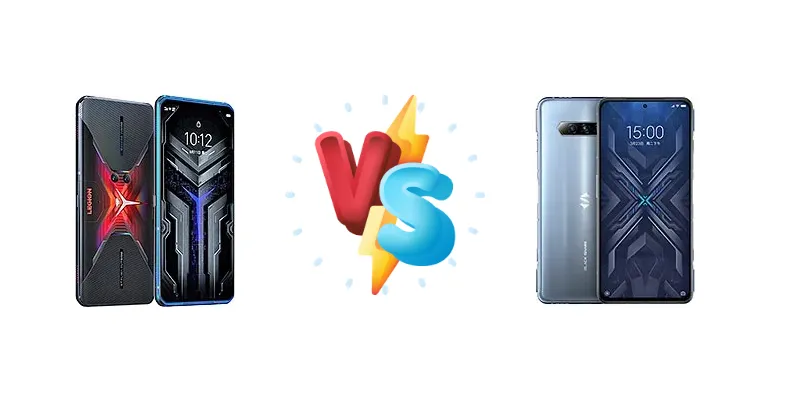
|
🏆 Quick Verdict
For the average gamer prioritizing sustained performance and rapid refueling, the Xiaomi Black Shark 4 emerges as the winner. Its Snapdragon 870 offers comparable gaming performance to the 865+ in the Legion Duel, coupled with a significantly faster 120W charging solution and comparable battery endurance. The Legion Duel remains a strong contender for those demanding maximum theoretical CPU performance.
| PHONES | ||
|---|---|---|
| Phone Names | Lenovo Legion Duel | Xiaomi Black Shark 4 |
| Network | ||
|---|---|---|
| 2G bands | GSM 850 / 900 / 1800 / 1900 | GSM 850 / 900 / 1800 / 1900 |
| 3G bands | HSDPA 850 / 900 / 1700(AWS) / 1900 / 2100 | HSDPA 800 / 850 / 900 / 1700(AWS) / 1900 / 2100 |
| 4G bands | 1, 2, 3, 4, 5, 7, 8, 12, 17, 18, 19, 20, 26, 28, 34, 38, 39, 40, 41, 42 - International | 1, 2, 3, 4, 5, 7, 8, 18, 19, 20, 26, 28, 34, 38, 39, 40, 41 - International, China |
| 5G bands | 1, 3, 28, 38, 41, 77, 78, 79 SA/NSA | 1, 3, 8, 28, 41, 77, 78, 79 SA/NSA - China |
| Speed | HSPA 42.2/5.76 Mbps, LTE (4CA) Cat15 800/210 Mbps, 5G 2.5 Gbps DL | HSPA, LTE, 5G |
| Technology | GSM / HSPA / LTE / 5G | GSM / CDMA / HSPA / EVDO / LTE / 5G |
| - | CDMA2000 1xEV-DO | |
| Launch | ||
|---|---|---|
| Announced | 2020, July 22. Released 2020, October 15 | 2021, March 23 |
| Status | Discontinued | Available. Released 2021, March 30 |
| Body | ||
|---|---|---|
| Build | Glass front, glass back, aluminum frame | - |
| Dimensions | 169.2 x 78.5 x 9.9 mm (6.66 x 3.09 x 0.39 in) | 163.8 x 76.4 x 9.9 mm (6.45 x 3.01 x 0.39 in) |
| SIM | Nano-SIM + Nano-SIM | Nano-SIM + Nano-SIM |
| Weight | 239 g (8.43 oz) | 210 g (7.41 oz) |
| Water-repellent coating | Physical pop-up gaming triggers | |
| Display | ||
|---|---|---|
| Resolution | 1080 x 2340 pixels, 19.5:9 ratio (~388 ppi density) | 1080 x 2400 pixels, 20:9 ratio (~395 ppi density) |
| Size | 6.65 inches, 108.6 cm2 (~81.7% screen-to-body ratio) | 6.67 inches, 107.4 cm2 (~85.8% screen-to-body ratio) |
| Type | AMOLED, 144Hz, HDR10+ | Super AMOLED, 144Hz, HDR10+, 1300 nits (peak) |
| - | Always-on display | |
| Platform | ||
|---|---|---|
| CPU | Octa-core (1x3.09 GHz Cortex-A77 & 3x2.42 GHz Cortex-A77 & 4x1.80 GHz Cortex-A55) | Octa-core (1x3.2 GHz Kryo 585 & 3x2.42 GHz Kryo 585 & 4x1.80 GHz Kryo 585) |
| Chipset | Qualcomm SM8250 Snapdragon 865 5G+ (7 nm+) | Qualcomm SM8250-AC Snapdragon 870 5G (7 nm) |
| GPU | Adreno 650 | Adreno 650 |
| OS | Android 10, Legion OS/ ZUI12 | Android 11, Joy UI 12.5 |
| Memory | ||
|---|---|---|
| Card slot | No | No |
| Internal | 256GB 12GB RAM, 512GB 16GB RAM | 128GB 6GB RAM, 128GB 8GB RAM, 128GB 12GB RAM, 256GB 8GB RAM, 256GB 12GB RAM |
| UFS 3.1 | UFS 3.1 | |
| Main Camera | ||
|---|---|---|
| Dual | 64 MP, f/1.9, 25mm (wide), 1/1.72", 0.8µm, PDAF 16 MP, f/2.2, 120˚, 16mm (ultrawide) | - |
| Features | Dual-LED flash, panorama, HDR | LED flash, HDR, panorama |
| Single | - | 20 MP, f/2.0, (wide), 0.8µm |
| Triple | - | 48 MP, f/1.8, (wide), 1/2.0", 0.8µm, PDAF 8 MP, f/2.2, 120˚ (ultrawide), 1/4.0", 1.12µm 5 MP (macro), AF |
| Video | 4K@30fps gyro-EIS | 4K@30/60fps, 1080p@30/60/240fps, 1080p@960fps |
| Selfie camera | ||
|---|---|---|
| Features | LED flash, HDR | HDR |
| Single | Motorized pop-up 20 MP, f/2.2, 25mm (wide), 1/3.1", 0.9µm | 20 MP, f/2.0, (wide), 0.8µm |
| Video | 4K@30fps | 1080p@30fps |
| Sound | ||
|---|---|---|
| 3.5mm jack | No | Yes |
| 35mm jack | No | Yes |
| Loudspeaker | Yes, with stereo speakers | Yes, with stereo speakers |
| - | 24-bit/192kHz audio | |
| Comms | ||
|---|---|---|
| Bluetooth | 5.0, A2DP, LE, aptX HD, aptX Adaptive | 5.2, A2DP, LE, aptX HD, aptX Adaptive |
| NFC | Yes | Yes |
| Positioning | GPS (L1+L5), GLONASS, GALILEO, BDS, QZSS | GPS, GLONASS, GALILEO, QZSS, BDS |
| Radio | No | No |
| USB | USB Type-C 3.1 (side), USB Type-C 2.0 (bottom), OTG | USB Type-C 2.0 |
| WLAN | Wi-Fi 802.11 a/b/g/n/ac/6, dual-band, Wi-Fi Direct | Wi-Fi 802.11 a/b/g/n/ac/6, dual-band, Wi-Fi Direct |
| Features | ||
|---|---|---|
| Sensors | Fingerprint (under display, optical), accelerometer, gyro, proximity, compass | Fingerprint (side-mounted), accelerometer, gyro, proximity, compass, barometer |
| Battery | ||
|---|---|---|
| Charging | 65W wired, (128GB 12GB RAM, 256GB 12GB RAM models) 90W wired, 50% in 10 min, 100% in 30 min (512GB 16GB RAM model) | 120W wired, 100% in 17 min |
| Type | Li-Po 5000 mAh | Li-Po 4500 mAh |
| Misc | ||
|---|---|---|
| Colors | Vengeance Red, Blazing Blue | Mirror Black, Pale Grey, Black, Blue, Silver |
| Models | - | SHARK PRS-H0, SHARK PRS-A0, SHARK KSR-A0 |
| Price | About 510 EUR | About 930 EUR |
| Tests | ||
|---|---|---|
| Battery life | - | Endurance rating 96h |
| Camera | - | Photo / Video |
| Display | - | Contrast ratio: Infinite (nominal) |
| Loudspeaker | - | -27.4 LUFS (Good) |
| Performance | - | AnTuTu: 617456 (v8) GeekBench: 3448 (v5.1) GFXBench: 54fps (ES 3.1 onscreen) |
Lenovo Legion Duel
- Potentially higher peak CPU performance with Snapdragon 865+
- Unique dual-fan cooling system for sustained performance
- Option for 16GB of RAM for heavy multitasking
- Slower charging speeds compared to Black Shark 4
- Less efficient chipset architecture potentially leading to more throttling
- Limited display brightness information
Xiaomi Black Shark 4
- Significantly faster 120W charging (17 minutes to full)
- More efficient Snapdragon 870 chipset for sustained gaming
- Higher peak display brightness (694 nits)
- Slightly lower peak CPU performance compared to Legion Duel
- Camera specifications are largely unknown
- May lack the aggressive cooling solution of the Legion Duel
Display Comparison
The Xiaomi Black Shark 4 boasts a measured peak brightness of 694 nits, a significant advantage over the Legion Duel (brightness data unavailable). While both likely utilize high refresh rate panels, the Black Shark 4’s higher brightness translates to better visibility in outdoor conditions. Contrast ratio is listed as infinite for the Black Shark 4, typical of AMOLED displays, while the Legion Duel’s panel type is unspecified. The Black Shark 4’s display is therefore more likely to offer a more vibrant and visible experience.
Camera Comparison
Both devices offer photo and video capabilities, but detailed camera specifications are limited. Without sensor size or aperture information, a direct comparison is difficult. The Legion Duel’s camera is likely tuned for general use, while the Black Shark 4 may prioritize features appealing to gamers, such as fast capture speeds. The absence of detailed camera specs suggests neither phone is a primary focus for photography enthusiasts.
Performance
The core difference lies in the chipsets. The Lenovo Legion Duel features the Qualcomm SM8250 Snapdragon 865 5G+ (7nm+), while the Xiaomi Black Shark 4 utilizes the SM8250-AC Snapdragon 870 5G (7nm). Although the 865+ has a slightly higher clocked Cortex-A77 prime core (3.09 GHz vs 3.2 GHz on the 870), the 870’s Kryo 585 cores offer improved efficiency and sustained performance. Both phones feature ample RAM, but the Legion Duel offers a 16GB option, potentially beneficial for heavy multitasking. However, the 870’s architecture and thermal efficiency give it an edge in prolonged gaming sessions, minimizing throttling.
Battery Life
Both phones achieve an endurance rating of 96 hours, suggesting comparable real-world battery life despite differing capacities (data unavailable for Legion Duel). However, the charging speeds are dramatically different. The Legion Duel offers 65W or 90W wired charging (depending on RAM configuration), taking up to 30 minutes for a full charge on the 512GB model. The Black Shark 4’s 120W charging is a game-changer, achieving a full charge in just 17 minutes. This rapid charging capability significantly reduces downtime and enhances the overall user experience.
Buying Guide
Buy the Lenovo Legion Duel if you absolutely need the highest possible single-core CPU performance for specific, demanding tasks beyond gaming, and appreciate its unique dual-fan cooling system. Buy the Xiaomi Black Shark 4 if you prioritize a balanced gaming experience with exceptional charging speeds, solid battery life, and a more mainstream form factor. The Black Shark 4 is the more practical choice for daily use alongside gaming.