
Lenovo Legion Duel vs OnePlus 11R: A Deep Dive into Gaming and Performance
| Phones Images | |||||
|---|---|---|---|---|---|
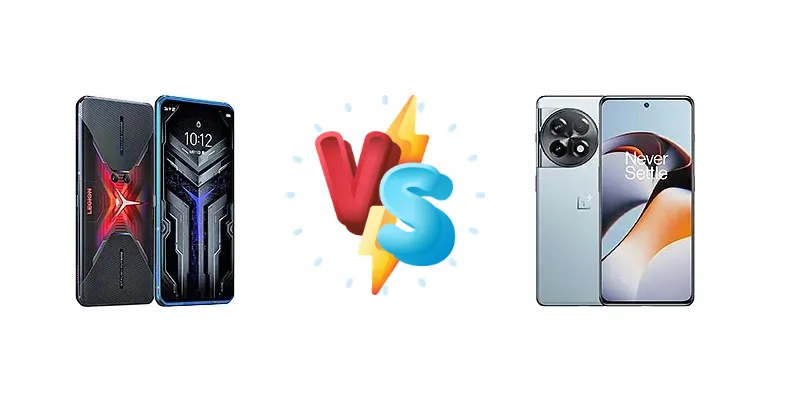
|
🏆 Quick Verdict
For most users, the OnePlus 11R emerges as the better choice. Its Snapdragon 8+ Gen 1 offers a significant performance uplift over the Legion Duel’s Snapdragon 865+, coupled with faster 100W charging. While the Legion Duel’s gaming-centric design is unique, the 11R delivers a more well-rounded and future-proof experience.
| PHONES | ||
|---|---|---|
| Phone Names | Lenovo Legion Duel | OnePlus 11R |
| Network | ||
|---|---|---|
| 2G bands | GSM 850 / 900 / 1800 / 1900 | GSM 850 / 900 / 1800 / 1900 |
| 3G bands | HSDPA 850 / 900 / 1700(AWS) / 1900 / 2100 | HSDPA 850 / 900 / 1700(AWS) / 2100 |
| 4G bands | 1, 2, 3, 4, 5, 7, 8, 12, 17, 18, 19, 20, 26, 28, 34, 38, 39, 40, 41, 42 - International | 1, 3, 4, 5, 8, 28, 34, 38, 39, 40, 41 |
| 5G bands | 1, 3, 28, 38, 41, 77, 78, 79 SA/NSA | 1, 3, 5, 8, 28, 40, 41, 77, 78 SA/NSA |
| Speed | HSPA 42.2/5.76 Mbps, LTE (4CA) Cat15 800/210 Mbps, 5G 2.5 Gbps DL | HSPA, LTE (3CA), 5G |
| Technology | GSM / HSPA / LTE / 5G | GSM / CDMA / HSPA / LTE / 5G |
| - | CDMA 800 | |
| Launch | ||
|---|---|---|
| Announced | 2020, July 22. Released 2020, October 15 | 2023, February 07 |
| Status | Discontinued | Available. Released 2023, February 21 |
| Body | ||
|---|---|---|
| Build | Glass front, glass back, aluminum frame | Glass front, glass back (Gorilla Glass 5), plastic frame |
| Dimensions | 169.2 x 78.5 x 9.9 mm (6.66 x 3.09 x 0.39 in) | 163.4 x 74.3 x 8.7 mm (6.43 x 2.93 x 0.34 in) |
| SIM | Nano-SIM + Nano-SIM | Nano-SIM + Nano-SIM |
| Weight | 239 g (8.43 oz) | 204 g (7.20 oz) |
| Water-repellent coating | - | |
| Display | ||
|---|---|---|
| Resolution | 1080 x 2340 pixels, 19.5:9 ratio (~388 ppi density) | 1240 x 2772 pixels, 20:9 ratio (~451 ppi density) |
| Size | 6.65 inches, 108.6 cm2 (~81.7% screen-to-body ratio) | 6.74 inches, 109.2 cm2 (~90.0% screen-to-body ratio) |
| Type | AMOLED, 144Hz, HDR10+ | Fluid AMOLED, 1B colors, 120Hz, HDR10+, 1450 nits (peak) |
| Platform | ||
|---|---|---|
| CPU | Octa-core (1x3.09 GHz Cortex-A77 & 3x2.42 GHz Cortex-A77 & 4x1.80 GHz Cortex-A55) | Octa-core (1x3.0 GHz Cortex-X2 & 3x2.5 GHz Cortex-A710 & 4x1.80 GHz Cortex-A510) |
| Chipset | Qualcomm SM8250 Snapdragon 865 5G+ (7 nm+) | Qualcomm SM8475 Snapdragon 8+ Gen 1 (4 nm) |
| GPU | Adreno 650 | Adreno 730 |
| OS | Android 10, Legion OS/ ZUI12 | Android 13, upgradable to Android 15, OxygenOS 15 |
| Memory | ||
|---|---|---|
| Card slot | No | No |
| Internal | 256GB 12GB RAM, 512GB 16GB RAM | 128GB 8GB RAM, 256GB 16GB RAM, 512GB 18GB RAM |
| UFS 3.1 | UFS 3.1 | |
| Main Camera | ||
|---|---|---|
| Dual | 64 MP, f/1.9, 25mm (wide), 1/1.72", 0.8µm, PDAF 16 MP, f/2.2, 120˚, 16mm (ultrawide) | - |
| Features | Dual-LED flash, panorama, HDR | Color spectrum sensor, LED flash, HDR, panorama |
| Single | - | 16 MP, f/2.4, 24mm (wide), 1/3.09", 1.0µm |
| Triple | - | 50 MP, f/1.8, 24mm (wide), 1/1.56", 1.0µm, multi-directional PDAF, OIS 8 MP, f/2.2, 120˚ (ultrawide), 1/4.0", 1.12µm 2 MP (macro) |
| Video | 4K@30fps gyro-EIS | 4K@30/60fps, 1080p@30/60/240fps, gyro-EIS |
| Selfie camera | ||
|---|---|---|
| Features | LED flash, HDR | HDR |
| Single | Motorized pop-up 20 MP, f/2.2, 25mm (wide), 1/3.1", 0.9µm | 16 MP, f/2.4, 24mm (wide), 1/3.09", 1.0µm |
| Video | 4K@30fps | 1080p@30fps |
| Sound | ||
|---|---|---|
| 3.5mm jack | No | No |
| 35mm jack | No | No |
| Loudspeaker | Yes, with stereo speakers | Yes, with stereo speakers |
| - | 24-bit/192kHz audio | |
| Comms | ||
|---|---|---|
| Bluetooth | 5.0, A2DP, LE, aptX HD, aptX Adaptive | 5.3, A2DP, LE, aptX HD |
| Infrared port | - | Yes |
| NFC | Yes | Yes |
| Positioning | GPS (L1+L5), GLONASS, GALILEO, BDS, QZSS | GPS (L1+L5), GLONASS (G1), BDS (B1I+B1c+B2a), GALILEO (E1+E5a), QZSS (L1+L5) |
| Radio | No | No |
| USB | USB Type-C 3.1 (side), USB Type-C 2.0 (bottom), OTG | USB Type-C 2.0 |
| WLAN | Wi-Fi 802.11 a/b/g/n/ac/6, dual-band, Wi-Fi Direct | Wi-Fi 802.11 a/b/g/n/ac/6, dual-band |
| Features | ||
|---|---|---|
| Sensors | Fingerprint (under display, optical), accelerometer, gyro, proximity, compass | Fingerprint (under display, optical), accelerometer, gyro, proximity, compass |
| Battery | ||
|---|---|---|
| Charging | 65W wired, (128GB 12GB RAM, 256GB 12GB RAM models) 90W wired, 50% in 10 min, 100% in 30 min (512GB 16GB RAM model) | 100W wired |
| Type | Li-Po 5000 mAh | Li-Po 5000 mAh |
| Misc | ||
|---|---|---|
| Colors | Vengeance Red, Blazing Blue | Galactic Silver, Sonic Black, Solar Red |
| Models | - | CPH2487 |
| Price | About 510 EUR | About 600 EUR |
| SAR | - | 1.16 W/kg (head) 0.61 W/kg (body) |
Lenovo Legion Duel
- Dedicated gaming features (triggers, cooling)
- Potentially larger display for immersion
- High RAM options (12GB/16GB)
- Older Snapdragon 865+ chipset
- Less efficient 7nm+ process
- Slower charging speeds (65W/90W)
OnePlus 11R
- Newer Snapdragon 8+ Gen 1 chipset
- More efficient 4nm process
- Faster 100W charging
- Lacks dedicated gaming hardware
- May prioritize camera over raw gaming performance
- Potentially less immersive display size
Display Comparison
Neither device's display specifications are provided, so a direct comparison is limited. However, given the Legion Duel's gaming focus, it likely prioritizes a high refresh rate and low latency. The OnePlus 11R, being a more mainstream device, likely balances color accuracy and power efficiency. The Legion Duel's larger size may allow for a more immersive experience, but without specific details like peak brightness or panel technology (LTPO), it's difficult to definitively declare a winner. Bezels are likely minimal on both, reflecting current design trends.
Camera Comparison
Camera details are absent for both devices. However, given the Legion Duel’s gaming focus, its camera system is likely secondary to its performance capabilities. The OnePlus 11R, as a more mainstream flagship, likely features a more sophisticated camera setup with larger sensors and advanced image processing. We can assume the 11R will offer better overall image quality and versatility, particularly in low-light conditions. Without specific sensor sizes or aperture information, a precise comparison is impossible, but the 11R is expected to excel.
Performance
The OnePlus 11R’s Snapdragon 8+ Gen 1 (4nm) represents a substantial leap over the Lenovo Legion Duel’s Snapdragon 865+ (7nm+). The 8+ Gen 1’s newer architecture, including the Cortex-X2 prime core, delivers significantly improved CPU performance – 3.0 GHz vs 3.09 GHz – and a more powerful Adreno GPU. The 4nm process node also translates to better thermal efficiency, reducing the likelihood of throttling during extended gaming sessions. While the Legion Duel’s 12GB/16GB of RAM is competitive, the 8+ Gen 1’s overall system-on-chip (SoC) efficiency gives the 11R a clear advantage.
Battery Life
The OnePlus 11R’s 100W wired charging is a major advantage, allowing for a full charge in a significantly shorter time than the Legion Duel’s 65W/90W options. The 90W charging on the 512GB Legion Duel model, achieving 100% in 30 minutes, is still respectable, but the 11R’s 100W is faster. While battery capacity isn’t specified, the 11R’s more efficient Snapdragon 8+ Gen 1 will likely deliver comparable or better real-world battery life despite potentially having a smaller battery. The faster charging speed mitigates any potential capacity difference.
Buying Guide
Buy the Lenovo Legion Duel if you prioritize a dedicated gaming experience with unique features like built-in cooling and shoulder triggers, and are willing to accept an older chipset. Buy the OnePlus 11R if you prefer a more modern, versatile smartphone with superior processing power, faster charging, and a more competitive price point, even if it lacks dedicated gaming hardware.