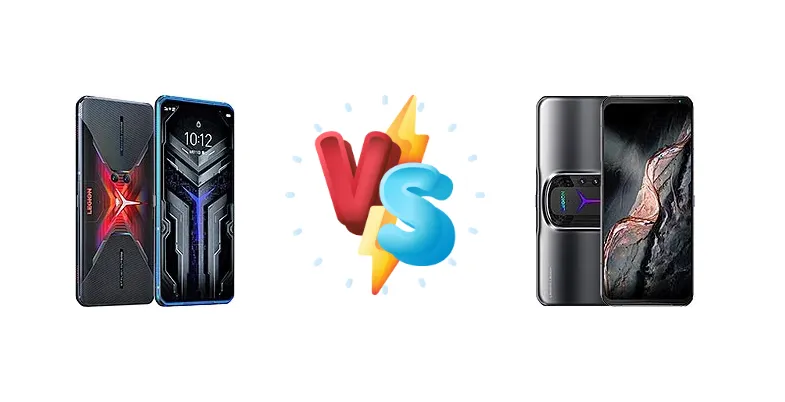
Lenovo has consistently pushed boundaries in the gaming phone space with its Legion series. The Duel, featuring the Snapdragon 865+, established a strong foundation with its unique design and powerful performance. The Y90, arriving later with the Snapdragon 8 Gen 1, aims to build upon that legacy with a newer chipset and refined features. This comparison dives deep into the core differences to determine which Legion device reigns supreme for mobile gamers.
🏆 Quick Verdict
For most gamers, the Lenovo Legion Y90 emerges as the superior choice. While the Duel remains a capable device, the Y90’s Snapdragon 8 Gen 1 offers a significant performance uplift, despite a slightly slower charging speed. The architectural improvements of the newer chipset translate to a more future-proof gaming experience.
| Network |
|---|
| 2G bands | GSM 850 / 900 / 1800 / 1900 | GSM 850 / 900 / 1800 / 1900 |
| 3G bands | HSDPA 850 / 900 / 1700(AWS) / 1900 / 2100 | HSDPA 800 / 850 / 900 / 1900 / 2100 |
| 4G bands | 1, 2, 3, 4, 5, 7, 8, 12, 17, 18, 19, 20, 26, 28, 34, 38, 39, 40, 41, 42 - International | LTE |
| 5G bands | 1, 3, 28, 38, 41, 77, 78, 79 SA/NSA | SA/NSA/Sub6 |
| Speed | HSPA 42.2/5.76 Mbps, LTE (4CA) Cat15 800/210 Mbps, 5G 2.5 Gbps DL | HSPA, LTE, 5G |
| Technology | GSM / HSPA / LTE / 5G | GSM / CDMA / HSPA / CDMA2000 / LTE / 5G |
| | - | CDMA2000 1x |
| Launch |
|---|
| Announced | 2020, July 22. Released 2020, October 15 | 2022, March 01 |
| Status | Discontinued | Available. Released 2022, March 10 |
| Body |
|---|
| Build | Glass front, glass back, aluminum frame | - |
| Dimensions | 169.2 x 78.5 x 9.9 mm (6.66 x 3.09 x 0.39 in) | 177 x 78.4 x 10.1 mm (6.97 x 3.09 x 0.40 in) |
| SIM | Nano-SIM + Nano-SIM | Nano-SIM + Nano-SIM |
| Weight | 239 g (8.43 oz) | 252 g (8.89 oz) |
| | Water-repellent coating | Built-in two cooling fans
RGB light panel (on the back)
4 ultrasonic buttons (Gaming triggers) |
| Display |
|---|
| Resolution | 1080 x 2340 pixels, 19.5:9 ratio (~388 ppi density) | 1080 x 2460 pixels (~388 ppi density) |
| Size | 6.65 inches, 108.6 cm2 (~81.7% screen-to-body ratio) | 6.92 inches, 113.7 cm2 (~81.9% screen-to-body ratio) |
| Type | AMOLED, 144Hz, HDR10+ | AMOLED, 144Hz, HDR10+, 1300 nits (peak) |
| Platform |
|---|
| CPU | Octa-core (1x3.09 GHz Cortex-A77 & 3x2.42 GHz Cortex-A77 & 4x1.80 GHz Cortex-A55) | Octa-core (1x3.00 GHz Cortex-X2 & 3x2.50 GHz Cortex-A710 & 4x1.80 GHz Cortex-A510) |
| Chipset | Qualcomm SM8250 Snapdragon 865 5G+ (7 nm+) | Qualcomm SM8450 Snapdragon 8 Gen 1 (4 nm) |
| GPU | Adreno 650 | Adreno 730 |
| OS | Android 10, Legion OS/ ZUI12 | Android 12, ZUI 13 |
| Memory |
|---|
| Card slot | No | No |
| Internal | 256GB 12GB RAM, 512GB 16GB RAM | 256GB 12GB RAM, 256GB 16GB RAM, 640GB 18GB RAM |
| | UFS 3.1 | UFS 3.1
640GB (512GB UFS + 128GB SSD) |
| Main Camera |
|---|
| Dual | 64 MP, f/1.9, 25mm (wide), 1/1.72", 0.8µm, PDAF
16 MP, f/2.2, 120˚, 16mm (ultrawide) | 64 MP, f/1.9, 25mm (wide), 1/1.32", 1.0µm, PDAF
13 MP, 120˚ (ultrawide) |
| Features | Dual-LED flash, panorama, HDR | Dual-LED flash, panorama, HDR |
| Video | 4K@30fps gyro-EIS | 8K@24fps, 4K@30/60fps, 1080p@30/60/240fps, gyro-EIS, HDR10+ rec. |
| Selfie camera |
|---|
| Features | LED flash, HDR | HDR |
| Single | Motorized pop-up 20 MP, f/2.2, 25mm (wide), 1/3.1", 0.9µm | 16 MP |
| Video | 4K@30fps | 4K@30/60fps, 1080p@30/60/120fps |
| Sound |
|---|
| 3.5mm jack | No | No |
| 35mm jack | No | No |
| Loudspeaker | Yes, with stereo speakers | Yes, with stereo speakers |
| Comms |
|---|
| Bluetooth | 5.0, A2DP, LE, aptX HD, aptX Adaptive | 5.2, A2DP, LE |
| NFC | Yes | Yes |
| Positioning | GPS (L1+L5), GLONASS, GALILEO, BDS, QZSS | GPS (L1+L5), GLONASS, GALILEO, BDS, QZSS |
| Radio | No | No |
| USB | USB Type-C 3.1 (side), USB Type-C 2.0 (bottom), OTG | USB Type-C 3.1 Gen2, USB Type-C 2.0, OTG |
| WLAN | Wi-Fi 802.11 a/b/g/n/ac/6, dual-band, Wi-Fi Direct | Wi-Fi 802.11 a/b/g/n/ac/6, dual-band, Wi-Fi Direct |
| Features |
|---|
| Sensors | Fingerprint (under display, optical), accelerometer, gyro, proximity, compass | Fingerprint (under display, optical), accelerometer, gyro, proximity, compass |
| Battery |
|---|
| Charging | 65W wired, (128GB 12GB RAM, 256GB 12GB RAM models)
90W wired, 50% in 10 min, 100% in 30 min (512GB 16GB RAM model) | 68W wired, 100% in 35 min |
| Type | Li-Po 5000 mAh | Li-Po 5600 mAh |
| Misc |
|---|
| Colors | Vengeance Red, Blazing Blue | Gray |
| Models | - | L71061 |
| Price | About 510 EUR | About 570 EUR |
Lenovo Legion Duel
- Potentially lower price point
- Faster charging (512GB model)
- Proven Snapdragon 865+ performance
- Older chipset architecture
- Less power efficient
- May exhibit more thermal throttling
Lenovo Legion Y90
- Significantly more powerful Snapdragon 8 Gen 1
- Improved power efficiency and thermal management
- More future-proof for demanding games
- Slower charging speed
- Higher price
- Potential for higher initial heat output
Display Comparison
Both devices are expected to feature high refresh rate displays suitable for gaming, but specific details like panel type (OLED, AMOLED) and resolution are not provided. However, the focus here is on processing power, not display fidelity. The Duel’s age suggests it may lack features like LTPO for variable refresh rates found in newer devices like the Y90, potentially impacting battery life during less demanding tasks. Bezels are likely similar given the gaming-focused design language of both.
Camera Comparison
Neither phone is primarily marketed for its camera capabilities. The context data doesn’t provide sufficient detail for a meaningful comparison. We can assume both feature capable main sensors for adequate image capture, but the focus remains on gaming. Any differences in image processing or secondary sensors are unlikely to be a deciding factor for the target audience.
Performance
The core difference lies in the chipsets. The Legion Duel’s Snapdragon 865+ (7nm+) is a powerful processor, but the Legion Y90’s Snapdragon 8 Gen 1 (4nm) represents a substantial leap forward. The 4nm process node offers significantly improved power efficiency, meaning the Y90 is likely to sustain peak performance for longer periods before thermal throttling becomes a concern. The Y90’s CPU features the Cortex-X2 prime core clocked at 3.00 GHz, a step up from the Duel’s Cortex-A77 at 3.09 GHz, promising faster single-core performance. The Y90 also benefits from newer Cortex-A710 performance cores versus the Duel’s A77, further enhancing multi-core capabilities. Both utilize LPDDR5 RAM, but the Y90’s newer chipset likely supports faster RAM speeds.
Battery Life
The Legion Duel offers varying charging speeds depending on the RAM/storage configuration: 65W for 128/256GB models and 90W for the 512GB/16GB model, achieving 100% charge in 30 minutes with the faster charger. The Legion Y90, however, is limited to 68W wired charging, taking 35 minutes to reach full capacity. While the Y90 charges slightly slower, the Snapdragon 8 Gen 1’s improved efficiency may offset this difference in real-world usage, providing comparable or even better battery life despite potentially having a similar capacity battery. The Duel’s 90W charging is a clear advantage for those prioritizing the fastest possible recharge times.
Buying Guide
Buy the Lenovo Legion Duel if you prioritize a potentially lower price point and are satisfied with high-end, but not bleeding-edge, performance. It’s a solid option for gamers who don’t necessarily need the absolute latest chipset. Buy the Lenovo Legion Y90 if you demand the best possible Android gaming performance, are willing to pay a premium, and value the architectural advantages of the Snapdragon 8 Gen 1 for sustained performance and future game compatibility.
Frequently Asked Questions
❓ Will the Snapdragon 8 Gen 1 in the Legion Y90 overheat during extended gaming sessions?
While the Snapdragon 8 Gen 1 was initially known for thermal concerns, Lenovo’s Legion Y90 incorporates advanced cooling solutions, including vapor chamber cooling and multiple graphite layers. The 4nm process also contributes to improved efficiency. While it may get warm, it’s designed to mitigate overheating and sustain performance for longer periods compared to the Duel’s 865+.
❓ Does the Legion Y90 support higher frame rates in popular games like PUBG Mobile or Call of Duty: Mobile?
The Snapdragon 8 Gen 1’s Adreno 730 GPU provides a significant performance boost, enabling higher frame rates in demanding titles. The Legion Y90 is capable of running PUBG Mobile and Call of Duty: Mobile at 90fps or even higher settings, depending on the game’s optimization and graphics settings. The Duel, while capable, will likely be limited to lower frame rates.
❓ Is the difference in charging speed between the Duel (90W) and Y90 (68W) noticeable in everyday use?
Yes, the 22W difference is noticeable. The Duel, especially the 512GB model, will recharge significantly faster. However, the Y90’s improved power efficiency may mean you don’t *need* to charge as frequently, partially offsetting the slower charging speed. For users who frequently top up their battery throughout the day, the Duel’s faster charging is a clear advantage.