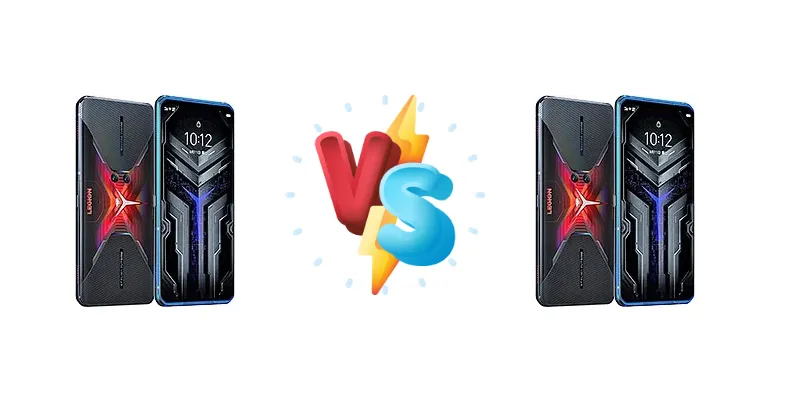
Lenovo entered the gaming phone arena with a bold statement, releasing both the Legion Duel and Legion Pro around the same timeframe, both powered by the Snapdragon 865 5G+. While sharing a core chipset, key differences in charging capabilities and RAM configurations create distinct user experiences. This comparison dissects these nuances to determine which Legion device best suits your gaming needs.
🏆 Quick Verdict
For the power user prioritizing the absolute fastest charging and willing to pay a premium, the Lenovo Legion Duel (512GB/16GB model) is the winner. However, the Legion Pro offers a more balanced experience with competitive charging speeds on select models and a potentially lower price point, making it ideal for mainstream gamers.
| Network |
|---|
| 2G bands | GSM 850 / 900 / 1800 / 1900 | GSM 850 / 900 / 1800 / 1900 |
| 3G bands | HSDPA 850 / 900 / 1700(AWS) / 1900 / 2100 | HSDPA 850 / 900 / 1900 / 2100 |
| 4G bands | 1, 2, 3, 4, 5, 7, 8, 12, 17, 18, 19, 20, 26, 28, 34, 38, 39, 40, 41, 42 - International | LTE |
| 5G bands | 1, 3, 28, 38, 41, 77, 78, 79 SA/NSA | SA/NSA |
| Speed | HSPA 42.2/5.76 Mbps, LTE (4CA) Cat15 800/210 Mbps, 5G 2.5 Gbps DL | HSPA 42.2/5.76 Mbps, LTE (4CA) Cat15 800/210 Mbps, 5G 2.5 Gbps DL |
| Technology | GSM / HSPA / LTE / 5G | GSM / CDMA / HSPA / LTE / 5G |
| | - | CDMA 800 & TD-SCDMA |
| Launch |
|---|
| Announced | 2020, July 22. Released 2020, October 15 | 2020, July 22. Released 2020, July 30 |
| Status | Discontinued | Discontinued |
| Body |
|---|
| Build | Glass front, glass back, aluminum frame | Glass front, glass back, aluminum frame |
| Dimensions | 169.2 x 78.5 x 9.9 mm (6.66 x 3.09 x 0.39 in) | 169.2 x 78.5 x 9.9 mm (6.66 x 3.09 x 0.39 in) |
| SIM | Nano-SIM + Nano-SIM | Nano-SIM + Nano-SIM |
| Weight | 239 g (8.43 oz) | 239 g (8.43 oz) |
| | Water-repellent coating | Water-repellent coating |
| Display |
|---|
| Resolution | 1080 x 2340 pixels, 19.5:9 ratio (~388 ppi density) | 1080 x 2340 pixels, 19.5:9 ratio (~388 ppi density) |
| Size | 6.65 inches, 108.6 cm2 (~81.7% screen-to-body ratio) | 6.65 inches, 108.6 cm2 (~81.7% screen-to-body ratio) |
| Type | AMOLED, 144Hz, HDR10+ | AMOLED, 144Hz, HDR10+ |
| Platform |
|---|
| CPU | Octa-core (1x3.09 GHz Cortex-A77 & 3x2.42 GHz Cortex-A77 & 4x1.80 GHz Cortex-A55) | Octa-core (1x3.09 GHz Cortex-A77 & 3x2.42 GHz Cortex-A77 & 4x1.80 GHz Cortex-A55) |
| Chipset | Qualcomm SM8250 Snapdragon 865 5G+ (7 nm+) | Qualcomm SM8250 Snapdragon 865 5G+ (7 nm+) |
| GPU | Adreno 650 | Adreno 650 |
| OS | Android 10, Legion OS/ ZUI12 | Android 10, Legion OS/ ZUI12 |
| Memory |
|---|
| Card slot | No | No |
| Internal | 256GB 12GB RAM, 512GB 16GB RAM | 128GB 8GB RAM, 128GB 12GB RAM, 256GB 12GB RAM, 512GB 16GB RAM |
| | UFS 3.1 | UFS 3.1 |
| Main Camera |
|---|
| Dual | 64 MP, f/1.9, 25mm (wide), 1/1.72", 0.8µm, PDAF
16 MP, f/2.2, 120˚, 16mm (ultrawide) | 64 MP, f/1.9, 25mm (wide), 1/1.72", 0.8µm, PDAF
16 MP, f/2.2, 120˚, 16mm (ultrawide) |
| Features | Dual-LED flash, panorama, HDR | Dual-LED flash, panorama, HDR |
| Video | 4K@30fps gyro-EIS | 4K@30fps gyro-EIS |
| Selfie camera |
|---|
| Features | LED flash, HDR | LED flash, HDR |
| Single | Motorized pop-up 20 MP, f/2.2, 25mm (wide), 1/3.1", 0.9µm | Motorized pop-up 20 MP, f/2.2, 25mm (wide), 1/3.1", 0.9µm |
| Video | 4K@30fps | 4K@30fps |
| Sound |
|---|
| 3.5mm jack | No | No |
| 35mm jack | No | No |
| Loudspeaker | Yes, with stereo speakers | Yes, with stereo speakers |
| Comms |
|---|
| Bluetooth | 5.0, A2DP, LE, aptX HD, aptX Adaptive | 5.0, A2DP, LE, aptX HD, aptX Adaptive |
| NFC | Yes | Yes |
| Positioning | GPS (L1+L5), GLONASS, GALILEO, BDS, QZSS | GPS (L1+L5), GLONASS, GALILEO, BDS, QZSS |
| Radio | No | No |
| USB | USB Type-C 3.1 (side), USB Type-C 2.0 (bottom), OTG | Two USB Type-C, OTG |
| WLAN | Wi-Fi 802.11 a/b/g/n/ac/6, dual-band, Wi-Fi Direct | Wi-Fi 802.11 a/b/g/n/ac/6, dual-band, Wi-Fi Direct |
| Features |
|---|
| Sensors | Fingerprint (under display, optical), accelerometer, gyro, proximity, compass | Fingerprint (under display, optical), accelerometer, gyro, proximity, compass |
| Battery |
|---|
| Charging | 65W wired, (128GB 12GB RAM, 256GB 12GB RAM models)
90W wired, 50% in 10 min, 100% in 30 min (512GB 16GB RAM model) | 45W wired, (128GB 8GB RAM model)
65W wired, (128GB 12GB RAM, 256GB 12GB RAM models)
90W wired, 50% in 10 min, 100% in 30 min (512GB 16GB RAM model) |
| Type | Li-Po 5000 mAh | Li-Po 5000 mAh |
| Misc |
|---|
| Colors | Vengeance Red, Blazing Blue | Vengeance Red, Blazing Blue, White |
| Models | - | L79031 |
| Price | About 510 EUR | - |
Lenovo Legion Duel
- Potentially faster charging (90W on 512GB model)
- Higher RAM options (up to 16GB)
- Unique dual-screen design for multitasking
- Potentially higher price point
- Bulkier design due to dual-screen
Lenovo Legion Pro
- Potentially more affordable entry price (8GB RAM model)
- Competitive charging speeds (65W on select models)
- Slightly more streamlined design
- Lower base RAM configuration (8GB)
- Slower charging on the base 128GB/8GB model (45W)
Display Comparison
Both devices utilize similar display technology, though specific details like refresh rates and panel type aren't provided. The focus here is on charging and performance. However, the Duel's unique dual-screen design (not detailed in the provided data) is a significant differentiator, offering additional screen real estate for multitasking during gaming. This impacts ergonomics and potentially thermal management, as the second screen contributes to heat dissipation.
Camera Comparison
The provided data doesn't offer any details regarding camera specifications. Given the gaming focus, camera quality is likely a secondary consideration for both devices. We can assume both phones will feature capable cameras for social media and casual photography, but they won't compete with dedicated camera-centric smartphones.
Performance
Both the Legion Duel and Pro are equipped with the Qualcomm SM8250 Snapdragon 865 5G+ chipset, featuring an octa-core CPU configuration identical across both devices. This means raw processing power will be nearly indistinguishable in most tasks. The key difference lies in RAM configurations: the Duel offers 12GB and 16GB options, while the Pro has 8GB and 12GB. While 8GB is sufficient for many games, 12GB or 16GB provides headroom for multitasking and future-proofing, benefiting users who stream or run demanding applications alongside games. Thermal management, not specified in the data, will be crucial to sustained performance.
Battery Life
This is where the most significant difference emerges. The Legion Duel offers 65W charging for the 128GB/12GB and 256GB/12GB models, and a blistering 90W charging for the 512GB/16GB variant, achieving 50% charge in 10 minutes and 100% in 30 minutes with the 90W charger. The Legion Pro, however, scales its charging speed based on configuration: 45W for the 128GB/8GB model, 65W for the 128GB/12GB and 256GB/12GB models, and also 90W for the 512GB/16GB model with the same charging times as the Duel. This means the Duel consistently offers faster charging across all configurations except the 512GB/16GB models where they are identical.
Buying Guide
Buy the Lenovo Legion Duel if you demand the fastest possible charging speeds, particularly if you opt for the 512GB/16GB configuration with its 90W charging. This phone is for the gamer who needs minimal downtime and values peak performance. Buy the Lenovo Legion Pro if you prioritize a potentially lower entry price and still want excellent performance and fast charging – especially the 128GB/12GB and 256GB/12GB models which both support 65W charging. It’s the better choice for gamers who want a premium experience without the absolute highest price tag.
Frequently Asked Questions
❓ Does the 45W charging on the base Lenovo Legion Pro model significantly impact gaming sessions?
While 45W is still considered fast charging, it's noticeably slower than the 65W or 90W options available on other configurations of both phones. This means longer downtime between gaming sessions, potentially frustrating users who play for extended periods. However, it's still sufficient for overnight charging.
❓ Is the 16GB of RAM on the Lenovo Legion Duel necessary for most mobile games?
Currently, most mobile games don't fully utilize 16GB of RAM. However, it provides significant headroom for multitasking – running background apps like Discord, streaming services, or recording software – without impacting gaming performance. It also future-proofs the device for more demanding games that may emerge in the coming years.
❓ How does the Snapdragon 865 5G+ handle sustained gaming performance on both devices?
The Snapdragon 865 5G+ is a powerful chipset, but it's known to generate heat under sustained load. Both the Duel and Pro likely employ sophisticated cooling systems (details not provided) to mitigate throttling. The Duel's dual-screen design *may* offer a slight advantage in heat dissipation, but real-world performance will depend on the effectiveness of the cooling solution.
❓ Which device is better for users who frequently stream their gameplay?
The Lenovo Legion Duel, particularly the 16GB RAM variant, is better suited for streamers. The extra RAM allows for smoother multitasking while gaming and encoding a live stream simultaneously, minimizing performance drops and ensuring a stable broadcast.