
Lenovo Legion Duel 2 vs. Xiaomi Poco F4 GT: A Deep Dive for Mobile Gamers
| Phones Images | |||||
|---|---|---|---|---|---|
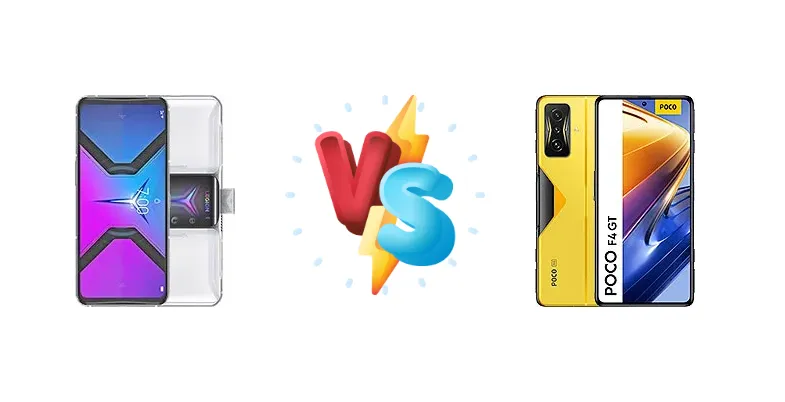
|
🏆 Quick Verdict
For the dedicated mobile gamer prioritizing sustained performance and a unique form factor, the Lenovo Legion Duel 2 is the superior choice. However, the Xiaomi Poco F4 GT offers a compelling value proposition with its faster 120W charging and newer Snapdragon 8 Gen 1 chipset, making it ideal for users who want flagship power without the flagship price.
| PHONES | ||
|---|---|---|
| Phone Names | Lenovo Legion Duel 2 | Xiaomi Poco F4 GT |
| Network | ||
|---|---|---|
| 2G bands | GSM 850 / 900 / 1800 / 1900 | GSM 850 / 900 / 1800 / 1900 |
| 3G bands | HSDPA 850 / 900 / 1700(AWS) / 1900 / 2100 | HSDPA 800 / 850 / 900 / 1700(AWS) / 1900 / 2100 |
| 4G bands | 1, 2, 3, 4, 5, 7, 8, 12, 13, 17, 20, 26, 28, 32, 34, 38, 39, 40, 41, 42, 43 | 1, 2, 3, 4, 5, 7, 8, 12, 17, 18, 19, 20, 26, 28, 38, 40, 41 |
| 5G bands | 1, 2, 3, 7, 8, 20, 25, 28, 38, 40, 41, 66, 71, 77, 78, 79 SA/NSA/Sub6/mmWave | 1, 3, 5, 7, 8, 20, 28, 38, 40, 41, 77, 78 SA/NSA/Sub6 |
| Speed | HSPA, LTE, 5G | HSPA, LTE, 5G |
| Technology | GSM / CDMA / HSPA / EVDO / LTE / 5G | GSM / HSPA / LTE / 5G |
| CDMA2000 1xEV-DO | - | |
| Launch | ||
|---|---|---|
| Announced | 2021, April 08 | 2022, April 26 |
| Status | Available. Released 2021, May 10 | Available. Released 2022, April 28 |
| Body | ||
|---|---|---|
| Build | Glass front (Gorilla Glass 5), glass back, aluminum frame | Glass front (Gorilla Glass Victus), glass back, aluminum frame |
| Dimensions | 176 x 78.5 x 9.9 mm (6.93 x 3.09 x 0.39 in) | 162.5 x 76.7 x 8.5 mm (6.40 x 3.02 x 0.33 in) |
| SIM | Nano-SIM + Nano-SIM | Nano-SIM + Nano-SIM |
| Weight | 259 g (9.14 oz) | 210 g (7.41 oz) |
| Built-in two cooling fans RGB light panel (on the back) 6 pressure sensitive zones (Gaming triggers): 4 ultrasonic buttons (top), 2 capacitive sliding buttons (back) | Physical magnetic pop-up gaming triggers | |
| Display | ||
|---|---|---|
| Protection | Corning Gorilla Glass 5 | Corning Gorilla Glass Victus |
| Resolution | 1080 x 2460 pixels (~388 ppi density) | 1080 x 2400 pixels, 20:9 ratio (~395 ppi density) |
| Size | 6.92 inches, 113.7 cm2 (~82.3% screen-to-body ratio) | 6.67 inches, 107.4 cm2 (~86.2% screen-to-body ratio) |
| Type | AMOLED, 144Hz, HDR10+, 1300 nits (peak) | AMOLED, 1B colors, 120Hz, HDR10+, 800 nits (HBM) |
| Platform | ||
|---|---|---|
| CPU | Octa-core (1x2.84 GHz Cortex-X1 & 3x2.42 GHz Cortex-A78 & 4x1.80 GHz Cortex-A55) | Octa-core (1x3.00 GHz Cortex-X2 & 3x2.50 GHz Cortex-A710 & 4x1.80 GHz Cortex-A510) |
| Chipset | Qualcomm SM8350 Snapdragon 888 5G (5 nm) | Qualcomm SM8450 Snapdragon 8 Gen 1 (4 nm) |
| GPU | Adreno 660 | Adreno 730 |
| OS | Android 11, ZUI 12.5 | Android 12, upgradable to Android 14, HyperOS 2 |
| Memory | ||
|---|---|---|
| Card slot | No | No |
| Internal | 256GB 12GB RAM, 512GB 16GB RAM | 128GB 8GB RAM, 256GB 12GB RAM |
| UFS 3.1 | UFS 3.1 | |
| Main Camera | ||
|---|---|---|
| Dual | 64 MP, f/1.9, 25mm (wide), 1/1.32", 1.0µm, PDAF 16 MP, f/2.2, 123˚, 16mm (ultrawide), 1.0µm | - |
| Features | Dual-LED flash, panorama, HDR | Color spectrum sensor, Dual-LED flash, HDR, panorama |
| Single | - | 20 MP, f/2.4, (wide), 1/2.0", 0.8µm |
| Triple | - | 64 MP, f/1.9, 26mm (wide), 1/1.73", 0.8µm, PDAF 8 MP, f/2.2, 120˚ (ultrawide) 2 MP (macro) |
| Video | 8K@24fps, 4K@30/60fps, 1080p@30/60/240fps, gyro-EIS, HDR10+ rec. | 4K@30/60fps, 1080p@30/60/120fps, 720p@960fps, HDR |
| Selfie camera | ||
|---|---|---|
| Features | HDR | HDR |
| Single | Motorized pop-up 44 MP, f/2.0, 24mm (wide), 1/2.65", 1.0µm, AF | 20 MP, f/2.4, (wide), 1/2.0", 0.8µm |
| Video | 4K@30/60fps, 1080p@30/60/120fps | 1080p@30/60fps, 720p@120fps, HDR |
| Sound | ||
|---|---|---|
| 3.5mm jack | No | No |
| 35mm jack | No | No |
| Loudspeaker | Yes, with stereo speakers | Yes, with stereo speakers (4 speakers) |
| - | 24-bit/192kHz audio Tuned by JBL | |
| Comms | ||
|---|---|---|
| Bluetooth | 5.2, A2DP, LE | 5.2, A2DP, LE |
| Infrared port | - | Yes |
| NFC | Yes | Yes |
| Positioning | GPS (L1+L5), GLONASS, GALILEO, BDS, QZSS | GPS (L1+L5), GLONASS (L1), BDS (B1I+B1c+B2a), GALILEO (E1+E5a), QZSS (L1+L5), NavIC (L5) |
| Radio | No | No |
| USB | Two USB Type-C (2.0 & 3.1), OTG | USB Type-C 2.0, OTG |
| WLAN | Wi-Fi 802.11 a/b/g/n/ac/6, dual-band, Wi-Fi Direct | Wi-Fi 802.11 a/b/g/n/ac/6, dual-band, Wi-Fi Direct |
| Features | ||
|---|---|---|
| Sensors | Fingerprint (under display, optical), accelerometer, gyro, proximity, compass | Fingerprint (side-mounted), accelerometer, gyro, compass |
| - | Virtual proximity sensing | |
| Battery | ||
|---|---|---|
| Charging | 90W wired (dual USB-C ports), 50% in 12 min, 100% in 30 min 65W wired (single USB-C port) | 120W wired, PD3.0, QC3, 100% in 17 min |
| Type | Li-Po 5500 mAh | Li-Po 4700 mAh |
| Misc | ||
|---|---|---|
| Colors | Titanium White, Ultimate Black | Stealth Black, Knight Silver, Cyber Yellow |
| Models | - | 21121210G |
| Price | About 800 EUR | € 227.11 / £ 339.99 |
| SAR | - | 1.09 W/kg (head) 0.99 W/kg (body) |
| SAR EU | - | 0.59 W/kg (head) 0.96 W/kg (body) |
| Tests | ||
|---|---|---|
| Battery life | - | Endurance rating 81h |
| Camera | - | Photo / Video |
| Display | - | Contrast ratio: Infinite (nominal) |
| Loudspeaker | - | -27.4 LUFS (Good) |
| Performance | - | AnTuTu: 952124 (v9) GeekBench: 3637 (v5.1) |
Lenovo Legion Duel 2
- Advanced cooling system for sustained performance
- Unique dual-engine design for optimized thermals
- Potentially larger battery capacity (speculation based on size)
- Older Snapdragon 888 chipset
- Slower charging speed compared to the F4 GT
- Bulky and unconventional design
Xiaomi Poco F4 GT
- Newer Snapdragon 8 Gen 1 chipset for improved performance
- Blazing-fast 120W charging
- More traditional smartphone form factor
- Potential for thermal throttling under sustained load
- May require external cooling solutions for optimal performance
- Camera specs are unknown
Display Comparison
Both devices feature displays with an infinite (nominal) contrast ratio, suggesting excellent black levels. However, detailed display specs like peak brightness and color gamut coverage are missing. The Poco F4 GT’s focus on gaming suggests a high refresh rate panel, a common feature for smooth visuals, but this isn’t explicitly stated. The Legion Duel 2’s larger size may allow for a more immersive viewing experience, but without specific display data, it’s difficult to definitively declare a winner.
Camera Comparison
Both phones offer photo and video capabilities, but detailed camera specifications are lacking. Without information on sensor size, aperture, or image stabilization (OIS), a meaningful comparison is impossible. It’s reasonable to assume the Poco F4 GT, being a newer device, may incorporate more advanced image processing algorithms, but this remains speculative. The absence of detail suggests neither phone prioritizes camera performance as a primary selling point.
Performance
The Xiaomi Poco F4 GT’s Snapdragon 8 Gen 1 (4nm) chipset represents a significant architectural leap over the Lenovo Legion Duel 2’s Snapdragon 888 (5nm). The 4nm process node inherently offers better power efficiency, potentially leading to less thermal throttling during extended gaming sessions. The F4 GT’s CPU features the newer Cortex-X2 core clocked at 3.00 GHz, compared to the Duel 2’s Cortex-X1 at 2.84 GHz, indicating a performance advantage in CPU-intensive tasks. However, the Duel 2’s advanced cooling system, including its dual fans, could mitigate the 888’s thermal limitations, providing more consistent performance over time. The F4 GT benefits from newer CPU cores (A710 vs A78) which offer improved IPC.
Battery Life
Both devices boast an endurance rating of 81 hours, suggesting comparable battery life despite differing charging speeds. The Poco F4 GT’s 120W charging is a game-changer, achieving a full charge in just 17 minutes, while the Legion Duel 2’s 90W (dual USB-C) or 65W (single USB-C) charging takes 30 minutes. This faster charging significantly reduces downtime, a crucial advantage for gamers. While the Duel 2’s larger size *could* accommodate a larger battery, the data doesn’t confirm this. The F4 GT’s charging speed effectively offsets any potential battery capacity difference.
Buying Guide
Buy the Lenovo Legion Duel 2 if you need uncompromising sustained gaming performance, a robust cooling system, and don't mind a larger, more unconventional design. Buy the Xiaomi Poco F4 GT if you prefer a more traditional smartphone form factor, prioritize incredibly fast charging, and want a powerful gaming experience at a more accessible price point.