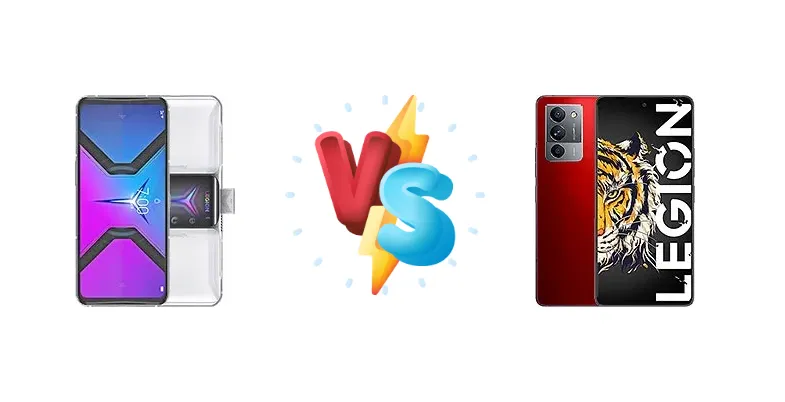
Lenovo has carved a niche with its Legion gaming phones, but the landscape shifts quickly. We're pitting the older, uniquely designed Legion Duel 2, powered by the Snapdragon 888, against the newer, more conventional Legion Y70, boasting the Snapdragon 8+ Gen 1. This comparison isn't just about raw specs; it's about understanding how these chipset generations translate into real-world gaming experiences and daily usability.
🏆 Quick Verdict
For most gamers, the Lenovo Legion Y70 emerges as the superior choice. The Snapdragon 8+ Gen 1 offers a significant performance uplift and improved thermal efficiency over the 888 in the Duel 2, despite the Duel 2's faster 90W charging. The Y70 delivers a smoother, more sustained gaming experience.
| Network |
|---|
| 2G bands | GSM 850 / 900 / 1800 / 1900 | GSM 850 / 900 / 1800 / 1900 |
| 3G bands | HSDPA 850 / 900 / 1700(AWS) / 1900 / 2100 | HSDPA 800 / 850 / 900 / 1900 / 2100 |
| 4G bands | 1, 2, 3, 4, 5, 7, 8, 12, 13, 17, 20, 26, 28, 32, 34, 38, 39, 40, 41, 42, 43 | LTE |
| 5G bands | 1, 2, 3, 7, 8, 20, 25, 28, 38, 40, 41, 66, 71, 77, 78, 79 SA/NSA/Sub6/mmWave | SA/NSA/Sub6 |
| Speed | HSPA, LTE, 5G | HSPA, LTE, 5G |
| Technology | GSM / CDMA / HSPA / EVDO / LTE / 5G | GSM / CDMA / HSPA / CDMA2000 / LTE / 5G |
| | CDMA2000 1xEV-DO | CDMA2000 1x |
| Launch |
|---|
| Announced | 2021, April 08 | 2022, August 18 |
| Status | Available. Released 2021, May 10 | Available. Released 2022, August 23 |
| Body |
|---|
| Build | Glass front (Gorilla Glass 5), glass back, aluminum frame | Glass front, aluminum frame |
| Dimensions | 176 x 78.5 x 9.9 mm (6.93 x 3.09 x 0.39 in) | 163.6 x 77 x 8 mm (6.44 x 3.03 x 0.31 in) |
| SIM | Nano-SIM + Nano-SIM | Nano-SIM + Nano-SIM |
| Weight | 259 g (9.14 oz) | 209 g (7.37 oz) |
| | Built-in two cooling fans
RGB light panel (on the back)
6 pressure sensitive zones (Gaming triggers):
4 ultrasonic buttons (top), 2 capacitive sliding buttons (back) | - |
| Display |
|---|
| Protection | Corning Gorilla Glass 5 | - |
| Resolution | 1080 x 2460 pixels (~388 ppi density) | 1080 x 2400 pixels, 20:9 ratio (~395 ppi density) |
| Size | 6.92 inches, 113.7 cm2 (~82.3% screen-to-body ratio) | 6.67 inches, 107.4 cm2 (~85.3% screen-to-body ratio) |
| Type | AMOLED, 144Hz, HDR10+, 1300 nits (peak) | OLED, 144Hz, HDR10+, 1000 nits (peak) |
| Platform |
|---|
| CPU | Octa-core (1x2.84 GHz Cortex-X1 & 3x2.42 GHz Cortex-A78 & 4x1.80 GHz Cortex-A55) | Octa-core (1x3.19 GHz Cortex-X2 & 3x2.75 GHz Cortex-A710 & 4x1.80 GHz Cortex-A510) |
| Chipset | Qualcomm SM8350 Snapdragon 888 5G (5 nm) | Qualcomm SM8475 Snapdragon 8+ Gen 1 (4 nm) |
| GPU | Adreno 660 | Adreno 730 |
| OS | Android 11, ZUI 12.5 | Android 12, ZUI 14 |
| Memory |
|---|
| Card slot | No | No |
| Internal | 256GB 12GB RAM, 512GB 16GB RAM | 128GB 8GB RAM, 256GB 12GB RAM, 512GB 16GB RAM |
| | UFS 3.1 | UFS 3.1 |
| Main Camera |
|---|
| Dual | 64 MP, f/1.9, 25mm (wide), 1/1.32", 1.0µm, PDAF
16 MP, f/2.2, 123˚, 16mm (ultrawide), 1.0µm | - |
| Features | Dual-LED flash, panorama, HDR | Dual-LED flash, panorama, HDR |
| Triple | - | 50 MP, (wide), 1/1.55", 1.0µm, PDAF, OIS
13 MP, 120˚ (ultrawide), 1.12µm, AF
Auxiliary lens |
| Video | 8K@24fps, 4K@30/60fps, 1080p@30/60/240fps, gyro-EIS, HDR10+ rec. | 8K@30fps, 4K@30/60fps, 1080p@30/60/240fps, gyro-EIS |
| Selfie camera |
|---|
| Features | HDR | - |
| Single | Motorized pop-up 44 MP, f/2.0, 24mm (wide), 1/2.65", 1.0µm, AF | 16 MP |
| Video | 4K@30/60fps, 1080p@30/60/120fps | Yes |
| Sound |
|---|
| 3.5mm jack | No | No |
| 35mm jack | No | No |
| Loudspeaker | Yes, with stereo speakers | Yes, with stereo speakers |
| Comms |
|---|
| Bluetooth | 5.2, A2DP, LE | 5.2, A2DP, LE |
| NFC | Yes | Yes |
| Positioning | GPS (L1+L5), GLONASS, GALILEO, BDS, QZSS | GPS (L1+L5), GLONASS, GALILEO, BDS, QZSS |
| Radio | No | No |
| USB | Two USB Type-C (2.0 & 3.1), OTG | USB Type-C |
| WLAN | Wi-Fi 802.11 a/b/g/n/ac/6, dual-band, Wi-Fi Direct | Wi-Fi 802.11 a/b/g/n/ac/6, dual-band, Wi-Fi Direct |
| Features |
|---|
| Sensors | Fingerprint (under display, optical), accelerometer, gyro, proximity, compass | Fingerprint (side-mounted), accelerometer, gyro, proximity, compass |
| Battery |
|---|
| Charging | 90W wired (dual USB-C ports), 50% in 12 min, 100% in 30 min
65W wired (single USB-C port) | 68W wired, 80% in 34 min |
| Type | Li-Po 5500 mAh | Li-Po 5100 mAh |
| Misc |
|---|
| Colors | Titanium White, Ultimate Black | Black, Silver, Red |
| Models | - | L71091 |
| Price | About 800 EUR | About 440 EUR |
Lenovo Legion Duel 2
- Faster 90W wired charging
- Unique dual-screen design
- Dual USB-C ports for versatile charging
- Older Snapdragon 888 chipset
- Potentially higher thermal throttling
- Less efficient CPU architecture
Lenovo Legion Y70
- More powerful Snapdragon 8+ Gen 1 chipset
- Improved thermal efficiency
- More modern smartphone design
- Slower 68W wired charging
- Standard single USB-C port
- May lack the Duel 2's unique features
Display Comparison
While both devices are geared towards gaming, details on display specs are missing. However, given the Legion branding, both likely feature high refresh rate panels. The Duel 2's unique design may impact bezel size, but the Y70 likely benefits from newer panel technology for improved color accuracy and brightness. The absence of LTPO information suggests neither device dynamically adjusts refresh rates for optimal power saving.
Camera Comparison
Camera details are limited. Both phones likely feature capable camera systems for their price points, but neither is positioned as a photography flagship. The focus is clearly on gaming. Without sensor size or aperture information, it's difficult to make a direct comparison. Any 2MP macro sensors on either device should be considered largely marketing filler.
Performance
The core difference lies in the chipsets. The Legion Y70’s Snapdragon 8+ Gen 1 (4nm) represents a substantial upgrade over the Duel 2’s Snapdragon 888 (5nm). The 8+ Gen 1’s Cortex-X2 prime core, clocked at 3.19 GHz, surpasses the Duel 2’s 2.84 GHz Cortex-X1. Furthermore, the Y70 utilizes the more efficient Cortex-A710 cores instead of the A78s in the Duel 2. This translates to better multi-core performance and, crucially, improved thermal efficiency, reducing the likelihood of throttling during extended gaming sessions. The Y70's chipset also benefits from the 4nm process, further enhancing efficiency.
Battery Life
The Duel 2 boasts a 90W wired charging capability (with dual USB-C ports offering flexibility), claiming 50% charge in 12 minutes and 100% in 30 minutes. The Y70, while still fast at 68W, takes longer to fully charge, reaching 80% in 34 minutes. However, the Snapdragon 8+ Gen 1’s improved efficiency in the Y70 may offset the smaller charging wattage, potentially leading to comparable real-world battery life despite potentially differing battery capacities (not specified in the data).
Buying Guide
Buy the Lenovo Legion Duel 2 if you prioritize the absolute fastest wired charging speeds (90W) and appreciate its distinctive, dual-screen design, even if it means accepting slightly older processing power. Buy the Lenovo Legion Y70 if you value sustained gaming performance, better thermal management, and a more modern smartphone form factor, making it the better all-around gaming device.
Frequently Asked Questions
❓ Will the Snapdragon 888 in the Duel 2 struggle with demanding games like Genshin Impact?
The Snapdragon 888 is capable, but it's prone to thermal throttling under sustained load. Expect frame drops and reduced performance in graphically intensive games like Genshin Impact after prolonged play sessions. The Y70's 8+ Gen 1 will maintain higher frame rates for longer.
❓ Does the Legion Y70's 68W charging feel significantly slower than the Duel 2's 90W?
While 90W sounds impressive, the difference in real-world charging time isn't as dramatic as the numbers suggest. The Y70's 80% charge in 34 minutes is still very fast, and the improved efficiency of the 8+ Gen 1 may mean you're less reliant on frequent top-ups.
❓ Is the Duel 2's dual-screen design actually useful for gaming?
The second screen on the Duel 2 can be used for displaying game stats, controlling music, or chatting while gaming. However, it adds bulk and isn't essential for the core gaming experience. Many users may find it a novelty feature.