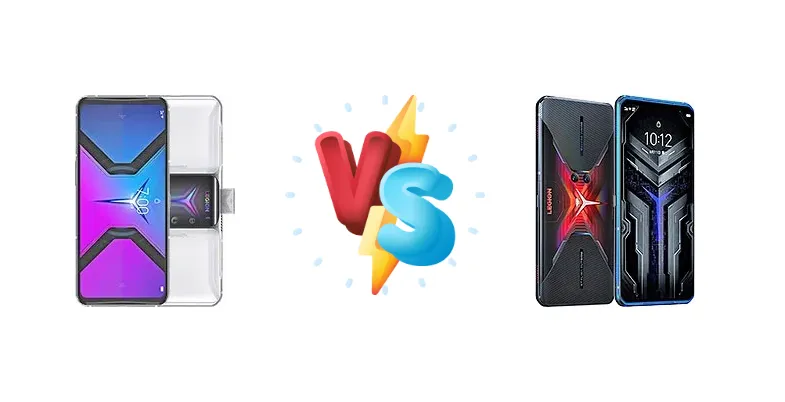
The Lenovo Legion series has carved a niche for itself in the gaming smartphone market, offering powerful hardware and unique features. But with multiple models, choosing the right one can be tricky. We're pitting the Legion Duel 2 against the Legion Pro to determine which phone delivers the best gaming experience.
🏆 Quick Verdict
The Legion Duel 2 boasts a significantly faster Snapdragon 888 and blazing-fast 90W charging, making it the clear performance winner. However, the Legion Pro offers more RAM options and potentially better value depending on the configuration. Ultimately, the Duel 2 prioritizes raw power, while the Pro balances features and price.
| Network |
|---|
| 2G bands | GSM 850 / 900 / 1800 / 1900 | GSM 850 / 900 / 1800 / 1900 |
| 3G bands | HSDPA 850 / 900 / 1700(AWS) / 1900 / 2100 | HSDPA 850 / 900 / 1900 / 2100 |
| 4G bands | 1, 2, 3, 4, 5, 7, 8, 12, 13, 17, 20, 26, 28, 32, 34, 38, 39, 40, 41, 42, 43 | LTE |
| 5G bands | 1, 2, 3, 7, 8, 20, 25, 28, 38, 40, 41, 66, 71, 77, 78, 79 SA/NSA/Sub6/mmWave | SA/NSA |
| Speed | HSPA, LTE, 5G | HSPA 42.2/5.76 Mbps, LTE (4CA) Cat15 800/210 Mbps, 5G 2.5 Gbps DL |
| Technology | GSM / CDMA / HSPA / EVDO / LTE / 5G | GSM / CDMA / HSPA / LTE / 5G |
| | CDMA2000 1xEV-DO | CDMA 800 & TD-SCDMA |
| Launch |
|---|
| Announced | 2021, April 08 | 2020, July 22. Released 2020, July 30 |
| Status | Available. Released 2021, May 10 | Discontinued |
| Body |
|---|
| Build | Glass front (Gorilla Glass 5), glass back, aluminum frame | Glass front, glass back, aluminum frame |
| Dimensions | 176 x 78.5 x 9.9 mm (6.93 x 3.09 x 0.39 in) | 169.2 x 78.5 x 9.9 mm (6.66 x 3.09 x 0.39 in) |
| SIM | Nano-SIM + Nano-SIM | Nano-SIM + Nano-SIM |
| Weight | 259 g (9.14 oz) | 239 g (8.43 oz) |
| | Built-in two cooling fans
RGB light panel (on the back)
6 pressure sensitive zones (Gaming triggers):
4 ultrasonic buttons (top), 2 capacitive sliding buttons (back) | Water-repellent coating |
| Display |
|---|
| Protection | Corning Gorilla Glass 5 | - |
| Resolution | 1080 x 2460 pixels (~388 ppi density) | 1080 x 2340 pixels, 19.5:9 ratio (~388 ppi density) |
| Size | 6.92 inches, 113.7 cm2 (~82.3% screen-to-body ratio) | 6.65 inches, 108.6 cm2 (~81.7% screen-to-body ratio) |
| Type | AMOLED, 144Hz, HDR10+, 1300 nits (peak) | AMOLED, 144Hz, HDR10+ |
| Platform |
|---|
| CPU | Octa-core (1x2.84 GHz Cortex-X1 & 3x2.42 GHz Cortex-A78 & 4x1.80 GHz Cortex-A55) | Octa-core (1x3.09 GHz Cortex-A77 & 3x2.42 GHz Cortex-A77 & 4x1.80 GHz Cortex-A55) |
| Chipset | Qualcomm SM8350 Snapdragon 888 5G (5 nm) | Qualcomm SM8250 Snapdragon 865 5G+ (7 nm+) |
| GPU | Adreno 660 | Adreno 650 |
| OS | Android 11, ZUI 12.5 | Android 10, Legion OS/ ZUI12 |
| Memory |
|---|
| Card slot | No | No |
| Internal | 256GB 12GB RAM, 512GB 16GB RAM | 128GB 8GB RAM, 128GB 12GB RAM, 256GB 12GB RAM, 512GB 16GB RAM |
| | UFS 3.1 | UFS 3.1 |
| Main Camera |
|---|
| Dual | 64 MP, f/1.9, 25mm (wide), 1/1.32", 1.0µm, PDAF
16 MP, f/2.2, 123˚, 16mm (ultrawide), 1.0µm | 64 MP, f/1.9, 25mm (wide), 1/1.72", 0.8µm, PDAF
16 MP, f/2.2, 120˚, 16mm (ultrawide) |
| Features | Dual-LED flash, panorama, HDR | Dual-LED flash, panorama, HDR |
| Video | 8K@24fps, 4K@30/60fps, 1080p@30/60/240fps, gyro-EIS, HDR10+ rec. | 4K@30fps gyro-EIS |
| Selfie camera |
|---|
| Features | HDR | LED flash, HDR |
| Single | Motorized pop-up 44 MP, f/2.0, 24mm (wide), 1/2.65", 1.0µm, AF | Motorized pop-up 20 MP, f/2.2, 25mm (wide), 1/3.1", 0.9µm |
| Video | 4K@30/60fps, 1080p@30/60/120fps | 4K@30fps |
| Sound |
|---|
| 3.5mm jack | No | No |
| 35mm jack | No | No |
| Loudspeaker | Yes, with stereo speakers | Yes, with stereo speakers |
| Comms |
|---|
| Bluetooth | 5.2, A2DP, LE | 5.0, A2DP, LE, aptX HD, aptX Adaptive |
| NFC | Yes | Yes |
| Positioning | GPS (L1+L5), GLONASS, GALILEO, BDS, QZSS | GPS (L1+L5), GLONASS, GALILEO, BDS, QZSS |
| Radio | No | No |
| USB | Two USB Type-C (2.0 & 3.1), OTG | Two USB Type-C, OTG |
| WLAN | Wi-Fi 802.11 a/b/g/n/ac/6, dual-band, Wi-Fi Direct | Wi-Fi 802.11 a/b/g/n/ac/6, dual-band, Wi-Fi Direct |
| Features |
|---|
| Sensors | Fingerprint (under display, optical), accelerometer, gyro, proximity, compass | Fingerprint (under display, optical), accelerometer, gyro, proximity, compass |
| Battery |
|---|
| Charging | 90W wired (dual USB-C ports), 50% in 12 min, 100% in 30 min
65W wired (single USB-C port) | 45W wired, (128GB 8GB RAM model)
65W wired, (128GB 12GB RAM, 256GB 12GB RAM models)
90W wired, 50% in 10 min, 100% in 30 min (512GB 16GB RAM model) |
| Type | Li-Po 5500 mAh | Li-Po 5000 mAh |
| Misc |
|---|
| Colors | Titanium White, Ultimate Black | Vengeance Red, Blazing Blue, White |
| Models | - | L79031 |
| Price | About 800 EUR | - |
Lenovo Legion Duel 2
- Blazing-fast 90W charging
- Superior Snapdragon 888 performance
- Potentially better cooling system
- Dual USB-C ports
- Potentially higher price
- Design might be polarizing
- May lack some features found on the Pro
Lenovo Legion Pro
- More RAM options (up to 16GB)
- Potentially better value for money
- More conventional design
- Variable charging speeds (up to 90W)
- Slower Snapdragon 865+ chipset
- Charging speeds not as fast as Duel 2
- May lack some of the Duel 2's unique features
Display Comparison
Both phones feature high refresh rate AMOLED displays, likely around 144Hz, offering smooth visuals. The Duel 2 might have a slightly larger display, but both should provide excellent color accuracy and brightness for immersive gaming. Expect similar display quality overall, with minor differences in size and potentially peak brightness.
Camera Comparison
Both phones likely feature a triple-camera system with a primary sensor, ultrawide lens, and potentially a macro lens. Image quality should be comparable in good lighting conditions, but the Duel 2's newer chipset might offer slightly better image processing. Low-light performance could be a differentiating factor, but detailed camera comparisons would require testing.
Performance
The Snapdragon 888 in the Duel 2 holds a clear advantage over the Snapdragon 865+ in the Legion Pro. The 888 offers improved CPU and GPU performance, resulting in smoother gameplay, faster load times, and better multitasking. The Duel 2's 5nm process also contributes to improved efficiency. The Legion Pro's RAM options (up to 16GB) help, but the chipset difference is significant.
Battery Life
The Duel 2's 90W charging is a game-changer, allowing for incredibly fast charging times. The Legion Pro's charging speeds vary (45W, 65W, or 90W depending on the configuration), but even the 90W model doesn't quite match the Duel 2's speed. Battery capacity is likely similar between the two, but the Duel 2's charging advantage is substantial.
Buying Guide
The Lenovo Legion Duel 2 is ideal for hardcore gamers who demand the absolute best performance and lightning-fast charging. The Legion Pro is a great choice for gamers who want a powerful device with more RAM options and potentially a more balanced feature set at a potentially lower price point.
Frequently Asked Questions
❓ Is the Legion Duel 2 worth the extra cost?
If you prioritize raw performance and incredibly fast charging, the Duel 2 is worth the investment. However, if you're on a tighter budget and don't need the absolute best, the Legion Pro offers a compelling alternative.
❓ Which phone has better cooling?
The Legion Duel 2 is generally believed to have a more advanced cooling system due to its design and focus on sustained performance. However, detailed thermal testing would be needed for a definitive answer.