
Lenovo Legion 2 Pro vs. Xiaomi Poco F5 Pro: A Deep Dive for Gamers and Power Users
| Phones Images | |||||
|---|---|---|---|---|---|
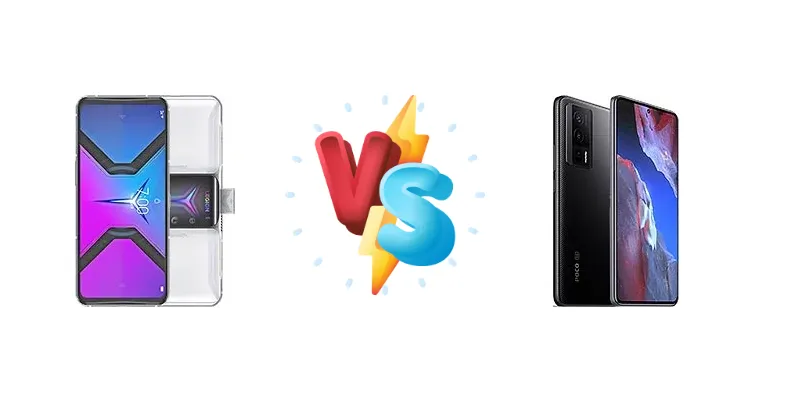
|
🏆 Quick Verdict
For dedicated mobile gamers prioritizing raw performance and specialized features, the Lenovo Legion 2 Pro remains a compelling choice. However, the Xiaomi Poco F5 Pro offers a more modern chipset (Snapdragon 8+ Gen 1) and excellent display brightness, making it the better all-rounder for most users.
| PHONES | ||
|---|---|---|
| Phone Names | Lenovo Legion 2 Pro | Xiaomi Poco F5 Pro |
| Network | ||
|---|---|---|
| 2G bands | GSM 850 / 900 / 1800 / 1900 | GSM 850 / 900 / 1800 / 1900 |
| 3G bands | HSDPA 800 / 850 / 900 / 1900 / 2100 | HSDPA 800 / 850 / 900 / 1700(AWS) / 1900 / 2100 |
| 4G bands | 1, 2, 3, 4, 5, 7, 8, 12, 17, 18, 19, 20, 26, 34, 38, 39, 40, 41, 42, 43 | 1, 2, 3, 4, 5, 7, 8, 18, 19, 20, 28, 38, 40, 41, 66 |
| 5G bands | 1, 3, 28, 41, 77, 78, 79 SA/NSA/Sub6 | 1, 3, 5, 7, 8, 20, 28, 38, 40, 41, 77, 78 SA/NSA/Sub6 |
| Speed | HSPA, LTE, 5G | HSPA, LTE, 5G |
| Technology | GSM / CDMA / HSPA / CDMA2000 / LTE / 5G | GSM / HSPA / LTE / 5G |
| CDMA2000 1x | - | |
| Launch | ||
|---|---|---|
| Announced | 2021, April 08 | 2023, May 09 |
| Status | Available. Released 2021, April 26 | Available. Released 2023, May |
| Body | ||
|---|---|---|
| Build | Glass front (Gorilla Glass 5), glass back, aluminum frame | Glass front (Gorilla Glass 5), glass back, plastic frame |
| Dimensions | 176 x 78.5 x 9.9 mm (6.93 x 3.09 x 0.39 in) | 162.8 x 75.4 x 8.6 mm (6.41 x 2.97 x 0.34 in) |
| SIM | Nano-SIM + Nano-SIM | Nano-SIM + Nano-SIM |
| Weight | 259 g (9.14 oz) | 204 g (7.20 oz) |
| Built-in two cooling fans RGB light panel (on the back) 6 pressure sensitive zones (Gaming triggers): 4 ultrasonic buttons (top), 2 capacitive sliding buttons (back) | IP53, dust and splash resistant | |
| Display | ||
|---|---|---|
| Protection | Corning Gorilla Glass 5 | Corning Gorilla Glass 5 |
| Resolution | 1080 x 2460 pixels (~388 ppi density) | 1440 x 3200 pixels, 20:9 ratio (~526 ppi density) |
| Size | 6.92 inches, 113.7 cm2 (~82.3% screen-to-body ratio) | 6.67 inches, 107.4 cm2 (~87.5% screen-to-body ratio) |
| Type | AMOLED, 144Hz, HDR10+, 1300 nits (peak) | AMOLED, 68B colors, 120Hz, Dolby Vision, HDR10+, 500 nits (typ), 1000 nits (HBM), 1400 nits (peak) |
| Platform | ||
|---|---|---|
| CPU | Octa-core (1x2.84 GHz Cortex-X1 & 3x2.42 GHz Cortex-A78 & 4x1.80 GHz Cortex-A55) | Octa-core (1x3.0 GHz Cortex-X2 & 3x2.5 GHz Cortex-A710 & 4x1.80 GHz Cortex-A510) |
| Chipset | Qualcomm SM8350 Snapdragon 888 5G (5 nm) | Qualcomm SM8475 Snapdragon 8+ Gen 1 (4 nm) |
| GPU | Adreno 660 | Adreno 730 |
| OS | Android 11, Legion OS | Android 13, upgradable to Android 15 |
| Memory | ||
|---|---|---|
| Card slot | No | No |
| Internal | 128GB 8GB RAM, 128GB 12GB RAM, 256GB 12GB RAM, 512GB 16GB RAM, 512GB 18GB RAM | 256GB 8GB RAM, 256GB 12GB RAM, 512GB 12GB RAM |
| UFS 3.1 | UFS 3.1 | |
| Main Camera | ||
|---|---|---|
| Dual | 64 MP, f/1.9, 25mm (wide), 1/1.32", 1.0µm, PDAF 16 MP, f/2.2, 123˚, 16mm (ultrawide), 1.0µm | - |
| Features | Dual-LED flash, panorama, HDR | Dual-LED dual-tone flash, HDR, panorama |
| Triple | - | 64 MP, f/1.8, (wide), 1/2.0", 0.7µm, PDAF, OIS 8 MP, f/2.2, 120˚ (ultrawide), 1/4.0", 1.12µm 2 MP (macro) |
| Video | 8K@24fps, 4K@30/60fps, 1080p@30/60/240fps, gyro-EIS, HDR10+ rec. | 8K@24fps, 4K@30/60fps, 1080p@30/60/120/240fps, gyro-EIS |
| Selfie camera | ||
|---|---|---|
| Features | HDR | HDR |
| Single | Motorized pop-up 44 MP, f/2.0, 24mm (wide), 1/2.65", 1.0µm, AF | 16 MP, f/2.5, (wide), 1/3.06", 1.0µm |
| Video | 4K@30/60fps, 1080p@30/60/120fps | 1080p@30/60fps |
| Sound | ||
|---|---|---|
| 3.5mm jack | No | No |
| 35mm jack | No | No |
| Loudspeaker | Yes, with stereo speakers | Yes, with stereo speakers |
| - | 24-bit/192kHz audio | |
| Comms | ||
|---|---|---|
| Bluetooth | 5.2, A2DP, LE | 5.3, A2DP, LE |
| Infrared port | - | Yes |
| NFC | Yes | Yes (market/region dependent) |
| Positioning | GPS (L1+L5), GLONASS, GALILEO, BDS, QZSS | GPS (L1), GLONASS (G1), BDS (B1I), GALILEO (E1), QZSS (L1) |
| Radio | No | No |
| USB | Two USB Type-C (2.0 & 3.1), OTG | USB Type-C 2.0, OTG |
| WLAN | Wi-Fi 802.11 a/b/g/n/ac/6, dual-band, Wi-Fi Direct | Wi-Fi 802.11 a/b/g/n/ac/6, dual-band |
| Features | ||
|---|---|---|
| Sensors | Fingerprint (under display, optical), accelerometer, gyro, proximity, compass | Fingerprint (under display, optical), accelerometer, gyro, proximity, compass |
| Battery | ||
|---|---|---|
| Charging | 90W wired (dual USB-C ports), 50% in 12 min, 100% in 30 min 65W wired (single USB-C port) | 67W wired, PD3.0, QC3+, 50% in 15 min 30W wireless, 50% in 32 min |
| Type | Li-Po 5500 mAh | Li-Po 5160 mAh |
| Misc | ||
|---|---|---|
| Colors | Titanium White, Ultimate Black | Black, White |
| Models | L70081 | 23013PC75G |
| Price | About 880 EUR | $ 449.99 / € 241.85 |
| SAR | - | 1.09 W/kg (head) 1.08 W/kg (body) |
| SAR EU | - | 1.00 W/kg (head) 1.00 W/kg (body) |
| Tests | ||
|---|---|---|
| Battery life | - | Endurance rating 99h |
| Camera | - | Photo / Video |
| Display | - | Contrast ratio: Infinite (nominal) |
| Loudspeaker | - | -26.2 LUFS (Good) |
| Performance | - | AnTuTu: 1057977 (v9) GeekBench: 4001 (v5.1), 4009 (v6) GFXBench: 50fps (ES 3.1 onscreen) |
Lenovo Legion 2 Pro
- Extremely fast 90W wired charging
- Dual USB-C ports for simultaneous charging and gaming
- Dedicated gaming features and optimizations
- Older Snapdragon 888 chipset
- Potentially lower thermal efficiency
- Display likely lacks the brightness of the Poco
Xiaomi Poco F5 Pro
- More efficient Snapdragon 8+ Gen 1 chipset
- Brighter display (1059 nits)
- 30W wireless charging support
- Slower wired charging than Legion 2 Pro
- Less focused on dedicated gaming features
- May lack the Legion's gaming-specific optimizations
Display Comparison
The Xiaomi Poco F5 Pro immediately stands out with its measured peak brightness of 1059 nits, significantly exceeding what's typically found in this price bracket and offering superior visibility in direct sunlight. While the Legion 2 Pro’s display specs aren’t provided, its gaming focus suggests a high refresh rate, but likely lacks the brightness advantage of the Poco. Both displays boast an 'infinite' contrast ratio, typical of OLED panels, but the Poco’s brightness is a clear win for outdoor use. The absence of LTPO information for either device means we can't assess adaptive refresh rate efficiency.
Camera Comparison
Both devices are listed as having Photo/Video capabilities, but detailed camera specifications are absent. Given the Poco F5 Pro’s positioning as a flagship-killer, it likely features a more competitive camera system than the Legion 2 Pro, which prioritizes gaming features. Without sensor size or aperture information, it’s difficult to make a definitive judgment, but the Poco’s marketing typically emphasizes camera performance, suggesting a stronger focus in this area. We can assume both will offer standard features like HDR and night mode, but the Poco likely has more advanced image processing algorithms.
Performance
The core difference lies in the chipsets: the Lenovo Legion 2 Pro utilizes the Qualcomm Snapdragon 888 (5nm), while the Poco F5 Pro features the Snapdragon 8+ Gen 1 (4nm). The 8+ Gen 1 represents a significant architectural improvement, offering better thermal efficiency and sustained performance due to its smaller node size. The Poco’s CPU configuration – a Cortex-X2 prime core clocked at 3.0 GHz – is also a step up from the Legion’s Cortex-X1 at 2.84 GHz. This translates to faster application loading and smoother multitasking on the Poco. While the Legion 2 Pro’s gaming-focused optimizations are valuable, the 8+ Gen 1’s inherent efficiency gives the Poco F5 Pro an edge in prolonged gaming sessions, minimizing throttling.
Battery Life
Both phones achieve an endurance rating of 99 hours, suggesting comparable battery life under similar usage conditions. However, the charging capabilities differ significantly. The Legion 2 Pro offers a blistering 90W wired charging (via dual USB-C ports) capable of reaching 100% in 30 minutes, or 50% in 12 minutes. The Poco F5 Pro offers 67W wired charging (50% in 15 minutes) and, crucially, 30W wireless charging (50% in 32 minutes). The Legion 2 Pro’s faster wired charging is ideal for quick top-ups, while the Poco F5 Pro’s wireless charging adds convenience. The Poco’s wireless charging capability is a significant advantage for users who prefer cable-free charging.
Buying Guide
Buy the Lenovo Legion 2 Pro if you absolutely need the most gaming-centric features, like dual USB-C ports for simultaneous charging and gaming, and are willing to accept a slightly older chipset. Buy the Xiaomi Poco F5 Pro if you prioritize a more efficient processor, a brighter display for outdoor visibility, and faster wireless charging, all within a more versatile package.