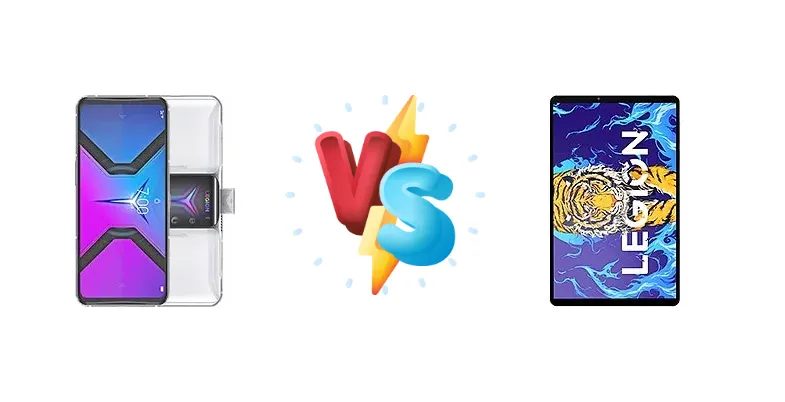
Lenovo's Legion series has consistently delivered strong gaming experiences, but with the 2 Pro and Y700, buyers face a choice between a flagship-tier chipset from a previous generation and a slightly less powerful, yet more efficient, option. This comparison dissects the key differences between the Snapdragon 888-powered Legion 2 Pro and the Snapdragon 870-equipped Y700, helping you determine which device best suits your gaming needs and budget.
🏆 Quick Verdict
For the hardcore gamer prioritizing raw power and fastest charging, the Lenovo Legion 2 Pro remains the superior choice, despite its age. However, the Legion Y700 offers a compelling balance of performance, efficiency, and affordability, making it ideal for users seeking a capable gaming experience without the flagship price tag.
| Network |
|---|
| 2G bands | GSM 850 / 900 / 1800 / 1900 | GSM 850 / 900 / 1800 / 1900 |
| 3G bands | HSDPA 800 / 850 / 900 / 1900 / 2100 | HSDPA 850 / 900 / 1900 / 2100 |
| 4G bands | 1, 2, 3, 4, 5, 7, 8, 12, 17, 18, 19, 20, 26, 34, 38, 39, 40, 41, 42, 43 | LTE |
| 5G bands | 1, 3, 28, 41, 77, 78, 79 SA/NSA/Sub6 | - |
| Speed | HSPA, LTE, 5G | HSPA, LTE - cellular model only |
| Technology | GSM / CDMA / HSPA / CDMA2000 / LTE / 5G | GSM / HSPA / LTE |
| | CDMA2000 1x | - |
| Launch |
|---|
| Announced | 2021, April 08 | 2022, March 01 |
| Status | Available. Released 2021, April 26 | Available. Released 2022, March 10 |
| Body |
|---|
| Build | Glass front (Gorilla Glass 5), glass back, aluminum frame | - |
| Dimensions | 176 x 78.5 x 9.9 mm (6.93 x 3.09 x 0.39 in) | 207.1 x 128.1 x 7.9 mm (8.15 x 5.04 x 0.31 in) |
| SIM | Nano-SIM + Nano-SIM | Nano-SIM (cellular model only) |
| Weight | 259 g (9.14 oz) | 375 g (13.23 oz) |
| | Built-in two cooling fans
RGB light panel (on the back)
6 pressure sensitive zones (Gaming triggers):
4 ultrasonic buttons (top), 2 capacitive sliding buttons (back) | - |
| Display |
|---|
| Protection | Corning Gorilla Glass 5 | - |
| Resolution | 1080 x 2460 pixels (~388 ppi density) | 1600 x 2560 pixels, 16:10 ratio (~343 ppi density) |
| Size | 6.92 inches, 113.7 cm2 (~82.3% screen-to-body ratio) | 8.8 inches, 224.5 cm2 (~84.6% screen-to-body ratio) |
| Type | AMOLED, 144Hz, HDR10+, 1300 nits (peak) | IPS LCD, 120Hz, Dolby Vision, HDR10, 500 nits (typ) |
| Platform |
|---|
| CPU | Octa-core (1x2.84 GHz Cortex-X1 & 3x2.42 GHz Cortex-A78 & 4x1.80 GHz Cortex-A55) | Octa-core (1x3.2 GHz Kryo 585 & 3x2.42 GHz Kryo 585 & 4x1.80 GHz Kryo 585) |
| Chipset | Qualcomm SM8350 Snapdragon 888 5G (5 nm) | Qualcomm SM8250-AC Snapdragon 870 5G (7 nm) |
| GPU | Adreno 660 | Adreno 650 |
| OS | Android 11, Legion OS | Android 12, ZUI 13 |
| Memory |
|---|
| Card slot | No | microSDXC (dedicated slot) |
| Internal | 128GB 8GB RAM, 128GB 12GB RAM, 256GB 12GB RAM, 512GB 16GB RAM, 512GB 18GB RAM | 128GB 8GB RAM, 256GB 12GB RAM |
| | UFS 3.1 | UFS 3.1 |
| Main Camera |
|---|
| Dual | 64 MP, f/1.9, 25mm (wide), 1/1.32", 1.0µm, PDAF
16 MP, f/2.2, 123˚, 16mm (ultrawide), 1.0µm | - |
| Features | Dual-LED flash, panorama, HDR | LED flash |
| Single | - | 13 MP |
| Video | 8K@24fps, 4K@30/60fps, 1080p@30/60/240fps, gyro-EIS, HDR10+ rec. | 1080p@30fps |
| Selfie camera |
|---|
| Features | HDR | - |
| Single | Motorized pop-up 44 MP, f/2.0, 24mm (wide), 1/2.65", 1.0µm, AF | 8 MP |
| Video | 4K@30/60fps, 1080p@30/60/120fps | 1080p@30fps |
| Sound |
|---|
| 3.5mm jack | No | Yes |
| 35mm jack | No | Yes |
| Loudspeaker | Yes, with stereo speakers | Yes, with stereo speakers |
| | - | Tuned by JBL |
| Comms |
|---|
| Bluetooth | 5.2, A2DP, LE | 5.1, A2DP, LE |
| NFC | Yes | No |
| Positioning | GPS (L1+L5), GLONASS, GALILEO, BDS, QZSS | No |
| Radio | No | Unspecified |
| USB | Two USB Type-C (2.0 & 3.1), OTG | USB Type-C 3.1 Gen2 |
| WLAN | Wi-Fi 802.11 a/b/g/n/ac/6, dual-band, Wi-Fi Direct | Wi-Fi 802.11 a/b/g/n/ac/6, dual-band, Wi-Fi Direct |
| Features |
|---|
| Sensors | Fingerprint (under display, optical), accelerometer, gyro, proximity, compass | Accelerometer, gyro, proximity, compass |
| Battery |
|---|
| Charging | 90W wired (dual USB-C ports), 50% in 12 min, 100% in 30 min
65W wired (single USB-C port) | 45W wired, 100% in 45 min |
| Type | Li-Po 5500 mAh | Li-Po 6550 mAh |
| Misc |
|---|
| Colors | Titanium White, Ultimate Black | Gray |
| Models | L70081 | TB-9707F |
| Price | About 880 EUR | About 360 EUR |
Lenovo Legion 2 Pro
- Faster Snapdragon 888 processor for superior gaming performance
- Ultra-fast 90W charging for minimal downtime
- Likely superior display quality (higher refresh rate, LTPO)
- Potential for higher temperatures and throttling under sustained load
- Likely higher price point
Lenovo Legion Y700
- More efficient Snapdragon 870 processor for longer battery life
- More affordable price point
- Potentially better thermal management
- Slightly lower peak gaming performance compared to the 888
- Slower 45W charging
Display Comparison
While both devices are geared towards gaming, display specifics are missing from the provided data. However, given the Legion 2 Pro's flagship positioning, it likely features a higher refresh rate and potentially a more advanced panel technology (like LTPO) compared to the Y700. The Y700, being a more budget-focused device, may prioritize cost-effectiveness over cutting-edge display features. Bezels are likely similar, given Lenovo's design language, but color accuracy and peak brightness would be key differentiators, favoring the 2 Pro.
Camera Comparison
Camera details are absent, but given the gaming focus, both phones likely prioritize functionality over photographic excellence. We can assume the Legion 2 Pro, as the higher-end model, will feature a larger main sensor and potentially optical image stabilization (OIS) for improved low-light performance. The Y700 will likely feature a more basic camera setup, focusing on adequate image quality for social media and casual use. The presence of a 2MP macro lens on either device is unlikely to significantly impact the overall camera experience.
Performance
The core difference lies in the chipsets. The Legion 2 Pro's Snapdragon 888 (5nm) boasts a Cortex-X1 prime core clocked at 2.84GHz, offering peak performance advantages over the Y700's Snapdragon 870 (7nm) with its 3.2GHz Kryo 585 prime core. While the 870's clock speed is higher, the 888's architectural advantages and more advanced GPU generally translate to superior graphics performance. The 5nm process of the 888 also contributes to better thermal efficiency, though the 888 is known to run hot. Both devices utilize an octa-core configuration, but the 888's architecture provides a performance edge. The Y700's 870 will deliver excellent performance for most games, but the 2 Pro will handle the most demanding titles at higher settings with greater consistency.
Battery Life
The Legion 2 Pro's 90W wired charging is a significant advantage, promising a 50% charge in just 12 minutes and a full charge in 30 minutes. The Y700's 45W charging, while respectable, takes 45 minutes to reach 100%. While battery capacity isn't specified, the faster charging of the 2 Pro mitigates any potential capacity disadvantage. The Snapdragon 870's 7nm process generally offers better power efficiency than the 888's 5nm, meaning the Y700 may provide longer battery life during typical usage, despite potentially having a smaller battery.
Buying Guide
Buy the Lenovo Legion 2 Pro if you demand the highest possible frame rates in demanding titles, need the fastest 90W charging for minimal downtime, and are willing to accept potentially higher temperatures during extended gaming sessions. Buy the Lenovo Legion Y700 if you prioritize a more balanced thermal profile, longer battery life between charges, and a significantly lower price point without sacrificing a smooth gaming experience.
Frequently Asked Questions
❓ Will the Snapdragon 870 in the Legion Y700 struggle with graphically demanding games like Genshin Impact?
The Snapdragon 870 is a very capable chip and will run Genshin Impact smoothly at medium to high settings. While it won't match the Legion 2 Pro's 888 in terms of maximum frame rates, it will provide a consistently enjoyable gaming experience without significant frame drops, especially with optimized game settings.
❓ Does the Legion 2 Pro's 90W charging cause significant battery degradation over time?
While 90W charging is incredibly fast, it's important to note that all fast charging technologies can contribute to slightly faster battery degradation over the long term. However, Lenovo likely incorporates battery protection features to mitigate this effect. Using the 65W charging option (via a single USB-C port) can help prolong battery health if desired.
❓ Is the thermal throttling on the Legion 2 Pro a major concern for extended gaming sessions?
The Snapdragon 888 is known to generate more heat than the 870. While the Legion 2 Pro likely has a robust cooling system, some throttling is possible during prolonged, intensive gaming. The Y700's 870 will generally maintain cooler temperatures and experience less throttling, making it a better choice for marathon gaming sessions.