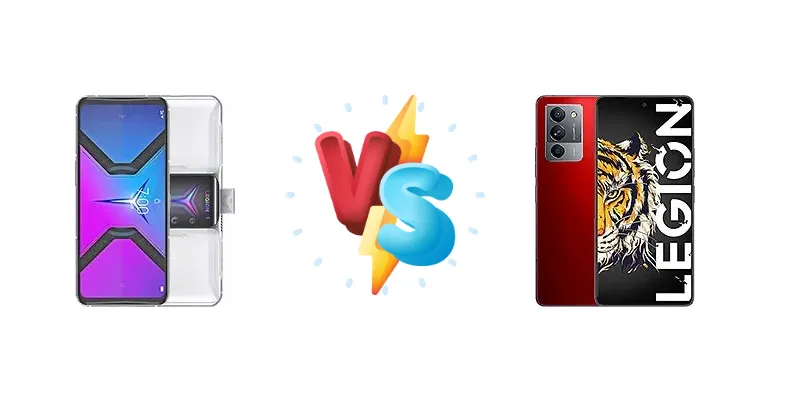
Lenovo has established itself as a serious contender in the gaming smartphone market. The Legion 2 Pro and the newer Legion Y70 both offer impressive specs and features for mobile gamers. But which one truly delivers the best experience? Let's dive into a detailed comparison to help you decide.
🏆 Quick Verdict
The Lenovo Legion Y70 edges out the 2 Pro thanks to its Snapdragon 8+ Gen 1 chipset, offering a noticeable performance boost. While the 2 Pro boasts faster charging, the Y70's improved efficiency and slightly better display make it the overall winner for most gamers.
| Network |
|---|
| 2G bands | GSM 850 / 900 / 1800 / 1900 | GSM 850 / 900 / 1800 / 1900 |
| 3G bands | HSDPA 800 / 850 / 900 / 1900 / 2100 | HSDPA 800 / 850 / 900 / 1900 / 2100 |
| 4G bands | 1, 2, 3, 4, 5, 7, 8, 12, 17, 18, 19, 20, 26, 34, 38, 39, 40, 41, 42, 43 | LTE |
| 5G bands | 1, 3, 28, 41, 77, 78, 79 SA/NSA/Sub6 | SA/NSA/Sub6 |
| Speed | HSPA, LTE, 5G | HSPA, LTE, 5G |
| Technology | GSM / CDMA / HSPA / CDMA2000 / LTE / 5G | GSM / CDMA / HSPA / CDMA2000 / LTE / 5G |
| | CDMA2000 1x | CDMA2000 1x |
| Launch |
|---|
| Announced | 2021, April 08 | 2022, August 18 |
| Status | Available. Released 2021, April 26 | Available. Released 2022, August 23 |
| Body |
|---|
| Build | Glass front (Gorilla Glass 5), glass back, aluminum frame | Glass front, aluminum frame |
| Dimensions | 176 x 78.5 x 9.9 mm (6.93 x 3.09 x 0.39 in) | 163.6 x 77 x 8 mm (6.44 x 3.03 x 0.31 in) |
| SIM | Nano-SIM + Nano-SIM | Nano-SIM + Nano-SIM |
| Weight | 259 g (9.14 oz) | 209 g (7.37 oz) |
| | Built-in two cooling fans
RGB light panel (on the back)
6 pressure sensitive zones (Gaming triggers):
4 ultrasonic buttons (top), 2 capacitive sliding buttons (back) | - |
| Display |
|---|
| Protection | Corning Gorilla Glass 5 | - |
| Resolution | 1080 x 2460 pixels (~388 ppi density) | 1080 x 2400 pixels, 20:9 ratio (~395 ppi density) |
| Size | 6.92 inches, 113.7 cm2 (~82.3% screen-to-body ratio) | 6.67 inches, 107.4 cm2 (~85.3% screen-to-body ratio) |
| Type | AMOLED, 144Hz, HDR10+, 1300 nits (peak) | OLED, 144Hz, HDR10+, 1000 nits (peak) |
| Platform |
|---|
| CPU | Octa-core (1x2.84 GHz Cortex-X1 & 3x2.42 GHz Cortex-A78 & 4x1.80 GHz Cortex-A55) | Octa-core (1x3.19 GHz Cortex-X2 & 3x2.75 GHz Cortex-A710 & 4x1.80 GHz Cortex-A510) |
| Chipset | Qualcomm SM8350 Snapdragon 888 5G (5 nm) | Qualcomm SM8475 Snapdragon 8+ Gen 1 (4 nm) |
| GPU | Adreno 660 | Adreno 730 |
| OS | Android 11, Legion OS | Android 12, ZUI 14 |
| Memory |
|---|
| Card slot | No | No |
| Internal | 128GB 8GB RAM, 128GB 12GB RAM, 256GB 12GB RAM, 512GB 16GB RAM, 512GB 18GB RAM | 128GB 8GB RAM, 256GB 12GB RAM, 512GB 16GB RAM |
| | UFS 3.1 | UFS 3.1 |
| Main Camera |
|---|
| Dual | 64 MP, f/1.9, 25mm (wide), 1/1.32", 1.0µm, PDAF
16 MP, f/2.2, 123˚, 16mm (ultrawide), 1.0µm | - |
| Features | Dual-LED flash, panorama, HDR | Dual-LED flash, panorama, HDR |
| Triple | - | 50 MP, (wide), 1/1.55", 1.0µm, PDAF, OIS
13 MP, 120˚ (ultrawide), 1.12µm, AF
Auxiliary lens |
| Video | 8K@24fps, 4K@30/60fps, 1080p@30/60/240fps, gyro-EIS, HDR10+ rec. | 8K@30fps, 4K@30/60fps, 1080p@30/60/240fps, gyro-EIS |
| Selfie camera |
|---|
| Features | HDR | - |
| Single | Motorized pop-up 44 MP, f/2.0, 24mm (wide), 1/2.65", 1.0µm, AF | 16 MP |
| Video | 4K@30/60fps, 1080p@30/60/120fps | Yes |
| Sound |
|---|
| 3.5mm jack | No | No |
| 35mm jack | No | No |
| Loudspeaker | Yes, with stereo speakers | Yes, with stereo speakers |
| Comms |
|---|
| Bluetooth | 5.2, A2DP, LE | 5.2, A2DP, LE |
| NFC | Yes | Yes |
| Positioning | GPS (L1+L5), GLONASS, GALILEO, BDS, QZSS | GPS (L1+L5), GLONASS, GALILEO, BDS, QZSS |
| Radio | No | No |
| USB | Two USB Type-C (2.0 & 3.1), OTG | USB Type-C |
| WLAN | Wi-Fi 802.11 a/b/g/n/ac/6, dual-band, Wi-Fi Direct | Wi-Fi 802.11 a/b/g/n/ac/6, dual-band, Wi-Fi Direct |
| Features |
|---|
| Sensors | Fingerprint (under display, optical), accelerometer, gyro, proximity, compass | Fingerprint (side-mounted), accelerometer, gyro, proximity, compass |
| Battery |
|---|
| Charging | 90W wired (dual USB-C ports), 50% in 12 min, 100% in 30 min
65W wired (single USB-C port) | 68W wired, 80% in 34 min |
| Type | Li-Po 5500 mAh | Li-Po 5100 mAh |
| Misc |
|---|
| Colors | Titanium White, Ultimate Black | Black, Silver, Red |
| Models | L70081 | L71091 |
| Price | About 880 EUR | About 440 EUR |
Lenovo Legion 2 Pro
- Incredibly fast 90W charging
- Larger display (6.93 inches)
- Good cooling system
- Solid gaming performance
- Older Snapdragon 888 chipset
- Camera performance could be better
- Design can be polarizing
Lenovo Legion Y70
- Latest Snapdragon 8+ Gen 1 chipset
- More efficient processor
- Vibrant display
- Competitive gaming performance
- Slower charging (68W)
- Slightly smaller display (6.9 inches)
- Design is similar to the 2 Pro
Display Comparison
Both phones feature high refresh rate displays (144Hz) for smooth gaming. The Y70 generally has slightly better color accuracy and brightness, offering a more immersive visual experience. The 2 Pro has a slightly larger screen (6.93 inches vs 6.9 inches), which some may prefer for media consumption.
Camera Comparison
Camera performance is generally comparable between the two. Both offer decent image quality in good lighting conditions, but struggle a bit in low light. Neither phone is a standout in the camera department, prioritizing gaming performance over photography.
Performance
The Snapdragon 8+ Gen 1 in the Y70 is a significant upgrade over the Snapdragon 888 in the 2 Pro. Expect smoother gameplay, faster app loading times, and better multitasking on the Y70. While the 2 Pro is still powerful, the Y70's chip provides a noticeable edge in demanding games.
Battery Life
The Legion 2 Pro has a larger battery capacity (5500mAh vs 5100mAh) and significantly faster charging (90W wired). However, the Y70's more efficient Snapdragon 8+ Gen 1 chip allows it to achieve similar battery life despite the smaller capacity. The 2 Pro's charging is a major advantage for those who need a quick top-up.
Buying Guide
The Lenovo Legion 2 Pro is ideal for those prioritizing incredibly fast charging and a slightly larger screen. The Legion Y70 is the better choice for gamers seeking the latest and greatest performance, a more efficient processor, and a vibrant display, even if charging speeds are a bit slower.
Frequently Asked Questions
❓ Is the Lenovo Legion Y70 worth the upgrade from the Legion 2 Pro?
Yes, the Snapdragon 8+ Gen 1 offers a significant performance boost, making the Y70 a worthwhile upgrade for serious mobile gamers. The improved display is also a plus.
❓ Which phone has better cooling?
Both phones feature robust cooling systems, but the Legion 2 Pro is generally considered to have a slightly more advanced system due to its active fan.