
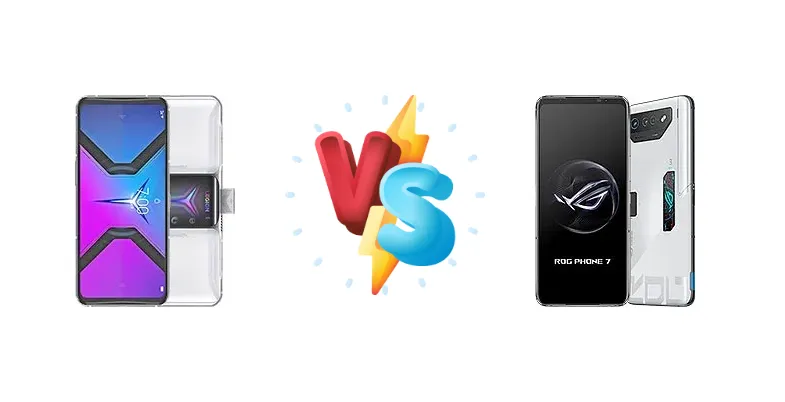
Lenovo Legion 2 Pro vs Asus ROG Phone 7 Ultimate: The Ultimate Gaming Phone Battle
| Phones Images | |||||
|---|---|---|---|---|---|
|
🏆 Quick Verdict
The Asus ROG Phone 7 Ultimate takes the crown thanks to its significantly faster Snapdragon 8 Gen 2 chipset, brighter display, and longer software support commitment. While the Legion 2 Pro boasts incredibly fast charging, the ROG Phone 7's overall package is more compelling for serious gamers.
| PHONES | ||
|---|---|---|
| Phone Names | Lenovo Legion 2 Pro | Asus ROG Phone 7 Ultimate |
| Network | ||
|---|---|---|
| 2G bands | GSM 850 / 900 / 1800 / 1900 | GSM 850 / 900 / 1800 / 1900 |
| 3G bands | HSDPA 800 / 850 / 900 / 1900 / 2100 | HSDPA 800 / 850 / 900 / 1700(AWS) / 1900 / 2100 |
| 4G bands | 1, 2, 3, 4, 5, 7, 8, 12, 17, 18, 19, 20, 26, 34, 38, 39, 40, 41, 42, 43 | 1, 2, 3, 4, 5, 7, 8, 12, 17, 18, 19, 20, 25, 26, 28, 32, 34, 38, 39, 40, 41, 42, 43, 48, 66 - International |
| 5G bands | 1, 3, 28, 41, 77, 78, 79 SA/NSA/Sub6 | 1, 2, 3, 5, 7, 8, 12, 18, 20, 25, 26, 28, 38, 40, 41, 48, 66, 77, 78, 79 SA/NSA/Sub6 - International |
| Speed | HSPA, LTE, 5G | HSPA, LTE (Up to 7CA), 5G |
| Technology | GSM / CDMA / HSPA / CDMA2000 / LTE / 5G | GSM / CDMA / HSPA / LTE / 5G |
| CDMA2000 1x | 1, 3, 5, 8, 28, 41, 77, 78, 79 SA/NSA/Sub6 - China | |
| Launch | ||
|---|---|---|
| Announced | 2021, April 08 | 2023, April 13 |
| Status | Available. Released 2021, April 26 | Available. Released 2023, May |
| Body | ||
|---|---|---|
| Build | Glass front (Gorilla Glass 5), glass back, aluminum frame | Glass front (Gorilla Glass Victus), glass back (Gorilla Glass 3), aluminum frame |
| Dimensions | 176 x 78.5 x 9.9 mm (6.93 x 3.09 x 0.39 in) | 173 x 77 x 10.3 mm (6.81 x 3.03 x 0.41 in) |
| SIM | Nano-SIM + Nano-SIM | Nano-SIM + Nano-SIM |
| Weight | 259 g (9.14 oz) | 239 g (8.43 oz) |
| Built-in two cooling fans RGB light panel (on the back) 6 pressure sensitive zones (Gaming triggers): 4 ultrasonic buttons (top), 2 capacitive sliding buttons (back) | Built-in motorized cooling air vent (AeroActive Portal) IP54 water resistant 2" OLED display (on the back) Pressure sensitive zones (Gaming triggers) | |
| Display | ||
|---|---|---|
| Protection | Corning Gorilla Glass 5 | Corning Gorilla Glass Victus |
| Resolution | 1080 x 2460 pixels (~388 ppi density) | 1080 x 2448 pixels (~395 ppi density) |
| Size | 6.92 inches, 113.7 cm2 (~82.3% screen-to-body ratio) | 6.78 inches, 109.5 cm2 (~82.2% screen-to-body ratio) |
| Type | AMOLED, 144Hz, HDR10+, 1300 nits (peak) | AMOLED, 1B colors, 165Hz, HDR10+, 1000 nits (HBM), 1500 nits (peak) |
| Platform | ||
|---|---|---|
| CPU | Octa-core (1x2.84 GHz Cortex-X1 & 3x2.42 GHz Cortex-A78 & 4x1.80 GHz Cortex-A55) | Octa-core (1x3.2 GHz Cortex-X3 & 2x2.8 GHz Cortex-A715 & 2x2.8 GHz Cortex-A710 & 3x2.0 GHz Cortex-A510) |
| Chipset | Qualcomm SM8350 Snapdragon 888 5G (5 nm) | Qualcomm SM8550-AB Snapdragon 8 Gen 2 (4 nm) |
| GPU | Adreno 660 | Adreno 740 |
| OS | Android 11, Legion OS | Android 13, up to 2 major Android upgrades |
| Memory | ||
|---|---|---|
| Card slot | No | No |
| Internal | 128GB 8GB RAM, 128GB 12GB RAM, 256GB 12GB RAM, 512GB 16GB RAM, 512GB 18GB RAM | 512GB 16GB RAM |
| UFS 3.1 | UFS 4.0 NTFS support for external storage | |
| Main Camera | ||
|---|---|---|
| Dual | 64 MP, f/1.9, 25mm (wide), 1/1.32", 1.0µm, PDAF 16 MP, f/2.2, 123˚, 16mm (ultrawide), 1.0µm | - |
| Features | Dual-LED flash, panorama, HDR | LED flash, HDR, panorama |
| Triple | - | 50 MP, f/1.9, 24mm (wide), 1/1.56", 1.0µm, PDAF 13 MP, f/2.2, 13mm, 120˚ (ultrawide) 5 MP (macro) |
| Video | 8K@24fps, 4K@30/60fps, 1080p@30/60/240fps, gyro-EIS, HDR10+ rec. | 8K@24fps, 4K@30/60fps, 1080p@30/60/120/240fps, 720p@480fps; gyro-EIS, HDR10+ |
| Selfie camera | ||
|---|---|---|
| Features | HDR | Panorama, HDR |
| Single | Motorized pop-up 44 MP, f/2.0, 24mm (wide), 1/2.65", 1.0µm, AF | 32 MP, f/2.5, 29mm (wide), 1/3.2", 0.7µm |
| Video | 4K@30/60fps, 1080p@30/60/120fps | 1080p@30fps |
| Sound | ||
|---|---|---|
| 3.5mm jack | No | Yes |
| 35mm jack | No | Yes |
| Loudspeaker | Yes, with stereo speakers | Yes, with stereo speakers (2 amplifiers) |
| - | 32-bit/384kHz audio | |
| Comms | ||
|---|---|---|
| Bluetooth | 5.2, A2DP, LE | 5.3, A2DP, LE, aptX HD, aptX Adaptive, aptX Lossless |
| NFC | Yes | Yes |
| Positioning | GPS (L1+L5), GLONASS, GALILEO, BDS, QZSS | GPS (L1+L5), GLONASS (L1), BDS (B1I+B1c+B2a), GALILEO (E1+E5a), QZSS (L1+L5), NavIC (L5) |
| Radio | No | No |
| USB | Two USB Type-C (2.0 & 3.1), OTG | USB Type-C 3.1 (side), DisplayPort 1.4; USB Type-C 2.0 (bottom), OTG, accessory connector |
| WLAN | Wi-Fi 802.11 a/b/g/n/ac/6, dual-band, Wi-Fi Direct | Wi-Fi 802.11 a/b/g/n/ac/6e/7, tri-band, Wi-Fi Direct |
| Features | ||
|---|---|---|
| Sensors | Fingerprint (under display, optical), accelerometer, gyro, proximity, compass | Fingerprint (under display, optical), accelerometer, gyro, proximity, compass |
| Battery | ||
|---|---|---|
| Charging | 90W wired (dual USB-C ports), 50% in 12 min, 100% in 30 min 65W wired (single USB-C port) | 65W wired, PD3.0, QC5, 100% in 42 min 10W reverse wired |
| Type | Li-Po 5500 mAh | Li-Po 6000 mAh |
| Misc | ||
|---|---|---|
| Colors | Titanium White, Ultimate Black | Storm White |
| Models | L70081 | - |
| Price | About 880 EUR | About 780 EUR |
| Tests | ||
|---|---|---|
| Battery life | - | Endurance rating 131h |
| Camera | - | Photo / Video |
| Display | - | Contrast ratio: Infinite (nominal) |
| Loudspeaker | - | -25.5 LUFS (Very good) |
| Performance | - | AnTuTu: 1325105 (v9) GeekBench: 5139 (v5.5), 5567 (v6) GFXBench: 107fps (ES 3.1 onscreen) |
Lenovo Legion 2 Pro
- Incredibly fast 90W charging
- Competitive price
- Good cooling system
- Solid performance for most games
- Older Snapdragon 888 chipset
- Less vibrant display
- Camera performance is average
- Software support may be limited
Asus ROG Phone 7 Ultimate
- Top-tier Snapdragon 8 Gen 2 performance
- Brighter and more vibrant display
- Excellent battery life
- Gaming-focused software and accessories
- Longer software support commitment
- Higher price
- 65W charging is slower than Legion 2 Pro
- Bulky design
Display Comparison
The Asus ROG Phone 7 Ultimate's display is a clear winner. Its 1095 nits peak brightness significantly outshines the Legion 2 Pro, offering better visibility in bright sunlight. The ROG Phone 7 also boasts an impressive infinite contrast ratio, while the Legion 2 Pro's display, though good, lacks the same level of vibrancy and clarity. Both offer high refresh rates for smooth gameplay.
Camera Comparison
While both phones offer capable camera systems, neither excels in this area compared to flagship smartphones. The ROG Phone 7 likely has a slight edge in image processing and low-light performance, but both are secondary to the gaming focus. Expect decent photo and video quality, but don't expect flagship-level camera performance.
Performance
The Snapdragon 8 Gen 2 in the ROG Phone 7 Ultimate provides a substantial performance advantage over the Snapdragon 888 in the Legion 2 Pro. Expect faster load times, smoother frame rates in demanding games, and improved multitasking capabilities on the ROG Phone 7. The ROG Phone 7's CPU architecture is also more efficient, contributing to better thermal management.
Battery Life
Both phones offer excellent battery life, with the ROG Phone 7 Ultimate boasting an endurance rating of 131 hours. The Legion 2 Pro's 90W charging is a standout feature, allowing for incredibly fast top-ups. However, the ROG Phone 7's larger battery capacity and efficient chipset contribute to its impressive longevity.
Buying Guide
The Lenovo Legion 2 Pro is ideal for gamers prioritizing blazing-fast charging and a more budget-friendly price point. The Asus ROG Phone 7 Ultimate is the choice for those seeking top-tier performance, a stunning display, and a comprehensive gaming ecosystem with accessories and software features.