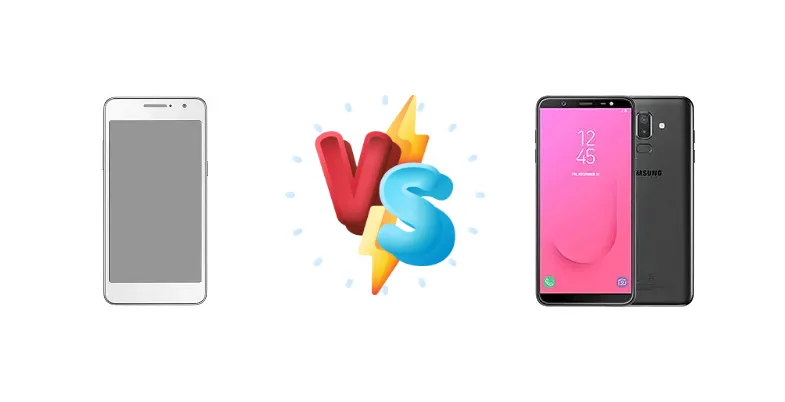
The Lenovo K7 and Samsung Galaxy J8 represent a shrinking segment of the smartphone market: truly affordable devices. Both aimed to deliver a functional Android experience without breaking the bank, but they took different approaches to achieving this. The K7 focuses on power efficiency with its Unisoc chipset, while the J8 opts for a slightly faster, though less efficient, Qualcomm Snapdragon processor. This comparison will dissect the key differences to determine which phone offers the best value.
🏆 Quick Verdict
For the average user prioritizing battery life and sustained performance under light loads, the Lenovo K7 is the better choice. Its Unisoc SC9863A, built on a smaller 28nm process, offers superior efficiency. However, the Samsung Galaxy J8’s Snapdragon 450 provides a noticeable performance edge for more demanding tasks, albeit at the cost of battery longevity.
| Network |
|---|
| 2G bands | GSM 850 / 900 / 1800 / 1900 | GSM 850 / 900 / 1800 / 1900 |
| 3G bands | HSDPA 850 / 900 / 1900 / 2100 | HSDPA 850 / 900 / 1700(AWS) / 1900 / 2100 |
| 4G bands | LTE | 1, 2, 3, 4, 5, 7, 8, 12, 17, 20, 28, 38, 40, 41, 66 - J810Y/DS |
| Speed | HSPA, LTE | HSPA 42.2/5.76 Mbps, LTE (2CA) Cat6 300/50 Mbps |
| Technology | GSM / CDMA / HSPA / LTE | GSM / HSPA / LTE |
| | CDMA 800 & TD-SCDMA | - |
| Launch |
|---|
| Announced | 2020, April 13 | 2018, May. Released 2018, July |
| Status | Cancelled | Discontinued |
| Body |
|---|
| Build | - | Glass front, plastic back, plastic frame |
| Dimensions | - | 159.2 x 75.7 x 8.2 mm (6.27 x 2.98 x 0.32 in) |
| SIM | Nano-SIM + Nano-SIM | Nano-SIM + Nano-SIM |
| Weight | 0 (5.68 oz) | 177 g (6.24 oz) |
| Display |
|---|
| Resolution | 720 x 1520 pixels, 19:9 ratio (~276 ppi density) | 720 x 1480 pixels, 18.5:9 ratio (~274 ppi density) |
| Size | 6.09 inches, 92.6 cm2 | 6.0 inches, 91.4 cm2 (~75.8% screen-to-body ratio) |
| Type | IPS LCD | Super AMOLED |
| Platform |
|---|
| CPU | Octa-core (4x1.6 GHz Cortex-A55 & 4x1.2 GHz Cortex-A55) | Octa-core 1.8 GHz Cortex-A53 |
| Chipset | Unisoc SC9863A (28 nm) | Qualcomm SDM450 Snapdragon 450 (14 nm) |
| GPU | IMG8322 | Adreno 506 |
| OS | Android 10 | Android 8.0 (Oreo), upgradable to Android 9.0 (Pie) |
| Memory |
|---|
| Card slot | microSDXC (uses shared SIM slot) | microSDXC (dedicated slot) |
| Internal | - | 32GB 3GB RAM, 64GB 4GB RAM |
| | eMMC 5.1 | eMMC 5.1 |
| Main Camera |
|---|
| Dual | - | 16 MP, f/1.7, AF
Auxiliary lens |
| Features | LED flash, HDR, panorama | LED flash, panorama, HDR |
| Triple | 13 MP, (wide), PDAF
Auxiliary lens | - |
| Video | 1080p@30fps | 1080p@30fps |
| Selfie camera |
|---|
| Features | HDR | LED flash |
| Single | 5 MP | 16 MP, f/1.9, 26mm (wide), 1/3.06", 1.0µm |
| Video | - | 1080p@30fps |
| Sound |
|---|
| 3.5mm jack | Yes | Yes |
| 35mm jack | Yes | Yes |
| Loudspeaker | Yes | Yes |
| Comms |
|---|
| Bluetooth | 5.0, A2DP, LE | 4.2, A2DP, LE |
| NFC | No | No |
| Positioning | GPS | GPS, GLONASS, BDS |
| Radio | FM radio | FM radio, recording |
| USB | Yes | microUSB 2.0, OTG |
| WLAN | Wi-Fi 802.11 b/g/n | Wi-Fi 802.11 b/g/n, Wi-Fi Direct |
| Features |
|---|
| Sensors | Fingerprint (rear-mounted), accelerometer, proximity | Fingerprint (rear-mounted), accelerometer, proximity |
| Battery |
|---|
| Music play | - | Up to 112 h |
| Talk time | - | Up to 23 h (3G) |
| Type | Li-Ion 4000 mAh | Li-Ion 3500 mAh, non-removable |
| Misc |
|---|
| Colors | Blue, Black | Black, Gold, Blue, Purple |
| Models | - | SM-J810G, SM-J810F, J810Y, SM-J810Y, SM-J810GF, SM-J810M |
| Price | - | About 310 EUR |
| SAR EU | - | 0.57 W/kg (head) 1.18 W/kg (body) |
Lenovo K7
- Superior power efficiency thanks to the Unisoc SC9863A and 28nm process.
- Potentially longer battery life for all-day use.
- More consistent performance under sustained loads due to less thermal throttling.
- Slightly slower CPU performance compared to the Snapdragon 450.
- May struggle with demanding games or multitasking.
Samsung Galaxy J8
- Faster CPU performance for quicker app loading and smoother multitasking.
- Samsung’s image processing may result in better photo quality in good lighting.
- Qualcomm chipset generally offers wider app compatibility.
- Less power efficient, leading to shorter battery life.
- Potential for thermal throttling during prolonged use.
- Snapdragon 450 is an older chipset.
Display Comparison
Neither device is known for a standout display. Given the context data focuses on the chipset, we can infer both likely feature LCD panels, common in this price bracket. The J8, benefiting from Samsung’s display expertise, *may* have slightly better color accuracy, but this is speculative. Bezels are likely to be substantial on both, reflecting their budget positioning. Brightness levels are also expected to be similar, likely around 400-450 nits, adequate for indoor use but struggling in direct sunlight.
Camera Comparison
Without specific camera specs, it’s safe to assume both phones feature basic camera setups geared towards casual photography. The J8, leveraging Samsung’s image processing algorithms, likely delivers more pleasing images in good lighting conditions. However, low-light performance will likely be poor on both. Any 2MP depth or macro sensors included on either device are likely to offer minimal benefit, serving primarily as marketing features. The larger sensor (if present) on the main camera will be the most significant factor in image quality, but this information is unavailable.
Performance
The core difference lies in the chipsets. The Samsung Galaxy J8’s Qualcomm Snapdragon 450 (14nm) boasts a higher clock speed (1.8 GHz) on its Cortex-A53 cores compared to the Lenovo K7’s Unisoc SC9863A (28nm) with its mix of 1.6 GHz and 1.2 GHz Cortex-A55 cores. While the J8’s clock speed is higher, the 14nm process of the Snapdragon 450 is significantly more efficient than the K7’s 28nm process. This means the J8 will consume more power for the same level of performance. The Cortex-A55 cores in the K7 are architecturally more efficient than the A53 cores in the J8, further contributing to its better power management. Expect the J8 to show a slight advantage in benchmark scores and app loading times, but the K7 to maintain smoother performance over extended use due to less thermal throttling.
Battery Life
Battery capacity is not provided, but the Unisoc SC9863A’s superior efficiency gives the Lenovo K7 a distinct advantage in battery life. The Snapdragon 450, while capable, is a power-hungry chip. Even with a similarly sized battery, the K7 will likely last longer on a single charge. Charging wattage is also unknown, but both phones likely support standard 5W or 10W charging, resulting in relatively slow 0-100% times – likely exceeding 3 hours.
Buying Guide
Buy the Lenovo K7 if you need a phone that will reliably last through a full day of moderate use – browsing, messaging, and occasional social media. It’s ideal for users who prioritize battery life and don’t engage in heavy gaming or multitasking. Buy the Samsung Galaxy J8 if you prefer a slightly snappier experience for app switching and light gaming, and are willing to accept potentially shorter battery life or carry a power bank. It’s better suited for users who occasionally push their phone a bit harder.
Frequently Asked Questions
❓ Will the Snapdragon 450 in the Galaxy J8 struggle with modern Android updates?
The Snapdragon 450 is an older chipset, and while it can run modern versions of Android, you may experience slowdowns or lag with future updates. The K7’s Unisoc chip, while also entry-level, may receive better optimization for newer Android versions due to its more recent development.
❓ Is the difference in CPU clock speed (1.8 GHz vs 1.6/1.2 GHz) noticeable in everyday use?
The clock speed difference is noticeable in synthetic benchmarks and app loading times, but in everyday tasks like browsing and messaging, the difference will be minimal. The K7’s more efficient architecture helps close the gap in real-world performance.
❓ Which phone is better for playing PUBG Mobile?
Neither phone is ideal for PUBG Mobile. Both chipsets will struggle to maintain stable frame rates at higher settings. The J8 might offer slightly better performance, but you’ll likely need to play at the lowest settings and resolution to achieve a playable experience. Expect significant frame drops and lag on both devices.