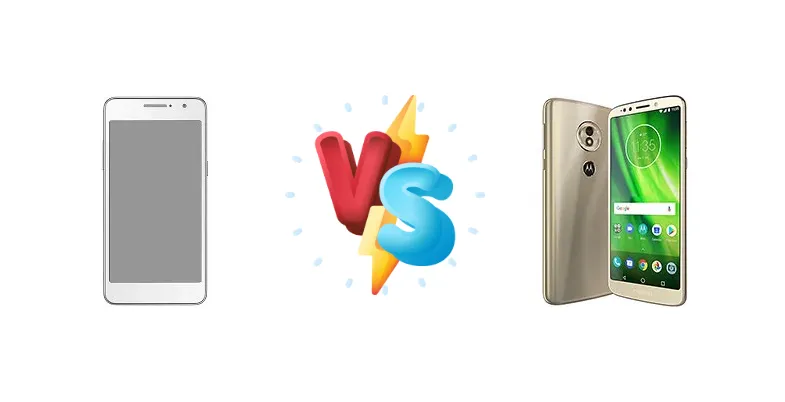
The Lenovo K7 and Motorola Moto G6 Play represent a shrinking segment of the smartphone market: truly affordable devices. Both phones aim to deliver essential functionality without breaking the bank, but they take different approaches to achieving this. The K7 leverages a Unisoc chipset, while the Moto G6 Play opts for a Qualcomm Snapdragon, creating a key point of divergence for performance and efficiency.
🏆 Quick Verdict
For the average user prioritizing consistent performance and a slightly more modern architecture, the Motorola Moto G6 Play is the better choice. While both phones share a 28nm process, the Snapdragon 430 (or 427 in the US variant) offers a more refined Cortex-A53 CPU core compared to the K7’s Cortex-A55, resulting in a smoother user experience.
| Network |
|---|
| 2G bands | GSM 850 / 900 / 1800 / 1900 | GSM 850 / 900 / 1800 / 1900 |
| 3G bands | HSDPA 850 / 900 / 1900 / 2100 | HSDPA 850 / 900 / 1900 / 2100 - Europe, Brazil |
| 4G bands | LTE | 1, 3, 5, 7, 8, 20, 38 - Europe |
| Speed | HSPA, LTE | HSPA 42.2/5.76 Mbps, LTE Cat4 150/50 Mbps |
| Technology | GSM / CDMA / HSPA / LTE | GSM / CDMA / HSPA / EVDO / LTE |
| | CDMA 800 & TD-SCDMA | 1, 2, 3, 4, 5, 7, 28 - Brazil |
| Launch |
|---|
| Announced | 2020, April 13 | 2018, April. Released 2018, May |
| Status | Cancelled | Discontinued |
| Body |
|---|
| Build | - | Glass front (Gorilla Glass), plastic back, plastic frame |
| Dimensions | - | 154.4 x 72.2 x 9 mm (6.08 x 2.84 x 0.35 in) |
| SIM | Nano-SIM + Nano-SIM | · Nano-SIM· Nano-SIM + Nano-SIM |
| Weight | 0 (5.68 oz) | 175 g (6.17 oz) |
| | - | Splash resistant |
| Display |
|---|
| Protection | - | Corning Gorilla Glass (unspecified version) |
| Resolution | 720 x 1520 pixels, 19:9 ratio (~276 ppi density) | 720 x 1440 pixels, 18:9 ratio (~282 ppi density) |
| Size | 6.09 inches, 92.6 cm2 | 5.7 inches, 83.8 cm2 (~75.2% screen-to-body ratio) |
| Type | IPS LCD | IPS LCD |
| Platform |
|---|
| CPU | Octa-core (4x1.6 GHz Cortex-A55 & 4x1.2 GHz Cortex-A55) | Octa-core 1.4 GHz Cortex-A53Quad-core 1.4 GHz Cortex-A53 - USA |
| Chipset | Unisoc SC9863A (28 nm) | Qualcomm MSM8937 Snapdragon 430 (28 nm)Qualcomm MSM8920 Snapdragon 427 (28 nm) - USA |
| GPU | IMG8322 | Adreno 505Adreno 308 - USA |
| OS | Android 10 | Android 8.0 (Oreo), upgradable to Android 9.0 (Pie) |
| Memory |
|---|
| Card slot | microSDXC (uses shared SIM slot) | microSDXC (dedicated slot) |
| Internal | - | 16GB 2GB RAM, 16GB 3GB RAM, 32GB 3GB RAM |
| | eMMC 5.1 | eMMC 5.1 |
| Main Camera |
|---|
| Features | LED flash, HDR, panorama | LED flash, HDR, panorama |
| Single | - | 13 MP, f/2.0, 1/3.1", 1.12µm, PDAF |
| Triple | 13 MP, (wide), PDAF
Auxiliary lens | - |
| Video | 1080p@30fps | 1080p@30fps |
| Selfie camera |
|---|
| Features | HDR | LED flash |
| Single | 5 MP | 5 MP (USA)
8 MP (other markets) |
| Video | - | 1080p@30fps |
| Sound |
|---|
| 3.5mm jack | Yes | Yes |
| 35mm jack | Yes | Yes |
| Loudspeaker | Yes | Yes |
| Comms |
|---|
| Bluetooth | 5.0, A2DP, LE | 4.2, A2DP, LE, EDR |
| NFC | No | Yes (Europe) |
| Positioning | GPS | GPS, GLONASS, BDS |
| Radio | FM radio | FM radio |
| USB | Yes | microUSB 2.0 |
| WLAN | Wi-Fi 802.11 b/g/n | Wi-Fi 802.11 b/g/n, Wi-Fi DirectWi-Fi 802.11 a/b/g/n, dual-band, Wi-Fi Direct - USA |
| Features |
|---|
| Sensors | Fingerprint (rear-mounted), accelerometer, proximity | Fingerprint (rear-mounted), accelerometer, gyro, proximity |
| Battery |
|---|
| Charging | - | 10W / 15W wired (market dependent) |
| Type | Li-Ion 4000 mAh | Li-Ion 4000 mAh, non-removable |
| Misc |
|---|
| Colors | Blue, Black | Deep Indigo, Silver, Flash Gray, Gold |
| Models | - | XT1922-1, XT1922-2, XT1922-3, XT1922-4, XT1922-5, XT1922-10 |
| Price | - | About 150 EUR |
| SAR | - | 1.20 W/kg (head) 1.11 W/kg (body) |
| SAR EU | - | 0.66 W/kg (head) 1.42 W/kg (body) |
| Tests |
|---|
| Audio quality | - |
Noise -89.0dB / Crosstalk -87.3dB |
| Battery life | - |
Endurance rating 92h
|
| Camera | - |
Photo / Video |
| Display | - |
Contrast ratio: 1404 (nominal), 3.419 (sunlight) |
| Loudspeaker | - |
Voice 66dB / Noise 70dB / Ring 76dB
|
| Performance | - |
AnTuTu: 58757 (v7)
GeekBench: 2328 (v4.4)
GFXBench: 5.3fps (ES 3.1 onscreen) |
Lenovo K7
- Potentially lower price point
- Long battery life (92h endurance)
- Octa-core processor (more cores)
- Less efficient CPU architecture (Cortex-A55)
- Unisoc chipset may have limited software support
- Unspecified charging speed
Motorola Moto G6 Play
- More efficient CPU architecture (Cortex-A53)
- Qualcomm chipset offers better software optimization
- Potentially faster charging (10W/15W)
- US variant has a quad-core processor
- Long battery life (92h endurance) - similar to K7
- Camera specs are unknown
Display Comparison
Both the Lenovo K7 and Motorola Moto G6 Play feature displays with a nominal contrast ratio of 1404 and a sunlight contrast ratio of 3.419, suggesting similar outdoor visibility. However, the context data lacks specifics on resolution, panel type (IPS, TFT), and refresh rate. Given the price point, both likely utilize IPS LCD panels, but the G6 Play’s better overall optimization may translate to slightly more accurate color reproduction. Without further data, it’s difficult to definitively declare a winner.
Camera Comparison
Both devices are listed with 'Photo / Video' capabilities, but lack any specific details regarding sensor size, megapixel count, or aperture. In this price range, camera performance is rarely a standout feature. It’s safe to assume both phones offer adequate cameras for casual snapshots in good lighting conditions, but struggle in low-light scenarios. The absence of details prevents a meaningful comparison beyond acknowledging that neither phone is likely to excel in photography.
Performance
The core difference lies in the chipsets. The Lenovo K7’s Unisoc SC9863A utilizes a combination of Cortex-A55 cores clocked at 1.6 GHz and 1.2 GHz. The Motorola Moto G6 Play, depending on the region, features either the Snapdragon 430 (octa-core 1.4 GHz Cortex-A53) or the Snapdragon 427 (quad-core 1.4 GHz Cortex-A53). While the K7 boasts more cores, the Cortex-A53 in the Snapdragon 430 is architecturally more efficient than the Cortex-A55 at the same clock speed. The US variant with the quad-core 427 will likely show a more noticeable performance difference compared to the K7. This translates to faster app launches and smoother multitasking on the Moto G6 Play.
Battery Life
Both the Lenovo K7 and Motorola Moto G6 Play achieve an impressive endurance rating of 92 hours, indicating excellent battery life. However, this rating is a composite score and doesn’t reveal charging speeds. The Moto G6 Play supports 10W or 15W charging (market dependent), while the K7’s charging speed is unspecified. The G6 Play’s potentially faster charging could offer a slight convenience advantage, allowing for quicker top-ups when needed. The similar endurance ratings suggest both phones can comfortably last a full day on a single charge with moderate usage.
Buying Guide
Buy the Lenovo K7 if you need a device for extremely basic tasks like calls, texts, and light social media, and are comfortable with potentially slower app loading times. Buy the Motorola Moto G6 Play if you prefer a more responsive experience, even with similar tasks, and value the Qualcomm chipset’s generally better software support and optimization. The G6 Play is also the better option for those who occasionally play mobile games.
Frequently Asked Questions
❓ Will the Unisoc chipset in the Lenovo K7 struggle with modern apps?
The Unisoc SC9863A is a budget chipset and may exhibit slower loading times and occasional lag when running demanding applications. While it can handle basic tasks, it's not ideal for power users or those who frequently use resource-intensive apps.
❓ Does the Motorola Moto G6 Play support VoLTE and Wi-Fi calling?
Support for VoLTE (Voice over LTE) and Wi-Fi calling varies by carrier and region. It's crucial to check with your mobile carrier to confirm compatibility before purchasing the Moto G6 Play, as these features are essential for modern network connectivity.
❓ Is the difference between the Snapdragon 430 and 427 significant?
The Snapdragon 427 has fewer cores (quad-core vs octa-core) than the 430. This means the 430 will generally perform better in multitasking and more demanding applications. If you are in the US and considering the 427 variant, be aware of this performance difference compared to the 430 available in other regions.