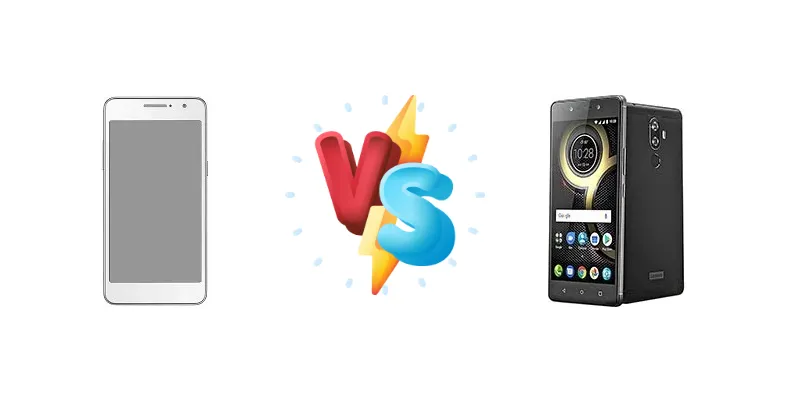
The Lenovo K7 and K8 Note represent distinct approaches to the budget smartphone market. The K7, with its Unisoc chipset, prioritizes efficiency, while the K8 Note aims for raw power with its MediaTek Helio X23. This comparison dissects their key differences to determine which device delivers the best value for your money.
🏆 Quick Verdict
For most users, the Lenovo K8 Note offers a more compelling experience. Its deca-core Helio X23 chipset provides a noticeable performance boost over the K7’s Unisoc SC9863A, making it better suited for multitasking and demanding applications. While the K7 offers better potential efficiency, the K8 Note’s 15W charging partially mitigates any battery concerns.
| Network |
|---|
| 2G bands | GSM 850 / 900 / 1800 / 1900 | GSM 850 / 900 / 1800 / 1900 - SIM 1 & SIM 2 |
| 3G bands | HSDPA 850 / 900 / 1900 / 2100 | HSDPA 850 / 900 / 2100 |
| 4G bands | LTE | 1, 3, 5, 7, 8, 40 |
| Speed | HSPA, LTE | HSPA 42.2/5.76 Mbps, LTE (2CA) Cat6 300/50 Mbps |
| Technology | GSM / CDMA / HSPA / LTE | GSM / HSPA / LTE |
| | CDMA 800 & TD-SCDMA | - |
| Launch |
|---|
| Announced | 2020, April 13 | 2017, August. Released 2017, August |
| Status | Cancelled | Discontinued |
| Body |
|---|
| Build | - | Glass front (Gorilla Glass 3), aluminum back, aluminum frame |
| Dimensions | - | 154.5 x 75.9 x 8.5 mm (6.08 x 2.99 x 0.33 in) |
| SIM | Nano-SIM + Nano-SIM | Nano-SIM + Nano-SIM |
| Weight | 0 (5.68 oz) | 180 g (6.35 oz) |
| | - | Splash Resistant |
| Display |
|---|
| Protection | - | Corning Gorilla Glass 3 |
| Resolution | 720 x 1520 pixels, 19:9 ratio (~276 ppi density) | 1080 x 1920 pixels, 16:9 ratio (~401 ppi density) |
| Size | 6.09 inches, 92.6 cm2 | 5.5 inches, 83.4 cm2 (~71.1% screen-to-body ratio) |
| Type | IPS LCD | IPS LCD |
| Platform |
|---|
| CPU | Octa-core (4x1.6 GHz Cortex-A55 & 4x1.2 GHz Cortex-A55) | Deca-core 2.3 GHz |
| Chipset | Unisoc SC9863A (28 nm) | Mediatek MT6797D Helio X23 (20 nm) |
| GPU | IMG8322 | Mali-T880 MP4 |
| OS | Android 10 | Android 7.1.1 (Nougat), upgradable to Android 8.0 (Oreo) |
| Memory |
|---|
| Card slot | microSDXC (uses shared SIM slot) | microSDXC (dedicated slot) |
| Internal | - | 32GB 3GB RAM, 64GB 4GB RAM |
| | eMMC 5.1 | - |
| Main Camera |
|---|
| Dual | - | 13 MP, f/1.7, PDAF
Auxiliary lens |
| Features | LED flash, HDR, panorama | Dual-LED dual-tone flash, HDR, panorama |
| Triple | 13 MP, (wide), PDAF
Auxiliary lens | - |
| Video | 1080p@30fps | 1080p@30fps |
| Selfie camera |
|---|
| Features | HDR | LED flash |
| Single | 5 MP | 13 MP, f/2.0 |
| Sound |
|---|
| 3.5mm jack | Yes | Yes |
| 35mm jack | Yes | Yes |
| Loudspeaker | Yes | Yes |
| Comms |
|---|
| Bluetooth | 5.0, A2DP, LE | 4.2, A2DP, LE |
| NFC | No | No |
| Positioning | GPS | GPS |
| Radio | FM radio | FM radio |
| USB | Yes | microUSB 2.0, OTG |
| WLAN | Wi-Fi 802.11 b/g/n | Wi-Fi 802.11 b/g/n/ac, Wi-Fi Direct |
| Features |
|---|
| Sensors | Fingerprint (rear-mounted), accelerometer, proximity | Fingerprint (rear-mounted), accelerometer, gyro, proximity, compass |
| Battery |
|---|
| Charging | - | 15W wired |
| Stand-by | - | Up to 378 h (3G) |
| Talk time | - | Up to 25 h (3G) |
| Type | Li-Ion 4000 mAh | Li-Po 4000 mAh, non-removable |
| Misc |
|---|
| Colors | Blue, Black | Fine Gold, Venom Black |
| Models | - | K8 Note, XT1902-3 |
| Price | - | About 180 EUR |
Lenovo K7
- Potentially better battery efficiency due to the Unisoc chipset.
- Likely more affordable price point.
- Simpler processor may result in less software complexity.
- Significantly lower processing power compared to the K8 Note.
- May struggle with demanding applications and multitasking.
- Slower charging speeds (assuming standard charging).
Lenovo K8 Note
- Faster and more responsive performance thanks to the deca-core Helio X23.
- 15W fast charging for quicker top-ups.
- Better suited for gaming and multitasking.
- Potentially shorter battery life due to the more powerful chipset.
- May run slightly warmer under heavy load.
- Likely a higher price tag than the K7.
Display Comparison
Neither device’s display specifications are provided, so a direct comparison is limited. However, given their market segment, both likely feature IPS LCD panels with 720p or 1080p resolution. The K8 Note, being the slightly more premium model, may have a marginally better panel with slightly improved color accuracy or brightness. Bezels are likely comparable, reflecting the design trends of their release period.
Camera Comparison
Without specific camera sensor details, a detailed comparison is difficult. Both phones likely feature a primary camera and potentially a depth sensor. The K8 Note, positioned as a slightly higher-tier device, may have a larger primary sensor and a wider aperture, resulting in better low-light performance. The inclusion of a 2MP macro camera on either device is largely a marketing gimmick and offers limited practical benefit. Image processing algorithms will also play a role, but without sample images, it’s impossible to assess their quality.
Performance
The core difference lies in the chipsets. The Lenovo K8 Note’s MediaTek Helio X23 is a deca-core processor built on a 20nm process, boasting a peak clock speed of 2.3 GHz. This contrasts sharply with the Lenovo K7’s Unisoc SC9863A, an octa-core chip fabricated on a larger 28nm node with lower clock speeds (1.6 GHz and 1.2 GHz). The Helio X23’s architecture, while older, offers significantly more processing power, particularly in multi-threaded tasks. The 20nm process, though less efficient than modern nodes, still provides a performance advantage over the K7’s 28nm chip. The K7’s efficiency may translate to slightly cooler operation under sustained load, but the K8 Note’s raw horsepower will be more noticeable in everyday use.
Battery Life
Battery capacity isn’t specified for either device. However, the K8 Note’s 15W wired charging is a significant advantage. While the K7 may have a slightly larger battery, the K8 Note’s faster charging will reduce downtime. The Unisoc SC9863A’s efficiency *could* offset the K8 Note’s more power-hungry chipset, but the 15W charging provides a tangible benefit in real-world usage, allowing for quicker top-ups when needed.
Buying Guide
Buy the Lenovo K7 if you prioritize long-term battery life and primarily use your phone for basic tasks like calling, texting, and light social media. It’s a good choice for users who value efficiency over outright speed. Buy the Lenovo K8 Note if you prefer a more responsive experience, enjoy occasional gaming, or frequently multitask between apps. The K8 Note’s superior processing power makes it the better option for power users on a budget.
Frequently Asked Questions
❓ Does the MediaTek Helio X23 in the K8 Note tend to overheat during prolonged gaming sessions?
The Helio X23 is known to generate more heat than some newer chipsets. While not extreme, extended gaming on the K8 Note may lead to noticeable warming. However, the phone’s thermal design should prevent significant throttling, maintaining a playable frame rate for most games. The K7’s Unisoc chip will likely run cooler, but at the cost of performance.
❓ Is the difference in processing power between the Unisoc SC9863A and Helio X23 noticeable in everyday tasks like browsing and social media?
Yes, the difference is noticeable. While both phones can handle basic tasks, the K8 Note’s Helio X23 will provide a smoother and more responsive experience when switching between apps, loading web pages, and scrolling through social media feeds. The K7 may exhibit slight lag or stuttering in these scenarios.
❓ Given the lack of detailed camera specs, should I assume the K8 Note has a significantly better camera?
Not necessarily 'significantly' better, but likely better. The K8 Note’s positioning as a slightly more premium device suggests a higher-quality camera sensor and potentially better image processing. However, software optimization plays a crucial role, and without sample images, it’s difficult to quantify the difference. Don't expect flagship-level camera performance from either device.