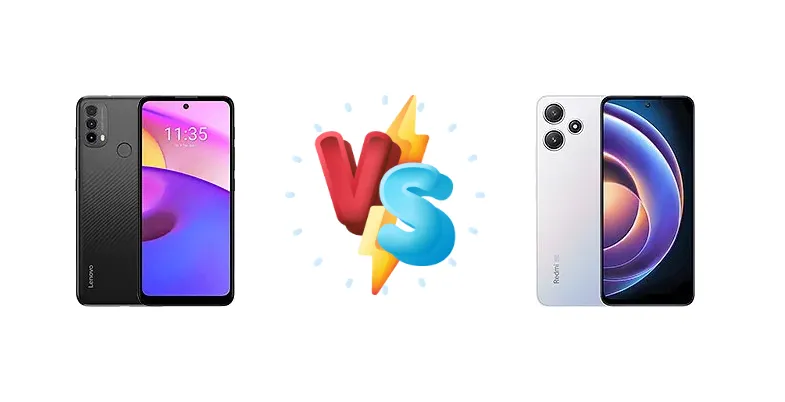
The sub-$200 smartphone market is fiercely competitive. The Lenovo K14 Plus and Xiaomi Redmi Note 12R both aim to deliver essential features at an accessible price point, but they take distinctly different approaches to achieving this. The K14 Plus relies on the Unisoc T700, while the Redmi Note 12R leverages the more modern Qualcomm Snapdragon 4 Gen 2. This comparison will dissect the key differences to determine which device offers the best value.
🏆 Quick Verdict
For the average user prioritizing performance and future-proofing, the Xiaomi Redmi Note 12R is the clear winner. Its Snapdragon 4 Gen 2 chipset, built on a 4nm process, provides a significant performance uplift over the Lenovo K14 Plus’s Unisoc T700. While the K14 Plus offers a slightly simpler experience, the Redmi Note 12R’s faster charging and more efficient processor make it the better overall choice.
| Network |
|---|
| 2G bands | GSM 850 / 900 / 1800 / 1900 | GSM 850 / 900 / 1800 / 1900 |
| 3G bands | HSDPA 850 / 900 / 1700(AWS) / 1900 / 2100 | HSDPA 850 / 900 / 2100 |
| 4G bands | LTE | 1, 3, 5, 8, 34, 38, 39, 40, 41 |
| 5G bands | - | 1, 5, 8, 28, 41, 78 SA/NSA |
| Speed | HSPA, LTE | HSPA, LTE, 5G |
| Technology | GSM / HSPA / LTE | GSM / CDMA / HSPA / EVDO / LTE / 5G |
| Launch |
|---|
| Announced | 2022, February 15 | 2023, June 28 |
| Status | Available. Released 2022, March | Available. Released 2023, June 28 |
| Body |
|---|
| Build | Glass front, plastic frame, plastic back | Glass front, plastic frame, glass back |
| Dimensions | 165.1 x 75.7 x 9.1 mm (6.5 x 2.98 x 0.36 in) | 168.6 x 76.3 x 8.2 mm (6.64 x 3.00 x 0.32 in) |
| SIM | · Nano-SIM· Nano-SIM + Nano-SIM | Nano-SIM + Nano-SIM |
| Weight | 198 g (6.98 oz) | 199 g (7.02 oz) |
| Display |
|---|
| Resolution | 720 x 1600 pixels, 20:9 ratio (~270 ppi density) | 1080 x 2460 pixels (~396 ppi density) |
| Size | 6.5 inches, 102.0 cm2 (~81.6% screen-to-body ratio) | 6.79 inches, 109.5 cm2 (~85.1% screen-to-body ratio) |
| Type | IPS LCD, 90Hz | IPS LCD, 90Hz, 550 nits |
| Platform |
|---|
| CPU | Octa-core 1.8 GHz | Octa-core (2x2.2 GHz Cortex-A78 & 6x1.95 GHz Cortex-A55) |
| Chipset | Unisoc T700 | Qualcomm SM4450 Snapdragon 4 Gen 2 (4 nm) |
| GPU | Mali G52 | Adreno 613 |
| OS | Android 11 | Android 13, MIUI 14 |
| Memory |
|---|
| Card slot | microSDXC (dedicated slot) | microSDXC (uses shared SIM slot) |
| Internal | 64GB 4GB RAM | 128GB 4GB RAM, 128GB 6GB RAM, 128GB 8GB RAM, 256GB 8GB RAM |
| | UFS 2.1 | - |
| Main Camera |
|---|
| Dual | - | 50 MP, f/1.8, (wide), PDAF
2 MP (macro) |
| Features | LED flash, HDR, panorama | LED flash, HDR |
| Triple | 48 MP, f/1.8, (wide), PDAF
2 MP (macro)
Auxiliary lens | - |
| Video | 1080p@30fps | 1080p@30fps |
| Selfie camera |
|---|
| Features | - | HDR |
| Single | 8 MP, f/2.0 | 5 MP, f/2.2, (wide), 1/5.0", 1.12µm |
| Video | 1080p@30fps | 1080p@30fps |
| Sound |
|---|
| 3.5mm jack | Yes | - |
| 35mm jack | Yes | Yes |
| Loudspeaker | Yes | Yes |
| Comms |
|---|
| Bluetooth | 5.0, A2DP, LE | 5.3, A2DP, LE |
| Infrared port | - | Yes |
| NFC | No | Yes (market/region dependent) |
| Positioning | GPS, GLONASS, GALILEO | GPS, GLONASS, GALILEO, BDS |
| Radio | FM radio | No |
| USB | USB Type-C 2.0 | USB Type-C |
| WLAN | Wi-Fi 802.11 b/g/n | Wi-Fi 802.11 a/b/g/n/ac, dual-band |
| Features |
|---|
| Sensors | Fingerprint (rear-mounted), accelerometer, proximity | Fingerprint (side-mounted), accelerometer, compass |
| Battery |
|---|
| Charging | 10W wired | 18W wired, PD |
| Type | Li-Po 5000 mAh | Li-Po 5000 mAh |
| Misc |
|---|
| Colors | Black, Gold | Black, Blue, Silver |
| Models | - | 23076RA4BC |
| Price | About 200 EUR | About 150 EUR |
Lenovo K14 Plus
- Potentially lower price point.
- Simpler user experience.
- Reliable for basic tasks.
- Inferior chipset performance.
- Slower charging speed.
- Less efficient processor.
Xiaomi Redmi Note 12R
- Superior chipset performance (Snapdragon 4 Gen 2).
- Faster 18W charging with PD.
- More power-efficient processor.
- Potentially slightly higher price.
- Xiaomi’s MIUI software can be polarizing.
- May have more pre-installed apps.
Display Comparison
Neither device’s display specifications are provided, so a direct comparison is limited. However, given the price bracket, both likely utilize LCD panels. The Redmi Note 12R, benefiting from Xiaomi’s broader display expertise, may offer slightly better color calibration. The absence of information regarding refresh rates suggests both are likely capped at 60Hz. Bezels are expected to be comparable, prioritizing cost-effectiveness over premium aesthetics.
Camera Comparison
Without detailed camera specifications, a precise comparison is difficult. However, it’s reasonable to assume both devices feature a primary camera and potentially a depth or macro sensor. The Redmi Note 12R, leveraging Qualcomm’s image signal processing capabilities, is likely to deliver superior image quality, particularly in challenging lighting conditions. The Unisoc T700’s ISP is less refined, potentially resulting in softer images and less dynamic range on the K14 Plus. The absence of OIS on either device suggests reliance on software stabilization.
Performance
The core difference lies in the chipsets. The Xiaomi Redmi Note 12R’s Qualcomm Snapdragon 4 Gen 2 (4nm) is a substantial upgrade over the Lenovo K14 Plus’s Unisoc T700. The 4nm fabrication process of the Snapdragon offers significantly improved power efficiency and thermal performance, translating to less throttling during sustained workloads. The Snapdragon’s CPU configuration – 2x2.2 GHz Cortex-A78 & 6x1.95 GHz Cortex-A55 – is also more sophisticated than the K14 Plus’s Octa-core 1.8 GHz setup, offering better single-core and multi-core performance. This means faster app loading times, smoother multitasking, and a more enjoyable gaming experience on the Redmi Note 12R.
Battery Life
Battery capacity isn’t specified for either device, but the Redmi Note 12R’s 18W wired charging with PD support is a significant advantage over the K14 Plus’s 10W charging. The Power Delivery (PD) standard also offers wider compatibility with chargers. While a larger battery capacity on the K14 Plus could partially offset the slower charging, the Snapdragon 4 Gen 2’s superior power efficiency means the Redmi Note 12R will likely achieve comparable or better battery life with a similar capacity, and recharge much faster.
Buying Guide
Buy the Lenovo K14 Plus if you need a basic, reliable smartphone for essential tasks like calling, texting, and light social media use, and prioritize simplicity over raw power. Buy the Xiaomi Redmi Note 12R if you prefer a smoother, more responsive experience for multitasking, gaming, and content consumption, and value faster charging speeds and a more efficient processor.
Frequently Asked Questions
❓ Will the Unisoc T700 in the Lenovo K14 Plus struggle with demanding apps like video editors or graphically intensive games?
Yes, the Unisoc T700 is a budget-focused chipset. While it can handle basic tasks, it will likely exhibit noticeable lag and slowdowns when running resource-intensive applications. The Redmi Note 12R’s Snapdragon 4 Gen 2 is significantly better equipped for these workloads.
❓ How long will it take to fully charge the Xiaomi Redmi Note 12R from 0% to 100% with an 18W PD charger?
With an 18W PD charger, the Redmi Note 12R should fully charge in approximately 1.5 to 2 hours, depending on battery capacity. This is considerably faster than the Lenovo K14 Plus, which will likely take over 3 hours with its 10W charging.
❓ Is the Snapdragon 4 Gen 2 in the Redmi Note 12R capable of running popular games like PUBG Mobile or Call of Duty Mobile at acceptable frame rates?
The Snapdragon 4 Gen 2 can run PUBG Mobile and Call of Duty Mobile, but you’ll likely need to lower the graphics settings to medium or low to achieve consistently smooth frame rates. It’s capable of playable performance, but don’t expect the same experience as a phone with a higher-end chipset.
❓ Does the Lenovo K14 Plus support fast charging at all, or is 10W its maximum charging speed?
The Lenovo K14 Plus is limited to 10W wired charging. It does not support any form of fast charging technology, meaning a full charge will take a significant amount of time.