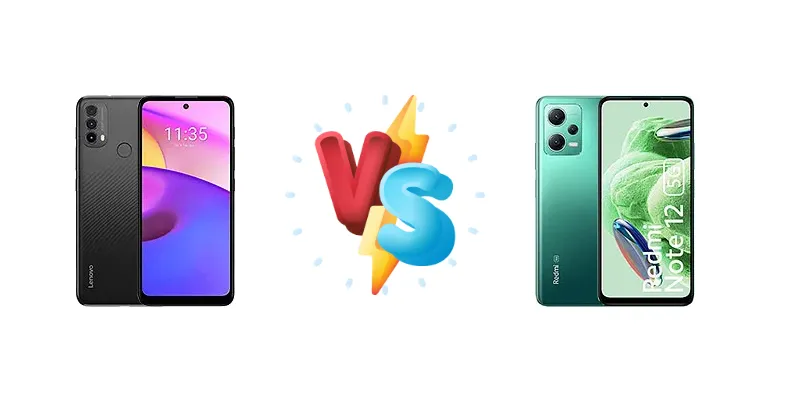
Looking for a budget-friendly smartphone? The Lenovo K14 Plus and Xiaomi Redmi Note 12 are both contenders, offering compelling features at accessible price points. But which one reigns supreme? This comprehensive comparison dives deep into their specs, performance, and overall value to help you decide.
🏆 Quick Verdict
The Xiaomi Redmi Note 12 is the clear winner. Its superior chipset, faster charging, brighter display, and significantly better battery life make it a more well-rounded and compelling choice despite a potentially similar price point. The K14 Plus is a basic option, but the Redmi Note 12 offers much more for the money.
| Network |
|---|
| 2G bands | GSM 850 / 900 / 1800 / 1900 | GSM 850 / 900 / 1800 / 1900 |
| 3G bands | HSDPA 850 / 900 / 1700(AWS) / 1900 / 2100 | HSDPA 850 / 900 / 2100 |
| 4G bands | LTE | 1, 3, 5, 8, 40, 41 |
| 5G bands | - | 1, 3, 5, 8, 28, 40, 78 SA/NSA |
| Speed | HSPA, LTE | HSPA, LTE, 5G |
| Technology | GSM / HSPA / LTE | GSM / HSPA / LTE / 5G |
| Launch |
|---|
| Announced | 2022, February 15 | 2022, October 27 |
| Status | Available. Released 2022, March | Available. Released 2023, January 11 |
| Body |
|---|
| Build | Glass front, plastic frame, plastic back | - |
| Dimensions | 165.1 x 75.7 x 9.1 mm (6.5 x 2.98 x 0.36 in) | 165.9 x 76.2 x 8 mm (6.53 x 3.00 x 0.31 in) |
| SIM | · Nano-SIM· Nano-SIM + Nano-SIM | Nano-SIM + Nano-SIM |
| Weight | 198 g (6.98 oz) | 188 g (6.63 oz) |
| | - | IP53, dust and splash resistant |
| Display |
|---|
| Protection | - | Corning Gorilla Glass 3 |
| Resolution | 720 x 1600 pixels, 20:9 ratio (~270 ppi density) | 1080 x 2400 pixels, 20:9 ratio (~395 ppi density) |
| Size | 6.5 inches, 102.0 cm2 (~81.6% screen-to-body ratio) | 6.67 inches, 107.4 cm2 (~85.0% screen-to-body ratio) |
| Type | IPS LCD, 90Hz | AMOLED, 120Hz, 1200 nits (peak) |
| Platform |
|---|
| CPU | Octa-core 1.8 GHz | Octa-core (2x2.0 GHz Cortex-A78 & 6x1.8 GHz Cortex-A55) |
| Chipset | Unisoc T700 | Qualcomm SM4375 Snapdragon 4 Gen 1 (6 nm) |
| GPU | Mali G52 | Adreno 619 |
| OS | Android 11 | Android 12, MIUI 14 (International), MIUI 13 (India) |
| Memory |
|---|
| Card slot | microSDXC (dedicated slot) | microSDXC (uses shared SIM slot) |
| Internal | 64GB 4GB RAM | 128GB 4GB RAM, 128GB 6GB RAM, 256GB 8GB RAM |
| | UFS 2.1 | UFS 2.2 |
| Main Camera |
|---|
| Features | LED flash, HDR, panorama | Dual-LED dual-tone flash, HDR, panorama |
| Triple | 48 MP, f/1.8, (wide), PDAF
2 MP (macro)
Auxiliary lens | 48 MP, f/1.8, (wide), PDAF
8 MP, f/2.2, 120˚ (ultrawide), 1/4.0", 1.12µm
2 MP (macro) |
| Video | 1080p@30fps | 1080p@30fps |
| Selfie camera |
|---|
| Features | - | HDR |
| Single | 8 MP, f/2.0 | 13 MP, f/2.5, (wide), 1/3.0" |
| Video | 1080p@30fps | 1080p@30fps |
| Sound |
|---|
| 3.5mm jack | Yes | Yes |
| 35mm jack | Yes | Yes |
| Loudspeaker | Yes | Yes |
| | - | 24-bit/192kHz audio |
| Comms |
|---|
| Bluetooth | 5.0, A2DP, LE | 5.1, A2DP, LE |
| Infrared port | - | Yes |
| NFC | No | Yes (market/region dependent) |
| Positioning | GPS, GLONASS, GALILEO | GPS, GLONASS |
| Radio | FM radio | Unspecified |
| USB | USB Type-C 2.0 | USB Type-C 2.0, OTG |
| WLAN | Wi-Fi 802.11 b/g/n | Wi-Fi 802.11 a/b/g/n/ac, dual-band |
| Features |
|---|
| Sensors | Fingerprint (rear-mounted), accelerometer, proximity | Fingerprint (side-mounted), accelerometer, gyro, proximity, compass |
| Battery |
|---|
| Charging | 10W wired | 33W wired, 50% in 22 min |
| Type | Li-Po 5000 mAh | Li-Po 5000 mAh |
| Misc |
|---|
| Colors | Black, Gold | Frosted Green, Matte Black, Mystique Blue |
| Models | - | 22111317I, 22111317G |
| Price | About 200 EUR | € 151.99 / $ 219.99 / ₹ 11,999 |
| SAR | - | 1.09 W/kg (head) 1.05 W/kg (body) |
| SAR EU | - | 0.68 W/kg (head) 0.91 W/kg (body) |
| Tests |
|---|
| Battery life | - |
Endurance rating 101h
|
| Camera | - |
Photo / Video |
| Display | - |
Contrast ratio: Infinite (nominal) |
| Loudspeaker | - |
-28.0 LUFS (Good)
|
| Performance | - |
AnTuTu: 360745 (v9)
GeekBench: 1998 (v5.1), 2017 (v6) |
Lenovo K14 Plus
- Very affordable
- Decent basic functionality
- Lightweight
- Weak performance
- Slow charging
- Dim display
- Short battery life
- Limited camera capabilities
Xiaomi Redmi Note 12
- Good performance
- Fast charging (33W)
- Bright and vibrant display
- Excellent battery life
- Better camera
- May lack premium features
- Design might be considered basic by some
Display Comparison
The Redmi Note 12 boasts a significantly brighter display (706 nits) compared to the K14 Plus (likely around 350-400 nits based on typical Unisoc phone displays). The Redmi Note 12's 'infinite' contrast ratio suggests excellent image quality, while the K14 Plus will likely offer a more standard viewing experience. The Redmi Note 12's display is the clear winner here.
Camera Comparison
While both phones offer 'Photo / Video' capabilities, the Redmi Note 12 is expected to have a superior camera system due to the more powerful chipset and likely better image processing algorithms. Expect better image quality, dynamic range, and low-light performance from the Redmi Note 12. Specific camera specs (megapixels, aperture) are needed for a more precise comparison, but the Redmi Note 12 holds the advantage.
Performance
The Redmi Note 12's Snapdragon 4 Gen 1 chipset (6nm) is a substantial upgrade over the K14 Plus's Unisoc T700. The Snapdragon offers better CPU and GPU performance, resulting in smoother multitasking, faster app loading, and improved gaming capabilities. The K14 Plus will feel noticeably slower in demanding tasks.
Battery Life
The Redmi Note 12 shines in battery life, boasting an impressive endurance rating of 101 hours and an active use score of 10:58 hours. The K14 Plus, with its 10W charging and likely smaller battery, will offer significantly shorter battery life and slower charging speeds. The Redmi Note 12's 33W charging is also a major advantage.
Buying Guide
Who should buy the Lenovo K14 Plus? Users prioritizing the absolute lowest price and basic functionality. Who should buy the Xiaomi Redmi Note 12? Anyone seeking a reliable, feature-rich smartphone with good performance, a vibrant display, and excellent battery life, all without breaking the bank.
Frequently Asked Questions
❓ Is the Lenovo K14 Plus good for gaming?
No, the K14 Plus's chipset is not powerful enough for demanding games. You'll likely experience lag and low frame rates.
❓ How long does the Redmi Note 12's battery last?
The Redmi Note 12 offers excellent battery life, typically lasting a full day or more with moderate use. It has an endurance rating of 101 hours.
❓ Which phone has faster charging?
The Xiaomi Redmi Note 12 has significantly faster charging (33W) compared to the Lenovo K14 Plus (10W).
❓ Are replacement parts readily available for these phones?
Xiaomi phones generally have better availability of replacement parts and accessories compared to Lenovo, especially in certain regions.