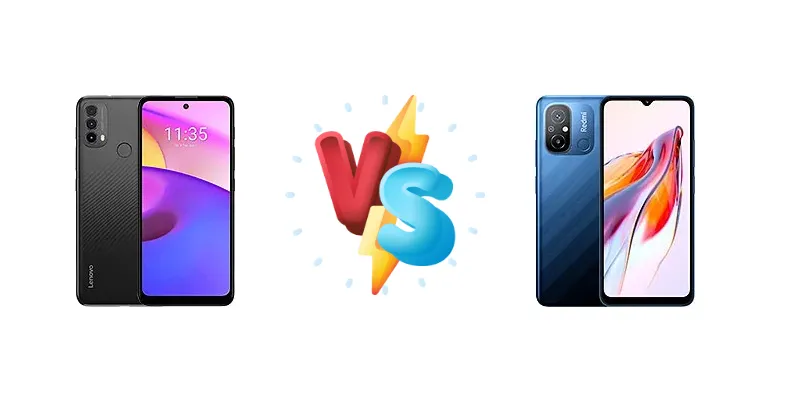
Looking for an affordable smartphone that doesn't completely break the bank? The Lenovo K14 Plus and Xiaomi Redmi 12C are both contenders in the budget phone arena. But which one offers the best bang for your buck? Let's dive into a detailed comparison.
🏆 Quick Verdict
The Xiaomi Redmi 12C edges out the Lenovo K14 Plus thanks to its significantly more powerful Helio G85 chipset, resulting in smoother performance and better gaming capabilities. While both offer basic features, the Redmi 12C provides a more enjoyable user experience overall.
| Network |
|---|
| 2G bands | GSM 850 / 900 / 1800 / 1900 | GSM 850 / 900 / 1800 / 1900 |
| 3G bands | HSDPA 850 / 900 / 1700(AWS) / 1900 / 2100 | HSDPA 850 / 900 / 2100 |
| 4G bands | LTE | 1, 3, 5, 7, 8, 20, 28, 38, 40, 41 - International |
| Speed | HSPA, LTE | HSPA, LTE |
| Technology | GSM / HSPA / LTE | GSM / CDMA / HSPA / EVDO / LTE |
| | - | CDMA2000 1xEV-DO |
| Launch |
|---|
| Announced | 2022, February 15 | 2022, December 31 |
| Status | Available. Released 2022, March | Available. Released 2023, January 01 |
| Body |
|---|
| Build | Glass front, plastic frame, plastic back | - |
| Dimensions | 165.1 x 75.7 x 9.1 mm (6.5 x 2.98 x 0.36 in) | 168.8 x 76.4 x 8.8 mm (6.65 x 3.01 x 0.35 in) |
| SIM | · Nano-SIM· Nano-SIM + Nano-SIM | Nano-SIM + Nano-SIM |
| Weight | 198 g (6.98 oz) | 192 g (6.77 oz) |
| Display |
|---|
| Resolution | 720 x 1600 pixels, 20:9 ratio (~270 ppi density) | 720 x 1650 pixels (~268 ppi density) |
| Size | 6.5 inches, 102.0 cm2 (~81.6% screen-to-body ratio) | 6.71 inches, 106.5 cm2 (~82.6% screen-to-body ratio) |
| Type | IPS LCD, 90Hz | IPS LCD, 500 nits (typ) |
| Platform |
|---|
| CPU | Octa-core 1.8 GHz | Octa-core (2x2.0 GHz Cortex-A75 & 6x1.8 GHz Cortex-A55) |
| Chipset | Unisoc T700 | Mediatek MT6769Z Helio G85 (12 nm) |
| GPU | Mali G52 | Mali-G52 MC2 |
| OS | Android 11 | Android 12, MIUI 13 |
| Memory |
|---|
| Card slot | microSDXC (dedicated slot) | microSDXC (dedicated slot) |
| Internal | 64GB 4GB RAM | 32GB 2GB RAM, 32GB 3GB RAM, 32GB 4GB RAM, 64GB 3GB RAM, 64GB 4GB RAM, 128GB 3GB RAM, 128GB 4GB RAM, 128GB 6GB RAM |
| | UFS 2.1 | eMMC 5.1 |
| Main Camera |
|---|
| Dual | - | 50 MP, (wide), PDAF
0.08 MP (depth) |
| Features | LED flash, HDR, panorama | LED flash, HDR |
| Single | - | 50 MP, f/1.8, (wide), 1/2.76", PDAF
Auxiliary lens |
| Triple | 48 MP, f/1.8, (wide), PDAF
2 MP (macro)
Auxiliary lens | - |
| Video | 1080p@30fps | 1080p@30fps |
| Selfie camera |
|---|
| Single | 8 MP, f/2.0 | 5 MP, f/2.2, (wide) |
| Video | 1080p@30fps | 1080p@30fps |
| Sound |
|---|
| 3.5mm jack | Yes | Yes |
| 35mm jack | Yes | Yes |
| Loudspeaker | Yes | Yes |
| Comms |
|---|
| Bluetooth | 5.0, A2DP, LE | 5.1, A2DP, LE |
| NFC | No | Yes (market/region dependent) |
| Positioning | GPS, GLONASS, GALILEO | GPS, GLONASS, BDS, GALILEO |
| Radio | FM radio | FM radio |
| USB | USB Type-C 2.0 | microUSB 2.0 |
| WLAN | Wi-Fi 802.11 b/g/n | Wi-Fi 802.11 a/b/g/n/ac, dual-band, Wi-Fi Direct |
| Features |
|---|
| Sensors | Fingerprint (rear-mounted), accelerometer, proximity | Fingerprint (rear-mounted), accelerometer |
| | - | Virtual proximity sensing |
| Battery |
|---|
| Charging | 10W wired | 10W wired |
| Type | Li-Po 5000 mAh | Li-Po 5000 mAh |
| Misc |
|---|
| Colors | Black, Gold | Graphite Gray, Ocean Blue, Mint Green, Lavender Purple |
| Models | - | 22120RN86G, 22120RN86I, 22126RN91Y, 2212ARNC4L |
| Price | About 200 EUR | £ 132.99 / € 107.41 |
| SAR | - | 1.08 W/kg (head) 0.64 W/kg (body) |
| SAR EU | - | 0.98 W/kg (head) 0.99 W/kg (body) |
Lenovo K14 Plus
- Very affordable
- Large display
- Decent battery life
- Weak processor
- Limited storage options
- Slow charging
Xiaomi Redmi 12C
- Better performance than K14 Plus
- More versatile camera
- Slightly better display
- Still a budget phone with limitations
- Slow charging
- Design may be basic
Display Comparison
Both phones feature large 6.5-inch HD+ displays, offering decent viewing angles for their price range. However, the Redmi 12C often has slightly better color accuracy and brightness, leading to a marginally more vibrant visual experience. The K14 Plus may have a slightly different panel type, but both are adequate for casual viewing.
Camera Comparison
The Redmi 12C generally boasts a more versatile camera system, often including a higher resolution main sensor and potentially a depth sensor for improved portrait mode. While neither phone excels in low-light photography, the Redmi 12C's image processing tends to be slightly better. Both likely offer a basic front-facing camera suitable for selfies.
Performance
This is where the Redmi 12C truly shines. The Mediatek Helio G85 is a noticeable upgrade over the Unisoc T700. Expect smoother multitasking, faster app loading times, and a better experience with graphically demanding apps. The K14 Plus will feel sluggish by comparison, especially when handling multiple tasks.
Battery Life
Both devices are expected to have around 5000mAh batteries, providing all-day battery life for moderate users. Charging speeds are identical at 10W, meaning charging will take a considerable amount of time. Battery optimization will be key to maximizing usage on either device.
Buying Guide
Who should buy the Lenovo K14 Plus? Users prioritizing a very basic, ultra-budget device for essential tasks like calls and messaging. Who should buy the Xiaomi Redmi 12C? Those seeking a slightly more capable phone for light gaming, social media, and everyday use without spending a fortune.
Frequently Asked Questions
❓ Is the Lenovo K14 Plus good for gaming?
No, the Unisoc T700 chipset is not powerful enough for demanding games. It can handle very basic games at low settings, but performance will be limited.
❓ How much storage do these phones offer?
Both phones typically come with 32GB or 64GB of internal storage, expandable via microSD card. Storage options may vary depending on the region and specific model.
❓ Which phone has better software support?
Xiaomi generally provides better software updates and support for its Redmi series compared to Lenovo's K series. However, both are budget devices and updates may be infrequent.