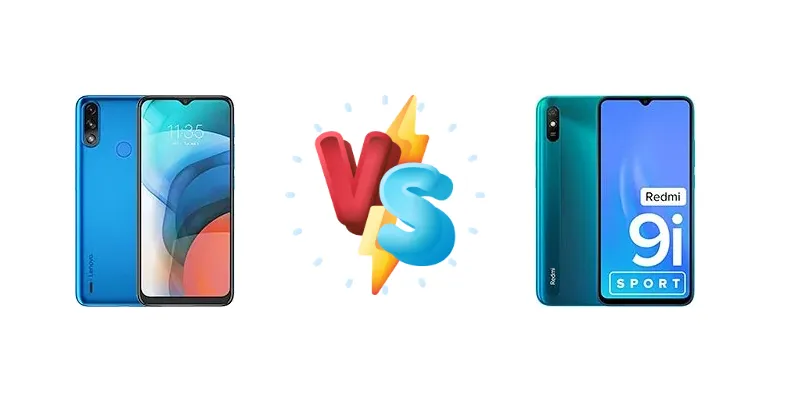
The Lenovo K13 and Xiaomi Redmi 9i Sport represent the extreme end of the budget smartphone spectrum. Both aim to deliver essential smartphone functionality at the lowest possible price point, but they take different approaches to achieving this. This comparison dissects their core components to determine which offers the best value for users prioritizing performance and efficiency.
🏆 Quick Verdict
For the average user, the Xiaomi Redmi 9i Sport is the better choice. While both phones offer similar basic functionality, the Redmi 9i Sport’s Mediatek Helio G25 chipset, fabricated on a smaller 12nm process, provides a noticeable performance advantage and improved power efficiency over the Lenovo K13’s older 28nm Unisoc SC9863A.
| Network |
|---|
| 2G bands | GSM 850 / 900 / 1800 / 1900 | GSM 850 / 900 / 1800 / 1900 |
| 3G bands | HSDPA 850 / 900 / 1900 / 2100 | HSDPA 850 / 900 / 2100 |
| 4G bands | LTE | 1, 3, 5, 8, 40, 41 |
| Speed | HSPA, LTE | HSPA, LTE |
| Technology | GSM / HSPA / LTE | GSM / HSPA / LTE |
| Launch |
|---|
| Announced | 2021, August 30 | 2021, September 28 |
| Status | Available. Released 2021, August 30 | Available. Released 2021, September 28 |
| Body |
|---|
| Build | Glass front, plastic back, plastic frame | - |
| Dimensions | 165.1 x 75.9 x 9.2 mm (6.5 x 2.99 x 0.36 in) | 164.9 x 77.1 x 9 mm (6.49 x 3.04 x 0.35 in) |
| SIM | Nano-SIM + Nano-SIM | Nano-SIM + Nano-SIM |
| Weight | 200 g (7.05 oz) | 194 g (6.84 oz) |
| | Water-repellent design | Water-repellent coating |
| Display |
|---|
| Resolution | 720 x 1600 pixels, 20:9 ratio (~269 ppi density) | 720 x 1600 pixels, 20:9 ratio (~269 ppi density) |
| Size | 6.52 inches, 102.6 cm2 (~81.9% screen-to-body ratio) | 6.53 inches, 102.9 cm2 (~81.0% screen-to-body ratio) |
| Type | IPS LCD | IPS LCD, 400 nits (typ) |
| Platform |
|---|
| CPU | Octa-core (4x1.6 GHz Cortex-A55 & 4x1.2 GHz Cortex-A55) | Octa-core (4x2.0 GHz Cortex-A53 & 4x1.5 GHz Cortex-A53) |
| Chipset | Unisoc SC9863A (28 nm) | Mediatek MT6762G Helio G25 (12 nm) |
| GPU | IMG8322 | PowerVR GE8320 |
| OS | Android 10 (Go edition) | Android 10, MIUI 12 |
| Memory |
|---|
| Card slot | microSDXC (uses shared SIM slot) | microSDXC (dedicated slot) |
| Internal | 32GB 2GB RAM | 64GB 4GB RAM, 128GB 4GB RAM |
| | eMMC 5.1 | eMMC 5.1 |
| Main Camera |
|---|
| Dual | 13 MP, f/2.0, 26mm (wide), 1/3.1", 1.12µm, PDAF
2 MP (macro) | - |
| Features | LED flash, HDR, panorama | LED flash, HDR |
| Single | - | 13 MP, f/2.2, 28mm (wide), 1.0µm, PDAF |
| Video | 1080p@30fps | 1080p@30fps |
| Selfie camera |
|---|
| Features | HDR | HDR |
| Single | 5 MP, f/2.2, 27mm (wide), 1.12µm | 5 MP, f/2.2, (wide), 1.12µm |
| Video | 1080p@30fps | 1080p@30fps |
| Sound |
|---|
| 3.5mm jack | Yes | Yes |
| 35mm jack | Yes | Yes |
| Loudspeaker | Yes | Yes |
| Comms |
|---|
| Bluetooth | 4.2, A2DP, LE | 5.0, A2DP, LE |
| NFC | No | No |
| Positioning | GPS, GLONASS, GALILEO | GPS, GLONASS, BDS |
| Radio | FM radio | FM radio |
| USB | USB Type-C 2.0, OTG | microUSB 2.0, OTG |
| WLAN | Wi-Fi 802.11 b/g/n | Wi-Fi 802.11 а/b/g/n, Wi-Fi Direct |
| Features |
|---|
| Sensors | Fingerprint (rear-mounted), accelerometer, proximity | Accelerometer, proximity, compass |
| Battery |
|---|
| Charging | 10W wired | 10W wired |
| Type | Li-Ion 5000 mAh | Li-Po 5000 mAh |
| Misc |
|---|
| Colors | Tahiti Blue, Coral Red | Carbon Black, Coral Green, Metallic Blue |
| Price | About 90 EUR | About 100 EUR |
Lenovo K13
- Potentially lower price point
- Simple and straightforward user experience
- Durable build quality (likely)
- Significantly slower performance
- Less power efficient
- Outdated chipset
Xiaomi Redmi 9i Sport
- Better performance with Helio G25
- More power efficient
- Smoother multitasking experience
- May be slightly more expensive
- Basic camera performance
- Still limited by budget components
Display Comparison
Neither device boasts a standout display. Both likely feature basic LCD panels with resolutions around 720p+, typical for this price bracket. Without specific brightness data, it’s safe to assume both struggle in direct sunlight. The focus here isn’t on visual fidelity, but on basic readability. Bezels are expected to be substantial on both, maximizing screen real estate within a compact form factor.
Camera Comparison
Camera performance on both devices will be limited. Expect basic image quality suitable for social media sharing in good lighting conditions. Without sensor size information, it’s difficult to make a definitive statement, but both likely feature low-resolution primary sensors. The Redmi 9i Sport may benefit slightly from Mediatek’s image signal processor (ISP), potentially offering better noise reduction and dynamic range. The inclusion of a 2MP macro camera on either device is largely a marketing gimmick and offers minimal practical benefit.
Performance
The core difference lies in the chipsets. The Xiaomi Redmi 9i Sport’s Mediatek Helio G25, built on a 12nm process, is a clear upgrade over the Lenovo K13’s Unisoc SC9863A (28nm). The smaller fabrication node translates to better power efficiency and reduced heat generation. While both are octa-core CPUs, the Helio G25 utilizes Cortex-A53 cores clocked at 2.0 GHz, offering a performance boost over the K13’s mix of 1.6 GHz and 1.2 GHz Cortex-A55 cores. This means faster app loading times and smoother multitasking on the Redmi 9i Sport. The K13 will likely struggle with demanding applications.
Battery Life
Both phones feature 10W wired charging, indicating similar charging speeds. While battery capacity isn’t specified, both likely house batteries in the 5000mAh range, common for budget smartphones. However, the Redmi 9i Sport’s more efficient Helio G25 chipset will translate to longer battery life in real-world usage. The K13’s less efficient Unisoc chip will drain the battery faster, even with a similar capacity.
Buying Guide
Buy the Lenovo K13 if you absolutely need the lowest possible upfront cost and are willing to accept significantly slower performance and limited multitasking capabilities. It’s suitable for very basic use cases like calls and light messaging. Buy the Xiaomi Redmi 9i Sport if you prioritize a smoother user experience, even for basic tasks, and want a phone that can handle occasional light gaming or running multiple apps without significant slowdowns. The Redmi 9i Sport offers a better balance of performance and affordability.
Frequently Asked Questions
❓ Will the Redmi 9i Sport handle popular games like PUBG Mobile?
While the Helio G25 can run PUBG Mobile, expect to play at the lowest graphics settings and potentially experience frame drops during intense moments. It's not a gaming-focused chipset, but it's capable of casual gaming.
❓ Is the Unisoc SC9863A in the Lenovo K13 known for overheating?
The Unisoc SC9863A is not known for extreme overheating, but its 28nm process is less efficient, meaning it will generate more heat under load compared to the Redmi 9i Sport's Helio G25. This can lead to performance throttling during prolonged use.
❓ How much storage do these phones typically offer, and is it expandable?
Both phones typically come with 32GB of internal storage, which is quite limited. Fortunately, both support microSD card expansion, allowing you to add more storage for photos, videos, and apps.
❓ What version of Android do these phones run?
Both devices likely ship with Android 10 or 11 (Go Edition), a lightweight version of Android designed for devices with limited processing power and RAM. Updates beyond this are unlikely.