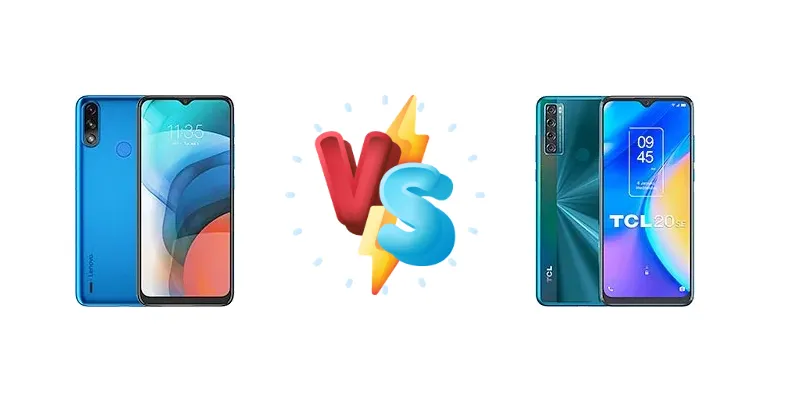
The Lenovo K13 and TCL 20 SE represent the fiercely competitive sub-$150 smartphone market. Both aim to deliver essential functionality at an accessible price, but they take different approaches to achieving this. The K13 relies on the Unisoc SC9863A, while the 20 SE opts for Qualcomm’s Snapdragon 460. This comparison dissects these choices, revealing which phone offers the best value for your money.
🏆 Quick Verdict
For most users, the TCL 20 SE is the better choice. Its Snapdragon 460 chipset, fabricated on an 11nm process, provides a noticeable performance advantage over the Lenovo K13’s 28nm Unisoc SC9863A. The faster 18W charging also significantly improves usability, offsetting the slightly smaller performance gap in everyday tasks.
| Network |
|---|
| 2G bands | GSM 850 / 900 / 1800 / 1900 | GSM 850 / 900 / 1800 / 1900 |
| 3G bands | HSDPA 850 / 900 / 1900 / 2100 | HSDPA 850 / 900 / 1900 / 2100 - EMEA, SEA, APAC |
| 4G bands | LTE | 1, 3, 5, 7, 8, 20, 28, 38, 40, 41 - EMEA, SEA, APAC |
| Speed | HSPA, LTE | HSPA, LTE |
| Technology | GSM / HSPA / LTE | GSM / HSPA / LTE |
| | - | 1, 2, 3, 4, 5, 7, 8, 12, 13, 17, 26, 28, 66 - LATAM |
| Launch |
|---|
| Announced | 2021, August 30 | 2021, January 11 |
| Status | Available. Released 2021, August 30 | Available. Released 2021, April 26 |
| Body |
|---|
| Build | Glass front, plastic back, plastic frame | - |
| Dimensions | 165.1 x 75.9 x 9.2 mm (6.5 x 2.99 x 0.36 in) | 172.1 x 77.1 x 9.1 mm (6.78 x 3.04 x 0.36 in) |
| SIM | Nano-SIM + Nano-SIM | · Nano-SIM· Nano-SIM + Nano-SIM |
| Weight | 200 g (7.05 oz) | 206 g (7.27 oz) |
| | Water-repellent design | - |
| Display |
|---|
| Resolution | 720 x 1600 pixels, 20:9 ratio (~269 ppi density) | 720 x 1640 pixels (~263 ppi density) |
| Size | 6.52 inches, 102.6 cm2 (~81.9% screen-to-body ratio) | 6.82 inches, 110.5 cm2 (~83.2% screen-to-body ratio) |
| Type | IPS LCD | IPS LCD, 450 nits (typ) |
| Platform |
|---|
| CPU | Octa-core (4x1.6 GHz Cortex-A55 & 4x1.2 GHz Cortex-A55) | Octa-core (4x1.8 GHz Kryo 240 & 4x1.6 GHz Kryo 240) |
| Chipset | Unisoc SC9863A (28 nm) | Qualcomm SM4250 Snapdragon 460 (11 nm) |
| GPU | IMG8322 | Adreno 610 |
| OS | Android 10 (Go edition) | Android 11, upgradable to Android 12, TCL UI |
| Memory |
|---|
| Card slot | microSDXC (uses shared SIM slot) | microSDXC (uses shared SIM slot) |
| Internal | 32GB 2GB RAM | 64GB 4GB RAM, 128GB 4GB RAM |
| | eMMC 5.1 | UFS 2.1 (128GB only) |
| Main Camera |
|---|
| Dual | 13 MP, f/2.0, 26mm (wide), 1/3.1", 1.12µm, PDAF
2 MP (macro) | - |
| Features | LED flash, HDR, panorama | Dual-LED flash, HDR, panorama |
| Quad | - | 16 MP, f/1.8, 27mm (wide), 1/2.0", 1.12µm, PDAF
5 MP, f/2.2, 14mm, 115˚ (ultrawide), 1/5.0", 1.12µm
Auxiliary lens
2 MP (macro)
or
48 MP, f/2.0, 27mm (wide), 1/2.0", 0.8µm, PDAF
5 MP, f/2.2, 14mm, 115˚ (ultrawide), 1/5.0", 1.12µm
Auxiliary lens
2 MP (macro) |
| Video | 1080p@30fps | 1080p@30fps |
| Selfie camera |
|---|
| Features | HDR | HDR |
| Single | 5 MP, f/2.2, 27mm (wide), 1.12µm | 8 MP, f/2.0, 26mm (wide), 1/4.0", 1.12µm
or
13 MP, f/2.2, 26mm (wide), 1/3.0", 1.12µm |
| Video | 1080p@30fps | 1080p@30fps |
| Sound |
|---|
| 3.5mm jack | Yes | Yes |
| 35mm jack | Yes | Yes |
| Loudspeaker | Yes | Yes, with dual speakers |
| | - | 24-bit/192kHz audio |
| Comms |
|---|
| Bluetooth | 4.2, A2DP, LE | 5.0, A2DP, LE, aptX |
| NFC | No | Yes |
| Positioning | GPS, GLONASS, GALILEO | GPS, GLONASS, GALILEO, BDS |
| Radio | FM radio | FM radio |
| USB | USB Type-C 2.0, OTG | USB Type-C 2.0, OTG |
| WLAN | Wi-Fi 802.11 b/g/n | Wi-Fi 802.11 b/g/n, Wi-Fi Direct |
| Features |
|---|
| Sensors | Fingerprint (rear-mounted), accelerometer, proximity | Fingerprint (rear-mounted), accelerometer, proximity, compass |
| Battery |
|---|
| Charging | 10W wired | 18W wired |
| Type | Li-Ion 5000 mAh | Li-Po 5000 mAh |
| Misc |
|---|
| Colors | Tahiti Blue, Coral Red | Aurora Green, Nuit Black |
| Models | - | T671H, T671F, T671O, T671E |
| Price | About 90 EUR | About 150 EUR |
Lenovo K13
- Lowest possible price point
- Simple and straightforward user experience
- Acceptable for basic tasks
- Outdated and inefficient Unisoc chipset
- Slow 10W charging
- Likely limited performance in demanding apps
TCL 20 SE
- More powerful Snapdragon 460 chipset
- Faster 18W charging
- Better overall performance and responsiveness
- Slightly higher price than the Lenovo K13
- Still an entry-level device with limitations
- May not be ideal for heavy gaming
Display Comparison
Neither device boasts a standout display. Both likely feature LCD panels, typical for this price bracket. However, the lack of detailed display specs necessitates focusing on the chipset's impact on UI smoothness. A more powerful chipset, like the Snapdragon 460 in the TCL 20 SE, will translate to smoother scrolling and animations, even on a similar panel.
Camera Comparison
Without detailed camera specs, a direct comparison is difficult. However, it’s safe to assume both phones feature basic camera setups geared towards casual photography. The focus should be on the image signal processor (ISP) within each chipset. Qualcomm’s ISPs are generally more sophisticated, offering better image processing and noise reduction, giving the TCL 20 SE a likely advantage in image quality, particularly in low-light conditions. The presence of a dedicated ISP in the Snapdragon 460 will also allow for faster image capture.
Performance
The core difference lies in the chipsets. The TCL 20 SE’s Qualcomm Snapdragon 460 (11nm) is a clear upgrade over the Lenovo K13’s Unisoc SC9863A (28nm). The 11nm fabrication process is significantly more efficient, leading to better thermal management and sustained performance. While both are octa-core, the Snapdragon 460’s Kryo 240 cores, clocked at 1.8 GHz, offer a performance edge over the K13’s Cortex-A55 cores (1.6 GHz and 1.2 GHz). This translates to faster app loading times and a more responsive overall experience on the TCL 20 SE.
Battery Life
Battery life will depend heavily on usage patterns, but the TCL 20 SE’s 18W charging is a significant advantage. The Lenovo K13 is limited to 10W charging, meaning significantly longer charge times. While battery capacity isn’t specified, the faster charging of the TCL 20 SE mitigates any potential capacity disadvantage, allowing for quicker top-ups throughout the day. The more efficient Snapdragon 460 also contributes to better battery life by consuming less power during operation.
Buying Guide
Buy the Lenovo K13 if your primary need is absolute minimal cost and you prioritize a simple, no-frills experience. It’s suitable for users who only need basic calling, texting, and light app usage. Buy the TCL 20 SE if you value smoother performance, faster charging, and a more responsive user experience, even if it means spending a little more. This phone is better suited for those who use social media, browse the web, or occasionally play casual games.
Frequently Asked Questions
❓ Will the TCL 20 SE handle popular social media apps like TikTok and Instagram smoothly?
Yes, the Snapdragon 460 in the TCL 20 SE is sufficiently powerful to run social media apps like TikTok and Instagram without significant lag. The 11nm process and faster cores contribute to a smoother experience compared to the Lenovo K13’s Unisoc chipset.
❓ How long will it take to fully charge the Lenovo K13 with its 10W charger?
Given the 10W charging rate and assuming a typical battery capacity for this segment (around 4000-5000 mAh), expect a full charge to take approximately 3-4 hours. This is considerably slower than the TCL 20 SE’s 18W charging.
❓ Is the Unisoc SC9863A chipset in the Lenovo K13 capable of playing any mobile games?
The Unisoc SC9863A can handle very basic 2D games and older, less demanding 3D titles. However, it will struggle with modern, graphically intensive games like PUBG or Call of Duty Mobile, even at low settings. Expect significant frame rate drops and lag.
❓ Does the TCL 20 SE support fast charging protocols beyond the standard 18W?
While the TCL 20 SE supports 18W charging, it doesn't explicitly advertise support for proprietary fast charging protocols like Qualcomm Quick Charge. It's likely to benefit from a charger that delivers up to 18W using the standard USB Power Delivery (USB-PD) protocol.