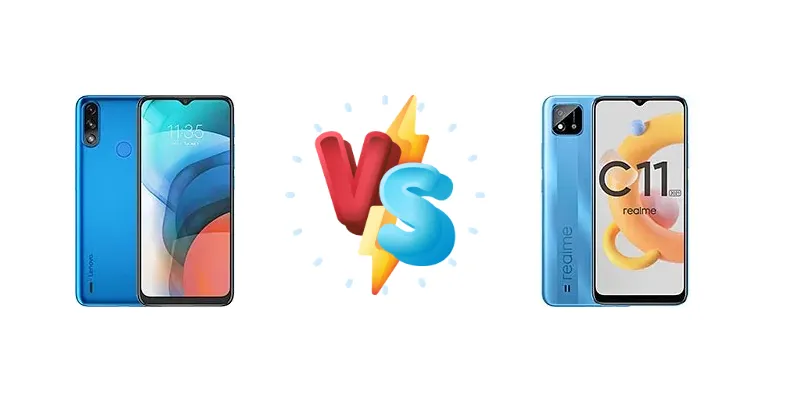
The Lenovo K13 and Realme C11 (2021) occupy the ultra-budget smartphone segment, and a quick glance at the specifications reveals a startling similarity: they are, in essence, the same phone under different branding. This comparison dissects the minute differences to determine which device provides the most compelling user experience, given their shared core hardware.
🏆 Quick Verdict
For the average user, the Realme C11 (2021) edges out the Lenovo K13 due to the inclusion of reverse wired charging. While both phones deliver identical performance with the Unisoc SC9863A, the added utility of being able to charge other devices makes the Realme a slightly more versatile option.
| Network |
|---|
| 2G bands | GSM 850 / 900 / 1800 / 1900 | GSM 850 / 900 / 1800 / 1900 |
| 3G bands | HSDPA 850 / 900 / 1900 / 2100 | HSDPA 850 / 900 / 1900 / 2100 |
| 4G bands | LTE | 1, 3, 5, 8, 38, 40, 41 |
| Speed | HSPA, LTE | HSPA, LTE |
| Technology | GSM / HSPA / LTE | GSM / HSPA / LTE |
| Launch |
|---|
| Announced | 2021, August 30 | 2021, June 28 |
| Status | Available. Released 2021, August 30 | Available. Released 2021, June 28 |
| Body |
|---|
| Build | Glass front, plastic back, plastic frame | Glass front, plastic frame, plastic back |
| Dimensions | 165.1 x 75.9 x 9.2 mm (6.5 x 2.99 x 0.36 in) | 165.2 x 76.4 x 8.9 mm (6.50 x 3.01 x 0.35 in) |
| SIM | Nano-SIM + Nano-SIM | Nano-SIM + Nano-SIM |
| Weight | 200 g (7.05 oz) | 190 g (6.70 oz) |
| | Water-repellent design | Splash resistant design |
| Display |
|---|
| Resolution | 720 x 1600 pixels, 20:9 ratio (~269 ppi density) | 720 x 1600 pixels, 20:9 ratio (~269 ppi density) |
| Size | 6.52 inches, 102.6 cm2 (~81.9% screen-to-body ratio) | 6.52 inches, 102.6 cm2 (~81.3% screen-to-body ratio) |
| Type | IPS LCD | IPS LCD, 400 nits (typ) |
| Platform |
|---|
| CPU | Octa-core (4x1.6 GHz Cortex-A55 & 4x1.2 GHz Cortex-A55) | Octa-core (4x1.6 GHz Cortex-A55 & 4x1.2 GHz Cortex-A55) |
| Chipset | Unisoc SC9863A (28 nm) | Unisoc SC9863A (28 nm) |
| GPU | IMG8322 | IMG8322 |
| OS | Android 10 (Go edition) | Android 11, Realme Go UI |
| Memory |
|---|
| Card slot | microSDXC (uses shared SIM slot) | microSDXC (dedicated slot) |
| Internal | 32GB 2GB RAM | 32GB 2GB RAM, 64GB 4GB RAM |
| | eMMC 5.1 | eMMC 5.1 |
| Main Camera |
|---|
| Dual | 13 MP, f/2.0, 26mm (wide), 1/3.1", 1.12µm, PDAF
2 MP (macro) | - |
| Features | LED flash, HDR, panorama | LED flash, HDR, panorama |
| Single | - | 8 MP, f/2.0, (wide), AF |
| Video | 1080p@30fps | 1080p@30fps |
| Selfie camera |
|---|
| Features | HDR | HDR, panorama |
| Single | 5 MP, f/2.2, 27mm (wide), 1.12µm | 5 MP, f/2.2, (wide) |
| Video | 1080p@30fps | 1080p@30fps |
| Sound |
|---|
| 3.5mm jack | Yes | Yes |
| 35mm jack | Yes | Yes |
| Loudspeaker | Yes | Yes |
| Comms |
|---|
| Bluetooth | 4.2, A2DP, LE | 4.2, A2DP |
| NFC | No | No |
| Positioning | GPS, GLONASS, GALILEO | GPS, GLONASS, GALILEO, BDS |
| Radio | FM radio | Unspecified |
| USB | USB Type-C 2.0, OTG | microUSB 2.0, OTG |
| WLAN | Wi-Fi 802.11 b/g/n | Wi-Fi 802.11 b/g/n |
| Features |
|---|
| Sensors | Fingerprint (rear-mounted), accelerometer, proximity | Accelerometer, gyro, proximity, compass |
| Battery |
|---|
| Charging | 10W wired | 10W wired
Reverse wired |
| Type | Li-Ion 5000 mAh | 5000 mAh |
| Misc |
|---|
| Colors | Tahiti Blue, Coral Red | Cool Blue, Cool Grey |
| Models | - | RMX3231 |
| Price | About 90 EUR | About 80 EUR |
Lenovo K13
- Potentially lower price point
- Simple and straightforward user experience
- Reliable for basic smartphone tasks
- Lacks reverse wired charging
- Limited performance for demanding apps
- Basic camera capabilities
Realme C11 (2021)
- Includes reverse wired charging
- Identical performance to Lenovo K13
- Slightly more versatile due to reverse charging
- May be slightly more expensive
- Limited performance for demanding apps
- Basic camera capabilities
Display Comparison
Both the Lenovo K13 and Realme C11 (2021) are expected to feature similar LCD panels, given their price bracket. Specific details like resolution and brightness are not provided, but it's safe to assume they target a basic viewing experience suitable for indoor use. The absence of features like high refresh rates or even full HD+ resolution indicates a focus on cost reduction. Bezels are likely to be substantial on both devices, maximizing screen real estate within a compact form factor.
Camera Comparison
Camera performance is expected to be similar on both devices, relying on the same underlying image signal processor (ISP) within the Unisoc SC9863A. Details regarding sensor resolution and aperture are not provided, but these phones likely feature a primary camera paired with basic auxiliary lenses (often a 2MP macro or depth sensor). Image quality will be acceptable in good lighting conditions, but will suffer in low light due to the limitations of the sensor and ISP. The lack of optical image stabilization (OIS) will exacerbate this issue.
Performance
The heart of both devices is the Unisoc SC9863A chipset, a 28nm octa-core processor with a configuration of 4x1.6 GHz Cortex-A55 cores and 4x1.2 GHz Cortex-A55 cores. This means performance will be virtually identical across both phones. Expect smooth operation for basic tasks like browsing, social media, and messaging, but struggles with demanding games or multitasking. The shared chipset also implies similar thermal limitations; neither phone is designed for sustained high performance, and throttling is likely under load. RAM configurations are not specified, but are likely to be modest, further impacting multitasking capabilities.
Battery Life
Both the Lenovo K13 and Realme C11 (2021) support 10W wired charging. However, the Realme C11 (2021) adds the functionality of reverse wired charging, allowing it to act as a power bank for other devices. While 10W charging is slow by modern standards, it's adequate for topping up the battery overnight. Battery capacity is not specified, but is likely in the 4000-5000 mAh range, providing all-day battery life with moderate usage. The Realme's reverse charging feature provides a unique advantage, especially for users with multiple devices.
Buying Guide
Buy the Lenovo K13 if you prioritize a potentially lower price point and are solely focused on basic smartphone functionality – calls, texts, and light app usage. Buy the Realme C11 (2021) if you value the convenience of reverse wired charging, allowing you to top up accessories like wireless earbuds or another phone in a pinch, and don't mind potentially paying a small premium.
Frequently Asked Questions
❓ Will the Unisoc SC9863A handle popular games like PUBG Mobile or Call of Duty?
The Unisoc SC9863A is an entry-level chipset and will struggle with graphically demanding games like PUBG Mobile or Call of Duty. You may be able to run them at the lowest settings with significant frame rate drops, but the experience will likely be far from optimal. These phones are better suited for casual gaming and less intensive applications.
❓ How long does it take to fully charge the Lenovo K13 or Realme C11 (2021) with the 10W charger?
With the included 10W charger, expect a full charge to take approximately 3-4 hours. 10W charging is a relatively slow standard, so patience is required. However, it's sufficient for overnight charging, ensuring your phone is ready to go in the morning.
❓ What is the benefit of reverse wired charging on the Realme C11 (2021)?
Reverse wired charging allows you to use your Realme C11 (2021) as a power bank to charge other devices, such as wireless earbuds, smartwatches, or even another smartphone. While the charging speed is limited to 10W, it can be a lifesaver in situations where you don't have access to a power outlet.