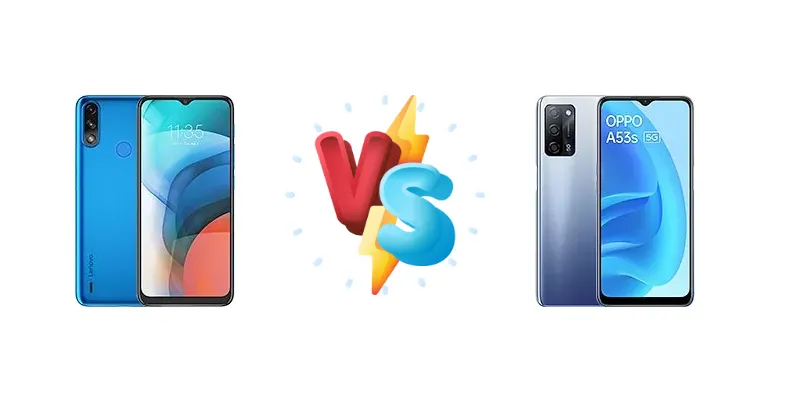
The Lenovo K13 and Oppo A53s 5G represent two approaches to the increasingly competitive budget 5G smartphone market. The K13 aims for ultimate affordability, while the A53s 5G attempts to balance cost with a more modern chipset. This comparison dissects their key differences to help you determine which device delivers the best value for your needs.
🏆 Quick Verdict
For the average user prioritizing smooth everyday performance and 5G connectivity, the Oppo A53s 5G is the clear winner. Its Mediatek Dimensity 700 chipset offers a significant performance uplift over the Lenovo K13’s Unisoc SC9863A, justifying the likely price difference. However, the K13 remains a viable option for those on the tightest of budgets.
| Network |
|---|
| 2G bands | GSM 850 / 900 / 1800 / 1900 | GSM 850 / 900 / 1800 / 1900 |
| 3G bands | HSDPA 850 / 900 / 1900 / 2100 | HSDPA 800 / 850 / 900 / 2100 |
| 4G bands | LTE | 1, 3, 5, 8, 34, 38, 39, 40, 41 |
| 5G bands | - | 1, 28, 41, 77, 78 SA/NSA |
| Speed | HSPA, LTE | HSPA, LTE, 5G |
| Technology | GSM / HSPA / LTE | GSM / HSPA / LTE / 5G |
| Launch |
|---|
| Announced | 2021, August 30 | 2021, April 27 |
| Status | Available. Released 2021, August 30 | Available. Released 2021, May 07 |
| Body |
|---|
| Build | Glass front, plastic back, plastic frame | - |
| Dimensions | 165.1 x 75.9 x 9.2 mm (6.5 x 2.99 x 0.36 in) | 164 x 75.7 x 8.4 mm (6.46 x 2.98 x 0.33 in) |
| SIM | Nano-SIM + Nano-SIM | Nano-SIM + Nano-SIM |
| Weight | 200 g (7.05 oz) | 189.6 g (6.70 oz) |
| | Water-repellent design | - |
| Display |
|---|
| Resolution | 720 x 1600 pixels, 20:9 ratio (~269 ppi density) | 720 x 1600 pixels, 20:9 ratio (~269 ppi density) |
| Size | 6.52 inches, 102.6 cm2 (~81.9% screen-to-body ratio) | 6.52 inches, 102.6 cm2 (~82.7% screen-to-body ratio) |
| Type | IPS LCD | IPS LCD, 480 nits (typ) |
| Platform |
|---|
| CPU | Octa-core (4x1.6 GHz Cortex-A55 & 4x1.2 GHz Cortex-A55) | Octa-core (2x2.2 GHz Cortex-A76 & 6x2.0 GHz Cortex-A55) |
| Chipset | Unisoc SC9863A (28 nm) | Mediatek Dimensity 700 (7 nm) |
| GPU | IMG8322 | Mali-G57 MC2 |
| OS | Android 10 (Go edition) | Android 11, ColorOS 11.1 |
| Memory |
|---|
| Card slot | microSDXC (uses shared SIM slot) | microSDXC (dedicated slot) |
| Internal | 32GB 2GB RAM | 128GB 6GB RAM, 128GB 8GB RAM |
| | eMMC 5.1 | UFS 2.2 |
| Main Camera |
|---|
| Dual | 13 MP, f/2.0, 26mm (wide), 1/3.1", 1.12µm, PDAF
2 MP (macro) | - |
| Features | LED flash, HDR, panorama | LED flash, HDR, panorama |
| Single | - | 8 MP, f/2.0, 26mm (wide) |
| Triple | - | 13 MP, f/2.2, 25mm (wide), 1/3.06", 1.12µm, PDAF
2 MP (macro)
Auxiliary lens |
| Video | 1080p@30fps | 1080p@30fps |
| Selfie camera |
|---|
| Features | HDR | HDR |
| Single | 5 MP, f/2.2, 27mm (wide), 1.12µm | 8 MP, f/2.0, 26mm (wide) |
| Video | 1080p@30fps | 1080p@30fps |
| Sound |
|---|
| 3.5mm jack | Yes | Yes |
| 35mm jack | Yes | Yes |
| Loudspeaker | Yes | Yes |
| Comms |
|---|
| Bluetooth | 4.2, A2DP, LE | 5.0, A2DP, LE, aptX HD |
| NFC | No | No |
| Positioning | GPS, GLONASS, GALILEO | GPS, GLONASS, GALILEO, BDS, QZSS |
| Radio | FM radio | No |
| USB | USB Type-C 2.0, OTG | USB Type-C 2.0, OTG |
| WLAN | Wi-Fi 802.11 b/g/n | Wi-Fi 802.11 a/b/g/n/ac, dual-band, Wi-Fi Direct |
| Features |
|---|
| Sensors | Fingerprint (rear-mounted), accelerometer, proximity | Fingerprint (side-mounted), accelerometer, gyro, proximity, compass |
| Battery |
|---|
| Charging | 10W wired | 10W wired |
| Type | Li-Ion 5000 mAh | Li-Po 5000 mAh |
| Misc |
|---|
| Colors | Tahiti Blue, Coral Red | Crystal Blue, Ink Black |
| Models | - | CPH2321 |
| Price | About 90 EUR | About 170 EUR |
Lenovo K13
- Most affordable option
- Potentially longer battery life due to less powerful chipset
- Functional for basic smartphone tasks
- Significantly slower performance
- Outdated 28nm chipset
- Limited multitasking capabilities
Oppo A53s 5G
- Faster and more responsive performance
- Modern 7nm Dimensity 700 chipset
- Better 5G connectivity and overall experience
- Likely more expensive than the Lenovo K13
- 10W charging is slow
- May experience slightly shorter battery life under heavy load
Display Comparison
Neither device boasts a standout display. Both likely utilize LCD panels, a common cost-saving measure in this segment. The key difference lies under the hood: the Oppo A53s 5G benefits from a more powerful GPU paired with its Dimensity 700, which can contribute to smoother scrolling and potentially better graphics rendering, even if the resolution and refresh rate are similar. Without specific display specs, it's reasonable to assume both offer adequate, but not exceptional, viewing experiences.
Camera Comparison
Without detailed camera specifications, a direct comparison is difficult. However, it’s safe to assume both devices feature basic camera setups geared towards casual photography. The Oppo A53s 5G likely benefits from Mediatek’s image signal processor (ISP) integrated within the Dimensity 700, potentially offering improved image processing and noise reduction. The K13’s Unisoc chipset likely has a less sophisticated ISP. The presence of a 5G modem in the A53s 5G suggests a more modern overall platform, which often extends to camera capabilities. Expect similar performance in good lighting conditions, but the A53s 5G should excel in low-light scenarios.
Performance
The performance gap is the most significant differentiator. The Oppo A53s 5G’s Mediatek Dimensity 700, fabricated on a 7nm process, is a substantial upgrade over the Lenovo K13’s 28nm Unisoc SC9863A. The Dimensity 700’s Cortex-A76 cores (2x2.2 GHz) provide a considerable boost in single-core performance compared to the K13’s Cortex-A55 cores (4x1.6 GHz & 4x1.2 GHz). This translates to faster app launches, smoother multitasking, and a more responsive overall experience. The 7nm process also contributes to better thermal efficiency, meaning the A53s 5G is less likely to throttle under sustained load. Gamers and power users will overwhelmingly prefer the A53s 5G.
Battery Life
Both devices feature 10W wired charging, indicating a focus on cost savings rather than fast charging technology. Battery life will largely depend on usage patterns and the efficiency of the respective chipsets. While the K13’s Unisoc SC9863A is less powerful, it also consumes less energy. However, the Dimensity 700’s 7nm process and optimized power management features in the A53s 5G may mitigate the power consumption difference. Expect similar all-day battery life with moderate usage on both devices, with charging times likely exceeding 2 hours for a full charge due to the slow 10W charging.
Buying Guide
Buy the Lenovo K13 if you need a functional smartphone for basic tasks like calls, texts, and light social media, and your budget is extremely limited. You're willing to accept slower performance and limited multitasking capabilities. Buy the Oppo A53s 5G if you prioritize a smoother user experience, faster app loading times, and the ability to handle more demanding tasks like gaming or video editing, and are willing to spend a bit more for those benefits.
Frequently Asked Questions
❓ Will the Oppo A53s 5G handle popular games like PUBG Mobile or Call of Duty Mobile?
The Oppo A53s 5G’s Mediatek Dimensity 700 is capable of running PUBG Mobile and Call of Duty Mobile, but you’ll likely need to lower the graphics settings to medium or low to achieve a consistently smooth frame rate. The K13’s Unisoc SC9863A will struggle with these titles, even on the lowest settings.
❓ Is the 10W charging on either phone a significant drawback?
Yes, 10W charging is quite slow by today’s standards. Expect a full charge to take over two hours. Neither phone prioritizes fast charging to keep costs down. If fast charging is important to you, you’ll need to consider a different device.
❓ How much of a real-world performance difference will I notice between the Unisoc and Dimensity chips?
The difference is substantial. The Dimensity 700 offers a significantly smoother and more responsive experience for everyday tasks like browsing, social media, and app switching. The Unisoc SC9863A will feel noticeably slower and may struggle with multitasking.