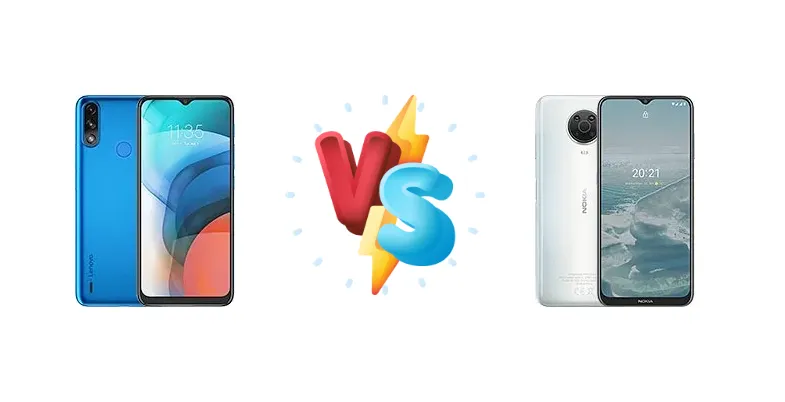
The Lenovo K13 and Nokia G20 represent the ultra-budget end of the smartphone spectrum, targeting users prioritizing affordability above all else. Both devices offer essential functionality, but significant differences in their core hardware – specifically the chipset – dictate their performance characteristics and suitability for different users. This comparison dissects those differences to reveal which phone delivers the best value.
🏆 Quick Verdict
For the average user, the Nokia G20 is the better choice. While both phones share a 10W charging rate, the Nokia G20’s MediaTek Helio G35, built on a 12nm process, provides a noticeable performance advantage over the Lenovo K13’s older, 28nm Unisoc SC9863A, making it more responsive for everyday tasks.
| Network |
|---|
| 2G bands | GSM 850 / 900 / 1800 / 1900 | GSM 850 / 900 / 1800 / 1900 |
| 3G bands | HSDPA 850 / 900 / 1900 / 2100 | HSDPA 850 / 900 / 1900 / 2100 - International |
| 4G bands | LTE | 1, 3, 5, 7, 8, 20, 28, 38, 40, 41 - International |
| Speed | HSPA, LTE | HSPA 42.2/5.76 Mbps, LTE Cat4 150/50 Mbps |
| Technology | GSM / HSPA / LTE | GSM / HSPA / LTE |
| | - | 1, 2, 3, 4, 5, 7, 8, 12, 17, 28, 66 - LATAM |
| Launch |
|---|
| Announced | 2021, August 30 | 2021, April 08 |
| Status | Available. Released 2021, August 30 | Available. Released 2021, May 17 |
| Body |
|---|
| Build | Glass front, plastic back, plastic frame | - |
| Dimensions | 165.1 x 75.9 x 9.2 mm (6.5 x 2.99 x 0.36 in) | 164.9 x 76 x 9.2 mm (6.49 x 2.99 x 0.36 in) |
| SIM | Nano-SIM + Nano-SIM | · Nano-SIM· Nano-SIM + Nano-SIM |
| Weight | 200 g (7.05 oz) | 197 g (6.95 oz) |
| | Water-repellent design | Splash protection |
| Display |
|---|
| Resolution | 720 x 1600 pixels, 20:9 ratio (~269 ppi density) | 720 x 1600 pixels, 20:9 ratio (~269 ppi density) |
| Size | 6.52 inches, 102.6 cm2 (~81.9% screen-to-body ratio) | 6.52 inches, 102.6 cm2 (~81.9% screen-to-body ratio) |
| Type | IPS LCD | IPS LCD |
| Platform |
|---|
| CPU | Octa-core (4x1.6 GHz Cortex-A55 & 4x1.2 GHz Cortex-A55) | Octa-core (4x2.3 GHz Cortex-A53 & 4x1.8 GHz Cortex-A53) |
| Chipset | Unisoc SC9863A (28 nm) | Mediatek MT6765G Helio G35 (12 nm) |
| GPU | IMG8322 | PowerVR GE8320 |
| OS | Android 10 (Go edition) | Android 11, upgradable to Android 13 |
| Memory |
|---|
| Card slot | microSDXC (uses shared SIM slot) | microSDXC (dedicated slot) |
| Internal | 32GB 2GB RAM | 64GB 4GB RAM, 128GB 4GB RAM |
| | eMMC 5.1 | - |
| Main Camera |
|---|
| Dual | 13 MP, f/2.0, 26mm (wide), 1/3.1", 1.12µm, PDAF
2 MP (macro) | - |
| Features | LED flash, HDR, panorama | LED flash, HDR, panorama |
| Quad | - | 48 MP, f/1.8, (wide), PDAF
5 MP, (ultrawide)
2 MP (macro)
Auxiliary lens |
| Single | - | 8 MP, (wide) |
| Video | 1080p@30fps | 1080p@30fps |
| Selfie camera |
|---|
| Features | HDR | - |
| Single | 5 MP, f/2.2, 27mm (wide), 1.12µm | 8 MP, (wide) |
| Video | 1080p@30fps | 1080p@30fps |
| Sound |
|---|
| 3.5mm jack | Yes | Yes |
| 35mm jack | Yes | Yes |
| Loudspeaker | Yes | Yes |
| Comms |
|---|
| Bluetooth | 4.2, A2DP, LE | 5.0, A2DP, LE |
| NFC | No | Yes (market/region dependent) |
| Positioning | GPS, GLONASS, GALILEO | GPS, GLONASS, BDS |
| Radio | FM radio | FM radio |
| USB | USB Type-C 2.0, OTG | USB Type-C 2.0, OTG |
| WLAN | Wi-Fi 802.11 b/g/n | Wi-Fi 802.11 b/g/n |
| Features |
|---|
| Sensors | Fingerprint (rear-mounted), accelerometer, proximity | Fingerprint (side-mounted), accelerometer, gyro, proximity |
| Battery |
|---|
| Charging | 10W wired | 10W wired |
| Type | Li-Ion 5000 mAh | Li-Po 5050 mAh |
| Misc |
|---|
| Colors | Tahiti Blue, Coral Red | Glacier, Night |
| Models | - | TA-1336, TA-1343, TA-1347, TA-1372, TA-1365 |
| Price | About 90 EUR | About 90 EUR |
| SAR | - | 1.01 W/kg (head) 1.02 W/kg (body) |
| SAR EU | - | 0.49 W/kg (head) 1.13 W/kg (body) |
Lenovo K13
- Potentially lower price point
- Basic functionality for essential tasks
- Simple and straightforward user experience
- Outdated Unisoc SC9863A chipset
- Poor performance in demanding apps
- Likely shorter battery life due to inefficient chipset
Nokia G20
- More modern MediaTek Helio G35 chipset
- Improved performance and responsiveness
- Better power efficiency and potentially longer battery life
- More future-proofed platform
- Slightly higher price compared to the K13
- Still limited by 10W charging
- Camera performance likely remains basic
Display Comparison
Neither Lenovo nor Nokia provide display specifications beyond resolution in their marketing materials. However, given the price point, both likely utilize IPS LCD panels. The key difference lies under the hood. The Nokia G20 benefits from the more efficient Helio G35, potentially allowing for slightly better sustained brightness. The older Unisoc chip in the K13 will likely struggle to maintain peak brightness for extended periods, impacting outdoor visibility.
Camera Comparison
Both devices are unlikely to excel in photography. Without detailed sensor information, it’s safe to assume both feature basic camera setups geared towards casual snapshots. The Nokia G20’s slightly more powerful chipset *could* translate to faster image processing, but the overall image quality will be heavily dependent on the sensor and lens quality, which are currently unknown. Focusing on the chipset, the G20's ISP (Image Signal Processor) is likely more capable than the K13's, potentially leading to better dynamic range and noise reduction.
Performance
The core differentiator is the chipset. The Nokia G20’s MediaTek Helio G35 (12nm) boasts a significant architectural advantage over the Lenovo K13’s Unisoc SC9863A (28nm). While both are octa-core, the G35 utilizes Cortex-A53 cores clocked at 2.3 GHz, compared to the K13’s slower Cortex-A55 cores peaking at 1.6 GHz. The 12nm fabrication process of the Helio G35 also translates to improved power efficiency and reduced heat generation, leading to more consistent performance under load. This means the G20 will handle multitasking and app switching more smoothly. The K13’s older architecture will exhibit noticeable lag in similar scenarios.
Battery Life
Both the Lenovo K13 and Nokia G20 are equipped with 10W wired charging, indicating a similar charging experience – slow by modern standards. Battery capacity is not specified in the provided data. However, the Nokia G20’s more efficient Helio G35 chipset will likely result in longer battery life despite potentially having a similar capacity to the K13. The 12nm process consumes less power, extending usage time between charges. The K13’s older, less efficient chip will drain the battery faster, especially during demanding tasks.
Buying Guide
Buy the Lenovo K13 if you absolutely need the lowest possible price and your usage is limited to very basic tasks like calls, texts, and light social media. Its older chipset will struggle with demanding apps. Buy the Nokia G20 if you prioritize a smoother user experience, occasional gaming, and a more future-proofed platform, even if it means spending slightly more. The Helio G35 offers a tangible improvement in responsiveness and app loading times.
Frequently Asked Questions
❓ Will the Nokia G20 handle popular games like PUBG Mobile?
While the Helio G35 isn't a gaming powerhouse, the Nokia G20 can run PUBG Mobile at lower settings. Expect frame rate drops during intense action, but it's playable. The Lenovo K13 will struggle significantly with PUBG, likely offering an unplayable experience.
❓ Is the 10W charging on either phone a major drawback?
Yes, 10W charging is slow by today's standards. Expect a full charge to take several hours (likely 3-4). Neither phone offers fast charging capabilities. This is a compromise made to keep the price low.
❓ How much of a difference will the chipset make for everyday tasks like browsing and social media?
The difference is substantial. The Nokia G20’s Helio G35 will provide a noticeably smoother and more responsive experience when browsing the web, using social media apps, and switching between applications. The Lenovo K13’s Unisoc chip will exhibit lag and slowdowns, especially with multiple apps open.
❓ Does either phone support software updates beyond the initial Android version?
Nokia has a better track record for software updates, even on their budget devices. While long-term support isn't guaranteed, the G20 is more likely to receive security patches and potentially a version upgrade than the Lenovo K13. Lenovo's update policy for the K13 is less clear.