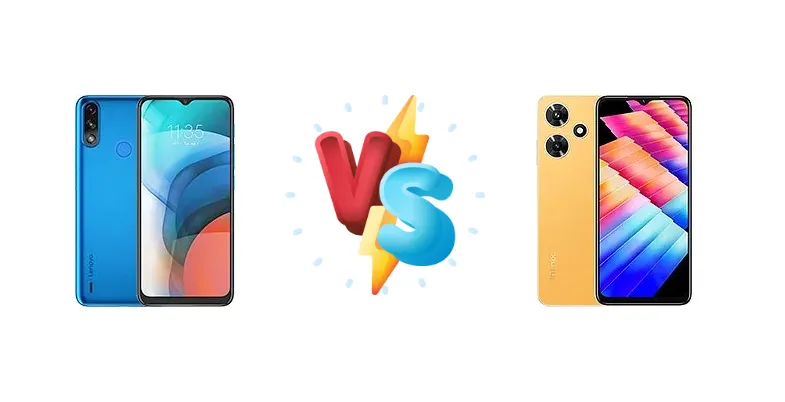
The Lenovo K13 and Infinix Hot 30i represent the fiercely competitive sub-$150 smartphone market. Both rely on Unisoc chipsets to deliver functionality, but significant architectural differences and charging capabilities separate these devices. This comparison dissects those differences to determine which phone offers the best value for budget-conscious consumers.
🏆 Quick Verdict
For most users, the Infinix Hot 30i emerges as the better choice. Its newer 12nm Unisoc T606 chipset, featuring Cortex-A75 performance cores, provides a noticeable performance uplift over the K13’s older 28nm SC9863A. The 18W charging also significantly reduces downtime compared to the K13’s slow 10W charging.
| Network |
|---|
| 2G bands | GSM 850 / 900 / 1800 / 1900 | GSM 850 / 900 / 1800 / 1900 |
| 3G bands | HSDPA 850 / 900 / 1900 / 2100 | HSDPA 850 / 900 / 1700(AWS) / 1900 / 2100 |
| 4G bands | LTE | 1, 2, 3, 4, 5, 7, 8, 20, 28, 38, 40, 41 |
| Speed | HSPA, LTE | HSPA, LTE |
| Technology | GSM / HSPA / LTE | GSM / HSPA / LTE |
| Launch |
|---|
| Announced | 2021, August 30 | 2023, March 31 |
| Status | Available. Released 2021, August 30 | Available. Released 2023, March 31 |
| Body |
|---|
| Build | Glass front, plastic back, plastic frame | Glass front, plastic frame, plastic back |
| Dimensions | 165.1 x 75.9 x 9.2 mm (6.5 x 2.99 x 0.36 in) | 164 x 75.8 x 8.4 mm (6.46 x 2.98 x 0.33 in) |
| SIM | Nano-SIM + Nano-SIM | Nano-SIM + Nano-SIM |
| Weight | 200 g (7.05 oz) | 191 g (6.74 oz) |
| | Water-repellent design | - |
| Display |
|---|
| Resolution | 720 x 1600 pixels, 20:9 ratio (~269 ppi density) | 720 x 1612 pixels, 20:9 ratio (~269 ppi density) |
| Size | 6.52 inches, 102.6 cm2 (~81.9% screen-to-body ratio) | 6.56 inches, 103.4 cm2 (~83.2% screen-to-body ratio) |
| Type | IPS LCD | IPS LCD, 90Hz, 500 nits (peak) |
| Platform |
|---|
| CPU | Octa-core (4x1.6 GHz Cortex-A55 & 4x1.2 GHz Cortex-A55) | Octa-core (2x1.6 GHz Cortex-A75 & 6x1.6 GHz Cortex-A55) |
| Chipset | Unisoc SC9863A (28 nm) | Unisoc T606 (12 nm) |
| GPU | IMG8322 | Mali-G57 MP1 |
| OS | Android 10 (Go edition) | Android 12, XOS 10.6 |
| Memory |
|---|
| Card slot | microSDXC (uses shared SIM slot) | microSDXC (dedicated slot) |
| Internal | 32GB 2GB RAM | 64GB 4GB RAM, 128GB 4GB RAM, 128GB 8GB RAM |
| | eMMC 5.1 | UFS 2.2 |
| Main Camera |
|---|
| Dual | 13 MP, f/2.0, 26mm (wide), 1/3.1", 1.12µm, PDAF
2 MP (macro) | 13 MP, f/1.9, (wide), AF
0.08 MP, (depth) |
| Features | LED flash, HDR, panorama | Dual-LED flash, HDR, panorama |
| Single | - | 13 MP, f/1.9, (wide), 1/3.07", AF
Auxiliary lens |
| Video | 1080p@30fps | 1080p@30fps |
| Selfie camera |
|---|
| Features | HDR | Dual-LED flash |
| Single | 5 MP, f/2.2, 27mm (wide), 1.12µm | 8 MP, f/2.0, (wide), 1/3.94" |
| Video | 1080p@30fps | 1080p@30fps |
| Sound |
|---|
| 3.5mm jack | Yes | Yes |
| 35mm jack | Yes | Yes |
| Loudspeaker | Yes | Yes |
| Comms |
|---|
| Bluetooth | 4.2, A2DP, LE | Yes |
| NFC | No | Yes (Hot 30i NFC only) |
| Positioning | GPS, GLONASS, GALILEO | GPS |
| Radio | FM radio | FM radio |
| USB | USB Type-C 2.0, OTG | USB Type-C 2.0, OTG |
| WLAN | Wi-Fi 802.11 b/g/n | Wi-Fi 802.11 a/b/g/n/ac, dual-band |
| Features |
|---|
| Sensors | Fingerprint (rear-mounted), accelerometer, proximity | Fingerprint (side-mounted), accelerometer, proximity, compass |
| Battery |
|---|
| Charging | 10W wired | 18W wired |
| Type | Li-Ion 5000 mAh | 5000 mAh |
| Misc |
|---|
| Colors | Tahiti Blue, Coral Red | Mirror Black, Glacier Blue, Diamond White, Marigold |
| Models | - | X669, X669D |
| Price | About 90 EUR | - |
Lenovo K13
- Potentially lower price point (depending on market)
- Simple and functional operating system experience
- May be more readily available in certain regions
- Outdated 28nm chipset
- Slow 10W charging
- Inferior CPU performance compared to the Hot 30i
Infinix Hot 30i
- More powerful Unisoc T606 chipset
- Faster 18W charging
- Improved CPU performance with Cortex-A75 cores
- May be slightly more expensive than the K13
- Potentially less readily available in some markets
- Likely similar display quality to the K13
Display Comparison
Neither device boasts a standout display. Given the context data focuses on processing, we can infer both likely utilize LCD panels common in this price bracket. The absence of information regarding resolution or refresh rate suggests both are standard. Bezels are likely substantial on both, prioritizing cost reduction. Color accuracy is expected to be basic, suitable for everyday use but not color-critical work.
Camera Comparison
Without detailed camera specifications, a direct comparison is difficult. However, it’s safe to assume both phones feature basic camera setups geared towards social media sharing. The market segment suggests both will likely include a primary sensor and potentially depth or macro lenses of limited utility. Image processing will likely be software-driven, prioritizing speed over detail. The absence of OIS on either device suggests low-light performance will be a weakness.
Performance
The core difference lies in the chipsets. The Infinix Hot 30i’s Unisoc T606, fabricated on a more efficient 12nm process, is a clear upgrade over the Lenovo K13’s 28nm Unisoc SC9863A. The T606’s CPU configuration – 2x1.6 GHz Cortex-A75 and 6x1.6 GHz Cortex-A55 – provides a significant advantage in single-core performance thanks to the A75 cores, translating to snappier app launches and smoother multitasking. The K13’s 4x1.6 GHz Cortex-A55 and 4x1.2 GHz Cortex-A55 configuration is geared towards efficiency but lacks the performance headroom of the T606. This means the Hot 30i will handle more demanding apps and games with greater ease.
Battery Life
While battery capacity isn’t specified, the charging wattage difference is crucial. The Infinix Hot 30i’s 18W wired charging is a substantial improvement over the Lenovo K13’s 10W charging. This translates to significantly faster charging times, reducing downtime and making the Hot 30i more convenient for users who rely heavily on their phones throughout the day. Even with a similar battery capacity, the faster charging speed gives the Hot 30i a clear advantage.
Buying Guide
Buy the Lenovo K13 if your primary need is a basic, functional smartphone for essential tasks like calls, texts, and light web browsing, and you prioritize minimal cost above all else. Buy the Infinix Hot 30i if you want a more responsive experience for social media, streaming, and casual gaming, and you value faster charging to minimize interruptions.
Frequently Asked Questions
❓ Will the Infinix Hot 30i handle popular games like PUBG Mobile or Call of Duty?
The Unisoc T606 in the Hot 30i is capable of running PUBG Mobile and Call of Duty, but likely at lower graphics settings (Medium or Low) to maintain a playable frame rate. The K13’s SC9863A will struggle with these titles, requiring even lower settings and potentially experiencing significant lag.
❓ How long will it take to fully charge the Infinix Hot 30i with the 18W charger?
While a precise time requires testing, the Infinix Hot 30i with its 18W charging should fully charge in approximately 2-3 hours, depending on battery capacity. This is significantly faster than the Lenovo K13, which could take 4-5 hours with its 10W charger.
❓ Is the difference in chipset architecture (A75 vs A55) noticeable in everyday use?
Yes, the Cortex-A75 cores in the Infinix Hot 30i’s T606 chipset provide a noticeable improvement in responsiveness for tasks like opening apps, scrolling through social media, and web browsing. The K13’s A55-only configuration will feel slower and less fluid in comparison.