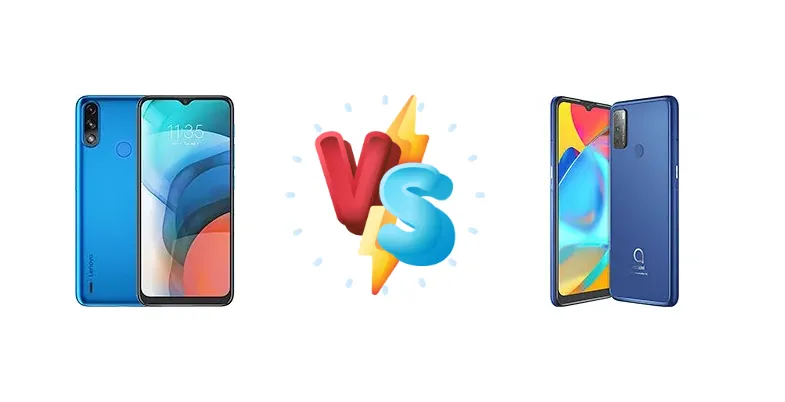
The Lenovo K13 and alcatel 3L (2021) represent the extreme end of the smartphone price spectrum. Both aim to deliver essential functionality at a minimal cost, but they achieve this through different approaches to hardware. This comparison dissects their core components to determine which offers the best value for users prioritizing affordability.
🏆 Quick Verdict
For the average user seeking a basic smartphone experience, the alcatel 3L (2021) is the slightly better choice. Its Mediatek Helio P22, fabricated on a 12nm process, offers a modest performance advantage and improved efficiency compared to the Lenovo K13’s older 28nm Unisoc SC9863A, despite similar CPU core counts.
| Network |
|---|
| 2G bands | GSM 850 / 900 / 1800 / 1900 | GSM 850 / 900 / 1800 / 1900 |
| 3G bands | HSDPA 850 / 900 / 1900 / 2100 | HSDPA 850 / 900 / 1900 / 2100 |
| 4G bands | LTE | 1, 3, 7, 8, 20, 28 |
| Speed | HSPA, LTE | HSPA 42.2/5.76 Mbps, LTE Cat4 150/50 Mbps |
| Technology | GSM / HSPA / LTE | GSM / HSPA / LTE |
| Launch |
|---|
| Announced | 2021, August 30 | 2021, January 12 |
| Status | Available. Released 2021, August 30 | Available. Released 2021, April 26 |
| Body |
|---|
| Build | Glass front, plastic back, plastic frame | Glass front, plastic back, plastic frame |
| Dimensions | 165.1 x 75.9 x 9.2 mm (6.5 x 2.99 x 0.36 in) | 165.6 x 75.6 x 8.7 mm (6.52 x 2.98 x 0.34 in) |
| SIM | Nano-SIM + Nano-SIM | · Nano-SIM· Nano-SIM + Nano-SIM |
| Weight | 200 g (7.05 oz) | 194 g (6.84 oz) |
| | Water-repellent design | - |
| Display |
|---|
| Resolution | 720 x 1600 pixels, 20:9 ratio (~269 ppi density) | 720 x 1600 pixels, 20:9 ratio (~269 ppi density) |
| Size | 6.52 inches, 102.6 cm2 (~81.9% screen-to-body ratio) | 6.52 inches, 102.6 cm2 (~82.0% screen-to-body ratio) |
| Type | IPS LCD | IPS LCD |
| Platform |
|---|
| CPU | Octa-core (4x1.6 GHz Cortex-A55 & 4x1.2 GHz Cortex-A55) | Octa-core (4x1.8 GHz Cortex-A53 & 4x1.5 GHz Cortex-A53) |
| Chipset | Unisoc SC9863A (28 nm) | Mediatek MT6762D Helio P22 (12 nm) |
| GPU | IMG8322 | PowerVR GE8320 |
| OS | Android 10 (Go edition) | Android 11 |
| Memory |
|---|
| Card slot | microSDXC (uses shared SIM slot) | microSDXC (only single sim model) |
| Internal | 32GB 2GB RAM | 64GB 4GB RAM |
| | eMMC 5.1 | eMMC 5.1 |
| Main Camera |
|---|
| Dual | 13 MP, f/2.0, 26mm (wide), 1/3.1", 1.12µm, PDAF
2 MP (macro) | - |
| Features | LED flash, HDR, panorama | LED flash, HDR, panorama |
| Triple | - | 48 MP, f/1.8, 26mm (wide), 1/2.0", 0.8µm, PDAF
2 MP (macro)
Auxiliary lens |
| Video | 1080p@30fps | 1080p@30fps |
| Selfie camera |
|---|
| Features | HDR | HDR |
| Single | 5 MP, f/2.2, 27mm (wide), 1.12µm | 8 MP, f/2.0, 26mm (wide), 1/4.0", 1.12µm |
| Video | 1080p@30fps | 1080p@30fps |
| Sound |
|---|
| 3.5mm jack | Yes | Yes |
| 35mm jack | Yes | Yes |
| Loudspeaker | Yes | Yes |
| Comms |
|---|
| Bluetooth | 4.2, A2DP, LE | 5.0, A2DP, LE |
| NFC | No | Yes |
| Positioning | GPS, GLONASS, GALILEO | GPS, GLONASS, GALILEO, BDS |
| Radio | FM radio | FM radio |
| USB | USB Type-C 2.0, OTG | microUSB 2.0, OTG |
| WLAN | Wi-Fi 802.11 b/g/n | Wi-Fi 802.11 b/g/n, Wi-Fi Direct |
| Features |
|---|
| Sensors | Fingerprint (rear-mounted), accelerometer, proximity | Fingerprint (rear-mounted), accelerometer, proximity, compass |
| Battery |
|---|
| Charging | 10W wired | 10W wired |
| Type | Li-Ion 5000 mAh | Li-Po 4000 mAh |
| Misc |
|---|
| Colors | Tahiti Blue, Coral Red | Jewelry Blue, Jewelry Black |
| Models | - | 6056D |
| Price | About 90 EUR | About 330 EUR |
Lenovo K13
- Potentially lower price point
- Simple and straightforward user experience
- Reliable for basic communication tasks
- Older, less efficient chipset
- Likely slower performance
- Limited multitasking capabilities
alcatel 3L (2021)
- More modern and efficient chipset
- Slightly better performance
- Improved battery life due to process node
- May be slightly more expensive
- Still limited for demanding tasks
- Camera performance likely similar to Lenovo K13
Display Comparison
Neither device boasts a standout display. Both are likely to feature LCD panels, typical for this price bracket. Detailed specifications regarding resolution, brightness, and color accuracy are unavailable, but we can assume both offer basic viewing experiences. The absence of higher refresh rates or advanced panel technologies like IPS is expected. Bezels are likely to be substantial on both devices, maximizing screen real estate within a compact form factor.
Camera Comparison
Camera performance on both devices will be limited. Details regarding sensor size and image processing are scarce. It’s safe to assume both feature basic camera setups, likely with a primary sensor and potentially a depth or macro lens of minimal resolution. Image quality will be acceptable in good lighting conditions but will suffer significantly in low light. The absence of Optical Image Stabilization (OIS) on either device further limits low-light capabilities. Focusing on megapixel counts alone would be misleading; image processing and sensor quality are far more critical at this price point.
Performance
The core difference lies in the chipsets. The alcatel 3L (2021) utilizes the Mediatek Helio P22 (MT6762D), built on a 12nm process. This smaller fabrication node generally translates to better power efficiency and slightly improved performance compared to the Lenovo K13’s Unisoc SC9863A, which is manufactured on a larger 28nm process. While both CPUs are octa-core, the alcatel 3L’s Cortex-A53 cores clock slightly higher (1.8 GHz vs 1.6 GHz), offering a marginal performance boost in CPU-intensive tasks. The Unisoc chip's older architecture will likely result in lower single-core performance, impacting app launch times and general responsiveness. Neither chipset is suited for demanding games or multitasking.
Battery Life
Both phones feature 10W wired charging, indicating similar charging speeds. Battery capacity is not specified, but given the target market, both are likely to house batteries in the 3000-4000 mAh range. The alcatel 3L’s more efficient Helio P22 chipset should translate to slightly better battery life, allowing for a bit more screen-on time between charges. However, real-world battery performance will heavily depend on usage patterns.
Buying Guide
Buy the Lenovo K13 if you need a phone primarily for basic communication – calls, texts, and light app usage – and are extremely budget-constrained. Its simplicity and lower price point are its main draws. Buy the alcatel 3L (2021) if you prefer a slightly more responsive experience for social media, web browsing, and occasional light gaming, and are willing to spend a little more for a more modern chipset.
Frequently Asked Questions
❓ Will the alcatel 3L (2021) be able to run popular social media apps like Facebook and Instagram smoothly?
Yes, the Mediatek Helio P22 chipset in the alcatel 3L (2021) is capable of running most popular social media apps without significant lag. However, expect longer loading times compared to phones with more powerful processors. Multitasking between several apps simultaneously may cause slowdowns.
❓ Is the Unisoc SC9863A in the Lenovo K13 known for overheating during prolonged use?
The Unisoc SC9863A is a low-power chipset, and overheating is unlikely to be a major concern with the Lenovo K13. However, sustained use of demanding apps (even simple ones) may cause the device to warm up slightly. The 28nm process is less efficient, so it will generate more heat than the alcatel 3L's chip.
❓ Can either of these phones handle basic mobile games like Candy Crush or Subway Surfers?
Both the Lenovo K13 and the alcatel 3L (2021) can handle casual mobile games like Candy Crush or Subway Surfers. However, don't expect high frame rates or detailed graphics. More demanding games will likely be unplayable or suffer from significant lag.