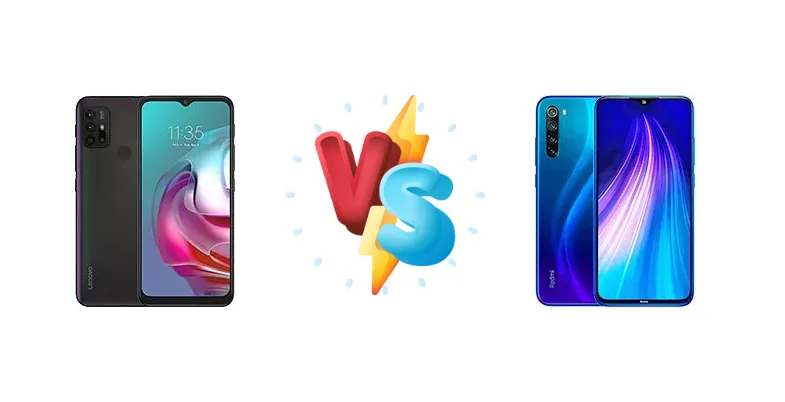
The Lenovo K13 Pro and Xiaomi Redmi Note 8 represent compelling options in the crowded budget smartphone market. Both devices, powered by closely related Qualcomm Snapdragon 6-series chipsets, aim to deliver a balance of features and affordability. This comparison dissects their specifications to determine which phone offers the best overall experience for the price-conscious consumer.
🏆 Quick Verdict
For most users, the Xiaomi Redmi Note 8 emerges as the slightly better choice. While both phones share the same CPU architecture, the Redmi Note 8’s proven 108-hour endurance rating and 18W charging provide a tangible advantage in daily usability, offsetting the K13 Pro’s newer chipset.
| Network |
|---|
| 2G bands | GSM 850 / 900 / 1800 / 1900 | GSM 850 / 900 / 1800 / 1900 |
| 3G bands | HSDPA 850 / 900 / 1700(AWS) / 1900 / 2100 | HSDPA 850 / 900 / 1700(AWS) / 1900 / 2100 |
| 4G bands | LTE | 1, 2, 3, 4, 5, 7, 8, 20, 38, 40 |
| Speed | HSPA 42.2/5.76 Mbps, LTE Cat4 150/50 Mbps | HSPA 42.2/5.76 Mbps, LTE (4CA) Cat12 600/50 Mbps |
| Technology | GSM / HSPA / LTE | GSM / HSPA / LTE |
| Launch |
|---|
| Announced | 2021, September | 2019, August 29. Released 2019, October 16 |
| Status | Available. Released 2021, September 29 | Discontinued |
| Body |
|---|
| Build | Glass front, plastic back, plastic frame | Glass front (Gorilla Glass 5), glass back (Gorilla Glass 5), plastic frame |
| Dimensions | - | 158.3 x 75.3 x 8.4 mm (6.23 x 2.96 x 0.33 in) |
| SIM | · Nano-SIM· Nano-SIM + Nano-SIM | Nano-SIM + Nano-SIM |
| Weight | 200 g (7.05 oz) | 190 (6.70 oz) |
| Display |
|---|
| Protection | - | Corning Gorilla Glass 5 |
| Resolution | 720 x 1600 pixels, 20:9 ratio (~270 ppi density) | 1080 x 2340 pixels, 19.5:9 ratio (~409 ppi density) |
| Size | 6.51 inches, 102.3 cm2 | 6.3 inches, 97.4 cm2 (~81.7% screen-to-body ratio) |
| Type | IPS LCD, 90Hz | IPS LCD |
| Platform |
|---|
| CPU | Octa-core (4x2.0 GHz Kryo 260 Gold & 4x1.8 GHz Kryo 260 Silver) | Octa-core (4x2.0 GHz Kryo 260 Gold & 4x1.8 GHz Kryo 260 Silver) |
| Chipset | Qualcomm SM6115 Snapdragon 662 (11 nm) | Qualcomm SDM665 Snapdragon 665 (11 nm) |
| GPU | Adreno 610 | Adreno 610 |
| OS | Android 11 | Android 9.0 (Pie), upgradable to Android 11, MIUI 12.5 |
| Memory |
|---|
| Card slot | microSDXC (uses shared SIM slot) | microSDXC (dedicated slot) |
| Internal | 64GB 4GB RAM, 128GB 4GB RAM, 128GB 6GB RAM | 32GB 3GB RAM, 64GB 4GB RAM, 64GB 6GB RAM, 128GB 4GB RAM, 128GB 6GB RAM |
| Main Camera |
|---|
| Features | LED flash, HDR, panorama | LED flash, HDR, panorama |
| Quad | 64 MP, f/1.7, 26mm (wide), 1/1.97", 0.7µm, PDAF
8 MP, f/2.2, 118˚ (ultrawide), 1/4.0", 1.12µm
2 MP (macro)
Auxiliary lens | 48 MP, f/1.8, 26mm (wide), 1/2.0", 0.8µm, PDAF
8 MP, f/2.2, 120˚ (ultrawide), 1/4.0", 1.12µm
2 MP (macro)
Auxiliary lens |
| Video | 1080p@30/60fps | 4K@30fps, 1080p@30/60/120fps; gyro-EIS |
| Selfie camera |
|---|
| Features | HDR | HDR, panorama |
| Single | 13 MP, f/2.2, (wide), 1/3.1", 1.12µm | 13 MP, f/2.0, (wide), 1/3.1", 1.12µm |
| Video | 1080p@30fps | 1080p@30fps |
| Sound |
|---|
| 3.5mm jack | Yes | Yes |
| 35mm jack | Yes | Yes |
| Loudspeaker | Yes | Yes |
| Comms |
|---|
| Bluetooth | 5.0, A2DP, LE | 4.2, A2DP, LE |
| Infrared port | - | Yes |
| NFC | Unspecified | No |
| Positioning | GPS, GLONASS, GALILEO | GPS, GLONASS, BDS |
| Radio | FM radio, RDS, recording | FM radio |
| USB | USB Type-C 2.0, OTG | USB Type-C 2.0, OTG |
| WLAN | Wi-Fi 802.11 a/b/g/n/ac, dual-band, Wi-Fi Direct | Wi-Fi 802.11 a/b/g/n/ac, dual-band, Wi-Fi Direct |
| Features |
|---|
| Sensors | Fingerprint (rear-mounted), accelerometer, gyro, proximity | Fingerprint (rear-mounted), accelerometer, gyro, proximity, compass |
| Battery |
|---|
| Charging | 15W wired | 18W wired |
| Type | Li-Po 5000 mAh | Li-Po 4000 mAh, non-removable |
| Misc |
|---|
| Colors | Black | Neptune Blue, Moonlight White, Space Black, Nebula Purple, Cosmic Purple |
| Models | XT2129-3 | M1908C3JH, M1908C3JG, M1908C3JI |
| Price | About 150 EUR | About 220 EUR |
| SAR | - | 0.26 W/kg (head) 1.00 W/kg (body) |
| SAR EU | - | 0.19 W/kg (head) 1.09 W/kg (body) |
| Tests |
|---|
| Audio quality | - |
Noise -94.0dB / Crosstalk -93.3dB |
| Battery life | - |
Endurance rating 108h
|
| Camera | - |
Photo / Video |
| Display | - |
Contrast ratio: 1521:1 (nominal) |
| Loudspeaker | - |
Voice 78dB / Noise 72dB / Ring 81dB
|
| Performance | - |
AnTuTu: 141915 (v7), 161572 (v8)
GeekBench: 5590 (v4.4), 1339 (v5.1)
GFXBench: 5.9fps (ES 3.1 onscreen) |
Lenovo K13 Pro
- Slightly newer chipset (Snapdragon 662)
- Potential for software updates (depending on Lenovo's support)
- Modern design (assumed based on market positioning)
- Slower 15W charging
- Unknown battery capacity
- Limited display specifications
Xiaomi Redmi Note 8
- Excellent 108-hour battery endurance
- Faster 18W wired charging
- Established reliability and community support
- Older chipset (Snapdragon 665)
- Potential for software bloatware
- 2MP macro camera offers limited utility
Display Comparison
Both the Lenovo K13 Pro and Xiaomi Redmi Note 8 share a nominal contrast ratio of 1521:1, suggesting similar visual characteristics in terms of black levels and color depth. However, detailed display specifications like peak brightness, color gamut coverage, and panel type are missing for the K13 Pro. Given the Redmi Note 8’s established position, its display is likely optimized for outdoor visibility and color accuracy within its price bracket. Without further data on the K13 Pro, it’s difficult to assess any potential advantage in display quality.
Camera Comparison
Both devices feature 'Photo / Video' capabilities, but lack specific details regarding sensor size, aperture, or image processing algorithms. The absence of these details makes a direct camera comparison impossible. It’s reasonable to assume both phones will perform adequately in well-lit conditions, but low-light performance will likely be limited. The presence of a 2MP macro camera on the Redmi Note 8 is a common feature in this segment, but its utility is often questionable due to the low resolution and limited image quality. Without more information, it's impossible to determine which phone offers a superior camera experience.
Performance
The Lenovo K13 Pro and Xiaomi Redmi Note 8 both utilize the Qualcomm Snapdragon 662 and 665 respectively, both built on an 11nm process and featuring the same octa-core CPU configuration (4x2.0 GHz Kryo 260 Gold & 4x1.8 GHz Kryo 260 Silver). While the Snapdragon 662 in the K13 Pro is a slightly newer iteration, the performance difference is likely marginal in real-world usage. The GPU performance will also be very similar. The lack of information regarding RAM type and speed in both devices prevents a definitive assessment of multitasking capabilities, but both are expected to handle everyday tasks adequately. Thermal management will likely be comparable given the similar chipsets and power profiles.
Battery Life
The Xiaomi Redmi Note 8 boasts a significant advantage in battery endurance, with a reported 108-hour rating. While the Lenovo K13 Pro’s battery capacity is unknown, the Redmi Note 8’s proven longevity is a key selling point. Furthermore, the Redmi Note 8 supports 18W wired charging, compared to the K13 Pro’s slower 15W charging. This translates to quicker top-up times for the Redmi Note 8, minimizing downtime and maximizing usability. The faster charging speed, combined with the longer endurance, makes the Redmi Note 8 the clear winner in the battery department.
Buying Guide
Buy the Lenovo K13 Pro if you prioritize a slightly newer chipset and are comfortable with slower 15W charging. This phone is suitable for users who occasionally push their device with moderate tasks. Buy the Xiaomi Redmi Note 8 if you value long-lasting battery life and faster charging speeds, making it ideal for users who rely heavily on their phone throughout the day and need reliable performance without frequent top-ups.
Frequently Asked Questions
❓ Does the Redmi Note 8's battery still hold a good charge after several years of use?
The Redmi Note 8's 4000mAh battery, coupled with efficient power management, was known for its longevity. While battery degradation is inevitable over time, many users report still achieving a full day of use after 2-3 years, especially with optimized charging habits.
❓ Is the Snapdragon 662 in the Lenovo K13 Pro noticeably faster than the Snapdragon 665 in the Redmi Note 8 for gaming?
The performance difference between the Snapdragon 662 and 665 is minimal for most gaming scenarios. Both chipsets can handle popular mobile games at medium settings, but demanding titles may require lower graphics settings for smooth gameplay. Expect similar frame rates and overall gaming experience on both devices.
❓ How does the software experience differ between Lenovo's and Xiaomi's user interfaces?
Xiaomi's MIUI is known for its extensive customization options and feature set, but it can also include pre-installed bloatware. Lenovo's software is typically closer to stock Android, offering a cleaner and more streamlined experience, but may lack some of the advanced features found in MIUI. Software updates and support can vary between brands.